

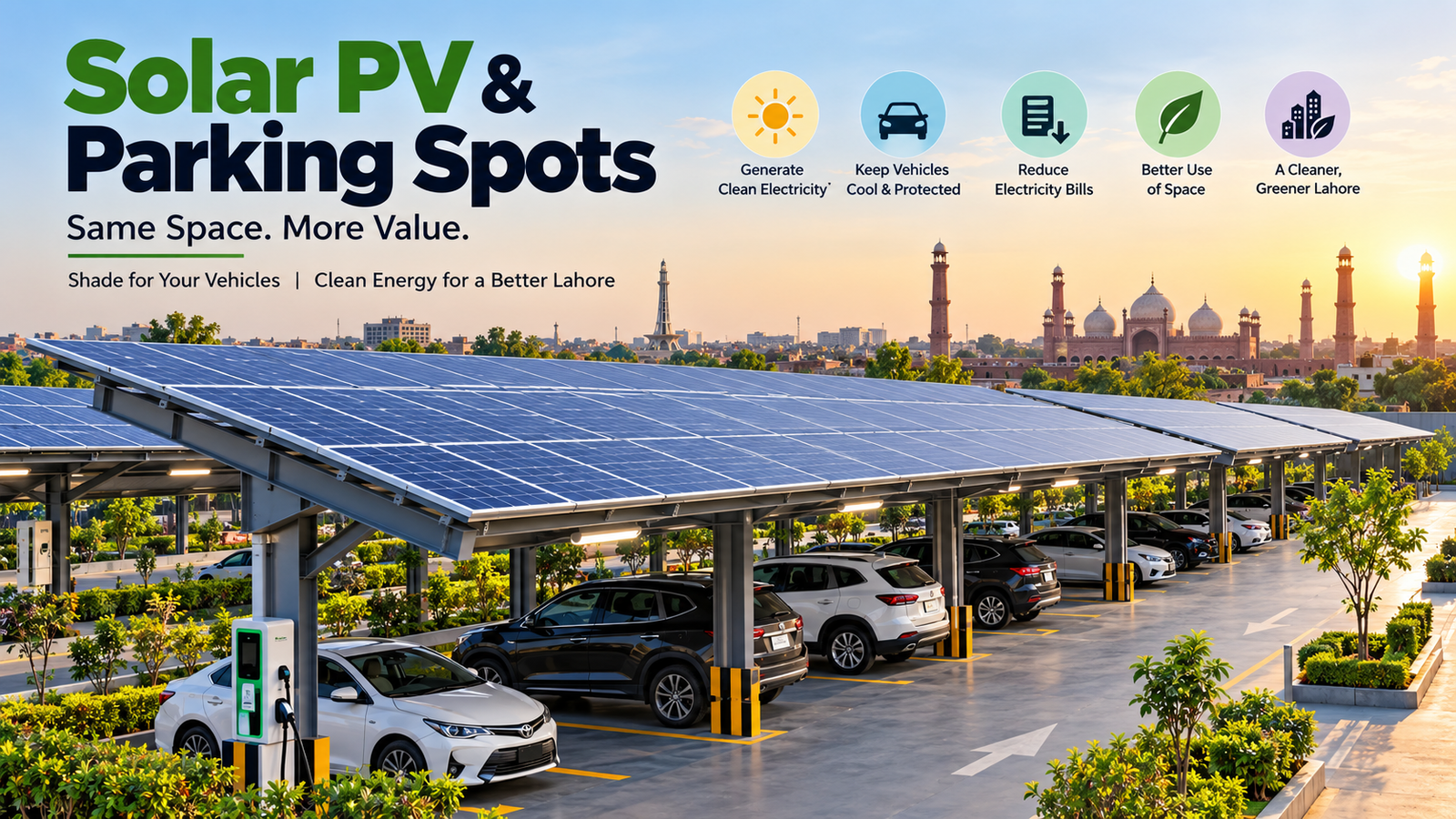
Parking spaces are usually treated as simple pieces of land where vehicles remain for a few hours. For homes, offices, schools, hospitals, shopping centres, factories, restaurants, and commercial buildings in Lahore, parking areas can take up a surprisingly large amount of usable space.
What if that same space could also generate electricity?
This is where solar PV parking structures, often called solar carports, come in.
Instead of installing solar panels only on rooftops, property owners can build a covered parking structure and install photovoltaic panels on top of it. The result is a space that performs two jobs at once: it provides shade for vehicles and produces electricity.
For Lahore, where electricity costs, hot summers, strong sunlight, limited rooftop space, and growing solar adoption are all important considerations, solar parking can be a practical option for many commercial and institutional properties.
This article explains how solar PV parking works, where it makes sense, its benefits, potential limitations, design considerations, and why it could become increasingly common across Lahore.
What Is a Solar PV Parking System?
A solar PV parking system is a parking structure with solar photovoltaic panels installed above the parking spaces.
The panels form a roof or canopy over the vehicles below.
During daylight hours, sunlight reaches the solar panels and is converted into electricity. That electricity can then be used by the building connected to the system.
Depending on the design, the generated power may support:
- Air conditioning
- Lighting
- Computers and office equipment
- Elevators
- Water pumps
- Security systems
- Shops and commercial equipment
- Industrial loads
- Electric vehicle charging
- Other building electricity requirements
A solar parking system therefore combines parking infrastructure with power generation.
Instead of leaving a large parking area exposed to sunlight, the same area becomes a productive energy asset.
Why Solar Parking Makes Sense in Lahore
Lahore has several characteristics that make solar-covered parking worth considering.
The city receives strong sunlight during much of the year. At the same time, many commercial and institutional buildings have large parking areas that remain completely exposed.
These include:
- Shopping centres
- Office buildings
- Universities
- Schools
- Hospitals
- Factories
- Warehouses
- Marriage halls
- Hotels
- Restaurants
- Housing societies
- Petrol stations
- Corporate campuses
Many of these properties also have significant daytime electricity consumption.
That is important because solar panels generate most of their electricity during daylight hours, when offices, schools, hospitals, factories, and shopping areas are usually operating.
This can create a useful match between solar generation and electricity demand.
The Biggest Advantage: Using the Same Land Twice
One of the strongest arguments for solar parking is efficient land use.
Traditional solar installations often require dedicated space.
A rooftop system uses the roof.
A ground-mounted solar project requires open land.
A solar carport, however, uses land that has already been assigned to parking.
No additional land is necessarily required.
For commercial properties in Lahore where land prices can be high, this matters.
A business may not want to sacrifice an open plot for solar panels. But if the business already has 50, 100, or 500 parking spaces, those areas may represent a major unused solar opportunity.
The parking area continues performing its original purpose while also producing electricity.
Solar Parking Can Protect Vehicles from Lahore’s Heat
Anyone who has left a car outdoors during a Lahore summer knows how quickly the interior can heat up.
Vehicles sitting under direct sunlight can become extremely uncomfortable.
A solar canopy provides shade.
This can reduce direct solar exposure on:
- Windscreens
- Dashboards
- Seats
- Steering wheels
- Car paint
- Interior materials
Drivers and passengers may also experience a more comfortable vehicle when returning to the parking area.
For businesses, schools, hospitals, offices, and shopping centres, shaded parking can become an additional facility offered to visitors, employees, students, customers, or residents.
Instead of building a normal shade structure, the owner can consider a structure that also produces electricity.
How a Solar Parking Structure Works
A typical solar parking installation contains several main components.
1. Structural Supports
Strong columns and beams support the canopy.
The design must account for the weight of the panels and mounting equipment while maintaining enough clearance for vehicles.
Parking movement must also be considered carefully so that columns do not interfere unnecessarily with doors, driving lanes, or turning areas.
2. Solar PV Panels
Solar modules are installed on top of the parking structure.
The total number of panels depends on available space, panel dimensions, layout, orientation, structural design, and project objectives.
3. Solar Inverters
Solar panels produce direct current electricity.
An inverter converts this electricity into alternating current suitable for normal electrical systems.
Depending on the project, designers may use string inverters, larger centralized equipment, or another suitable configuration.
4. Electrical Cabling
Power generated by the panels must be safely transferred to the building’s electrical system.
Good cable routing is especially important in parking areas because the equipment is exposed to outdoor conditions and vehicle movement.
5. Protection Equipment
The system should include proper protection according to the electrical design.
This can involve isolators, breakers, surge protection, grounding or earthing, distribution equipment, and other safety components.
6. Monitoring System
Modern solar installations can include monitoring software that allows owners to check electricity generation and identify unusual performance.
For a large commercial project, good monitoring can make maintenance easier.
Rooftop Solar vs Solar Parking
Many property owners may ask an obvious question:
Why install solar above parking when the building already has a roof?
In many cases, rooftop solar should be considered first because existing roofs can provide a simpler installation platform.
However, rooftops can have limitations.
A roof may contain:
- Water tanks
- HVAC equipment
- Communication equipment
- Stair structures
- Skylights
- Ventilation systems
- Service areas
- Structural restrictions
- Shaded sections
Some buildings simply do not have enough usable rooftop space for the solar capacity the owner wants.
Solar parking can provide additional installation area.
In larger projects, rooftop solar and solar parking do not necessarily have to compete with each other.
A business could install panels on both.
For example, a shopping centre might use its roof for one section of its solar project and use the parking area to expand total capacity.
Solar Parking for Shopping Centres in Lahore
Commercial shopping areas are particularly suitable candidates for solar carports.
Shopping centres often have three important characteristics:
- Large parking areas
- Significant daytime electricity consumption
- Customers who appreciate shaded parking
Solar electricity generated during the afternoon may help support the building’s electrical demand.
The parking canopy can also improve the customer experience.
Instead of customers returning to vehicles that have remained directly under the sun, they return to shaded cars.
For shopping centres competing for visitors, infrastructure improvements like covered parking can contribute to the overall quality of the property.
Solar Parking for Schools and Universities
Educational institutions can also benefit from solar-covered parking.
Schools and universities often have parking areas for:
- Teachers
- Staff
- Parents
- Visitors
- Students
- School vans
Many campuses also consume considerable electricity during daylight hours.
Solar parking may therefore support both energy generation and campus infrastructure.
It can also serve an educational purpose.
Students can observe a real renewable energy installation operating on their campus.
With suitable monitoring displays, institutions could even show students how much electricity the system generates during different times of the day.
Solar Parking for Hospitals
Hospitals operate continuously and generally have substantial electricity requirements.
Parking areas may also be extensive because they serve staff, patients, visitors, ambulances, and administrative vehicles.
Solar carports can potentially add renewable generation without occupying additional land.
However, hospital installations require careful professional planning because electrical reliability, traffic movement, emergency access, structural safety, and maintenance requirements are particularly important.
Solar Parking for Factories and Industrial Facilities
Industrial buildings around Lahore may have large parking areas for employees and management.
Factories may also operate significant electrical loads during the day.
Where suitable, solar parking can supplement rooftop installations.
Industrial properties may have another advantage: some already have engineering, maintenance, or facilities teams capable of supervising large infrastructure projects.
Solar carports can also be designed for company vehicles, staff transport areas, or fleet parking.
Solar Parking and Electric Vehicles
Solar parking becomes especially interesting when combined with electric vehicle charging.
A parking structure can generate electricity while vehicles remain parked underneath.
EV charging equipment can then be installed at selected spaces.
This creates a logical connection between renewable electricity generation and electric transportation.
It is important to understand, however, that electricity from a solar panel does not normally flow directly from one particular panel into the car parked underneath it.
The system is typically connected through electrical equipment that manages electricity generation, building demand, and EV charging.
A properly designed solar-plus-EV system could become valuable for:
- Corporate vehicle fleets
- Shopping centres
- Office campuses
- Universities
- Hotels
- Housing projects
- Commercial parking facilities
As electric vehicle adoption develops in Pakistan, properties that already have solar-covered parking may be better prepared to add charging infrastructure.
Can Solar Parking Reduce Electricity Bills?
A properly sized solar PV system can reduce the amount of electricity a property needs to purchase during periods when solar generation is available.
Actual savings depend on many factors, including:
- Installed solar capacity
- Electricity consumption
- Daytime load
- Solar system efficiency
- Shading
- Equipment quality
- System orientation
- Maintenance
- Electricity tariffs
- Applicable billing or grid arrangements
Because commercial facilities often use substantial electricity during daytime hours, they may be able to consume a significant portion of their solar production directly.
However, property owners should avoid choosing system capacity based only on available parking space.
A professional feasibility study should compare available installation area with the property’s actual electricity consumption.
Solar Parking Can Free Up Rooftop Space
Rooftops have many competing uses.
Building owners may need roof space for:
- Water tanks
- HVAC units
- Communication systems
- Maintenance access
- Building services
- Future expansion
Solar parking provides another location for solar panels.
This allows the building owner to preserve some rooftop space while still expanding renewable energy capacity.
For new commercial developments, solar parking can even be considered during the initial architectural design rather than added later.
The Importance of Proper Orientation
Solar panels perform best when they receive strong sunlight with limited obstruction.
The orientation and tilt of a parking canopy therefore matter.
But designers must balance energy generation with practical parking requirements.
A technically ideal solar angle may not always produce the best overall parking structure.
Engineers must consider:
- Vehicle clearance
- Rainwater drainage
- Wind loading
- Structural stability
- Panel orientation
- Shadows from surrounding buildings
- Existing parking layout
- Access roads
- Pedestrian movement
This is why solar carports should be treated as engineered infrastructure rather than simple metal shades with panels attached.
What About Lahore’s Dust and Smog?
Solar panels in Lahore can accumulate dust, dirt, pollution residue, leaves, bird droppings, and other material.
This can reduce the amount of sunlight reaching the solar cells.
Solar parking systems therefore require an appropriate cleaning plan.
The ideal cleaning frequency depends on site conditions.
A parking structure located close to a major road, construction site, industrial zone, or dusty open plot may require more frequent attention than another location.
Owners should monitor system output rather than assuming that every project requires exactly the same maintenance schedule.
Cleaning should also be performed using safe methods that do not damage panel surfaces or electrical equipment.
Rainwater Management Is Important
A solar canopy is effectively a roof.
Rainwater therefore needs somewhere to go.
Poor drainage design can result in water falling unpredictably around parked vehicles or collecting on the structure.
A well-designed system may include gutters and drainage channels that direct rainwater toward suitable discharge points.
Some projects may even explore rainwater collection where practical and appropriate.
Drainage should be considered during the initial design rather than added as an afterthought.
Structural Strength Matters
Solar carports are outdoor structures exposed to weather.
Their structural design must account for relevant loads and site conditions.
Foundations, columns, beams, connections, panel mounting systems, and corrosion protection all matter.
Using an undersized structure simply to reduce upfront cost can create long-term maintenance or safety problems.
For larger projects, qualified structural and electrical professionals should be involved.
A solar parking installation should be expected to remain outdoors for many years, so durability is essential.
Safety Around Vehicles
Parking areas are active environments.
Cars move continuously.
People walk between vehicles.
Delivery vehicles may enter.
Children may be present in school or shopping-centre parking areas.
Good design should therefore consider vehicle impact protection around important structural columns and electrical equipment.
Cable routes should be secure.
Electrical equipment should not be placed where it can easily be struck by vehicles.
Pedestrian movement should also remain clear.
The best solar parking project is not simply the one that installs the greatest number of panels. It is one that generates electricity while maintaining safe and convenient parking.
Cost Considerations
Solar carports generally involve more structural work than straightforward rooftop installations because the project requires a dedicated canopy.
Costs can include:
- Solar panels
- Inverters
- Steel structure
- Foundations
- Electrical equipment
- Wiring
- Civil work
- Drainage
- Engineering
- Labour
- Safety equipment
- Monitoring equipment
The economics should therefore be calculated for the complete project.
At the same time, the comparison should be fair.
If a business was already planning to install conventional covered parking, part of the solar carport structure is performing a job that would otherwise require spending money on a separate shade system.
The property owner is receiving both parking shade and electricity generation.
Solar Parking for Existing Buildings
Solar carports are not limited to new construction.
Existing parking areas can potentially be upgraded.
Before doing so, owners should evaluate:
- Parking dimensions
- Underground utilities
- Entry and exit routes
- Traffic flow
- Soil and foundation conditions
- Nearby trees
- Building shadows
- Electrical connection points
- Existing drainage
The site should be surveyed before finalizing the system.
A professional designer may be able to create a layout that preserves most or all existing parking capacity.
Solar Parking for New Developments
New projects have an even greater opportunity.
Architects, electrical engineers, structural engineers, and solar designers can coordinate from the beginning.
Instead of treating solar panels as an addition after construction, developers can design parking rows specifically for solar.
This allows better planning for:
- Column locations
- Electrical conduits
- Inverter rooms
- Drainage
- EV chargers
- Security cameras
- Lighting
- Future expansion
For large commercial developments in Lahore, solar-ready parking could become a valuable long-term design feature.
Solar Carports Can Also Support Parking Lighting
The canopy itself can provide mounting locations for LED lights.
This can improve visibility in parking areas at night.
Lighting systems can be integrated into the structure so that wiring remains organized and protected.
However, lighting should still be professionally designed.
Adequate illumination, electrical protection, emergency requirements, and maintenance accessibility should all be considered.
Should Batteries Be Added?
Battery storage can be combined with solar parking, but batteries are not automatically necessary for every project.
A battery allows some solar energy to be stored for later use.
This may be useful where backup power, load shifting, or energy resilience is important.
However, batteries increase project cost and require additional engineering.
Businesses should determine whether storage provides enough benefit for their specific electricity usage and operational needs.
A system can also be designed so battery storage may be added later if the electrical architecture allows it.
Maintenance Requirements
Solar parking systems require regular but manageable maintenance.
Typical tasks may include:
- Cleaning panels
- Inspecting mounting hardware
- Checking cables
- Monitoring inverter performance
- Inspecting drainage
- Checking corrosion
- Testing electrical protection
- Inspecting structural connections
- Reviewing generation data
Monitoring data is particularly useful.
If solar output unexpectedly drops, the owner can investigate possible causes instead of waiting for an electricity bill to reveal a problem.
Who Should Consider Solar Parking in Lahore?
Solar carports are particularly worth evaluating for properties with large open parking areas and substantial daytime electricity consumption.
Good candidates may include:
- Shopping malls
- Supermarkets
- Schools
- Colleges
- Universities
- Hospitals
- Factories
- Corporate offices
- Hotels
- Restaurants
- Sports facilities
- Event venues
- Housing societies
- Warehouses
- Commercial plazas
Small residential properties may also use solar carports, especially where rooftop space is limited, although the economics and structural design will differ from large commercial installations.
Questions to Ask Before Starting a Solar Parking Project
Before choosing a solar installer, property owners should ask several important questions.
How much usable parking area is available?
What is the property’s daytime electricity consumption?
How much solar capacity can realistically fit?
Will the structure interfere with vehicle movement?
What structural design will be used?
How will rainwater drain?
How will panels be cleaned?
Where will the inverter be installed?
Can EV chargers be added later?
How will the system be monitored?
What warranties apply to the panels, inverters, and structure?
Who will provide maintenance?
These questions help property owners compare proposals on more than just price.
The Future of Solar Parking in Lahore
Lahore’s built environment is continuing to expand.
New shopping areas, schools, housing projects, hospitals, restaurants, offices, and industrial facilities require parking.
At the same time, businesses are paying greater attention to electricity costs and energy efficiency.
Solar parking connects these two needs.
Instead of treating parking and electricity generation as separate infrastructure, developers can combine them.
A parking lot becomes a small power-generation site.
A normal shade becomes an energy-producing roof.
A future EV charging point can sit directly beneath renewable generation infrastructure.
This approach will not suit every property, but it represents one of the more practical ways of expanding solar capacity in dense urban environments where usable land is valuable.
Frequently Asked Questions About Solar PV Parking
1. What is a solar PV parking system?
A solar PV parking system uses a canopy built above parking spaces with photovoltaic panels installed on top. The structure provides shade for vehicles while the panels generate electricity.
2. Is solar parking suitable for Lahore?
It can be suitable for many Lahore properties because the city receives substantial sunlight and many commercial buildings have large exposed parking areas. Actual feasibility depends on the site’s size, shading, electricity usage, structural requirements, and available budget.
3. Is a solar carport better than rooftop solar?
Neither option is automatically better. Rooftop solar can be simpler for many buildings, while solar parking is useful when rooftop space is limited or additional solar capacity is needed. Some properties can use both.
4. Can solar panels protect parked cars from heat?
Yes. The canopy blocks direct sunlight from reaching much of the vehicle, helping keep parked cars more comfortable than vehicles left completely exposed.
5. Can electric cars be charged underneath solar parking?
Yes. EV chargers can be integrated into a solar parking project. The charging system should be designed professionally according to the site’s available electrical capacity and expected charging demand.
6. Do solar carports work during cloudy weather?
Solar panels can still generate electricity under cloudy conditions, although output is generally lower than during strong direct sunlight.
7. Do solar parking panels need cleaning in Lahore?
Yes. Dust, pollution, bird droppings, and other deposits can reduce performance. Cleaning frequency should be determined according to local site conditions and monitored system performance.
8. Can solar parking work during load shedding?
A standard grid-connected solar system may not automatically continue supplying electricity during a grid outage. Backup operation usually requires suitable system architecture, which may include hybrid inverters, batteries, or other equipment depending on the design.
9. Can batteries be added to solar parking?
Yes. Battery storage can be incorporated into some solar carport systems to store electricity for later use. Whether batteries make financial sense depends on the property’s objectives and electricity consumption pattern.
10. Are solar parking systems only for large businesses?
No. Solar carports can be used at homes, schools, offices, hospitals, factories, shopping centres, and many other properties. The system simply needs to be designed according to the available space and electricity requirements.
11. How long can a solar parking system last?
Quality solar modules are designed for long-term use, while inverters, structural components, and other equipment have their own service lives and warranty periods. Proper maintenance and good installation quality are essential for long-term performance.
12. Can an existing parking lot be converted into solar parking?
In many cases, yes. Engineers first need to evaluate parking layout, foundations, traffic flow, shadows, underground services, drainage, and electrical connection options.
13. Does solar parking require additional land?
Usually no additional land is necessary because the panels are installed above an existing parking area. This is one of the major advantages of solar carports.
14. Can solar parking reduce a commercial electricity bill?
Solar electricity used directly by the property can reduce the amount of grid electricity purchased during solar generation hours. The actual financial benefit depends on electricity consumption, solar capacity, system performance, tariffs, and the applicable billing arrangement.
15. What type of property benefits most from solar parking?
Properties with large exposed parking areas and high daytime electricity consumption often have the strongest potential. Examples include malls, factories, hospitals, educational institutions, offices, hotels, supermarkets, and large commercial facilities.
16. Can lights and security cameras be installed on a solar canopy?
Yes. Solar carport structures can provide mounting locations for lighting and security equipment when properly designed. Electrical wiring and equipment should be integrated safely into the structure.
17. Is solar parking worth considering for new buildings in Lahore?
Yes. New developments have the advantage of incorporating solar parking during the design stage. This makes it easier to plan foundations, electrical connections, drainage, lighting, EV charging, and future expansion.
18. What should I check before choosing a solar carport company?
Check the company’s experience, engineering approach, equipment warranties, structural design, electrical protection, after-sales support, monitoring system, maintenance plan, and previous installations. A low quotation alone should not determine the decision.
19. Can rooftop solar and parking solar work together?
Yes. They can be connected as part of a larger solar energy strategy. Using both areas can significantly increase the total solar capacity available at a property.
20. Is solar parking likely to become more common in Pakistan?
It has strong potential, particularly for commercial developments, institutions, factories, shopping centres, and properties preparing for electric vehicle charging. As businesses look for better ways to use available space, parking areas can become an important part of urban solar development.