
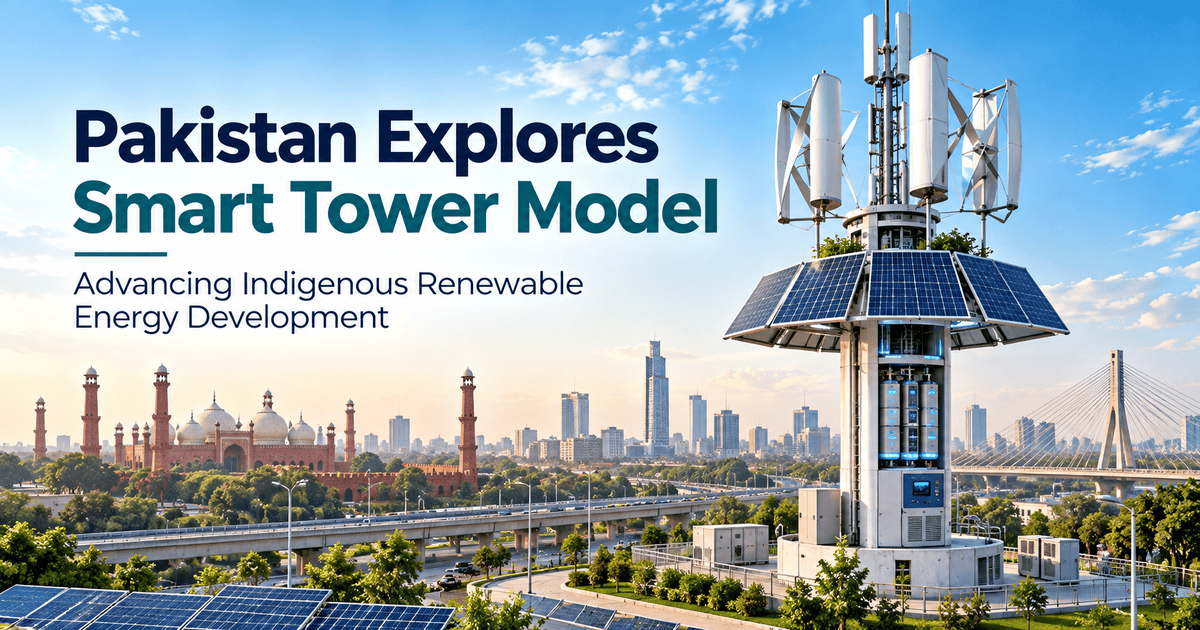
Pakistan’s energy sector may be heading toward a new phase as experts explore an innovative Smart Tower model designed to combine solar power, wind energy and battery storage in a single modular renewable-energy system.
The idea was discussed during a Special Guest Lecture and Consultative Discussion on the “Smart Tower Programme for Pakistan” on September 24, 2026. The discussion focused on how Pakistan could develop more of its renewable-energy infrastructure locally instead of depending heavily on imported equipment, fuels and technologies.
For a country with strong sunlight, useful wind resources and growing electricity demand, the concept deserves attention.
What makes the Smart Tower particularly interesting is that it is not simply another solar project. Its proposed design combines several technologies and places local manufacturing, community participation, skills development and decentralised electricity generation at the centre of the model.
For cities such as Lahore, as well as industrial areas and underserved rural communities throughout Pakistan, such systems could eventually offer another way to produce cleaner and more reliable electricity.
What Is the Smart Tower Model?
The Smart Tower is a proposed modular renewable-energy system that combines three important technologies:
- Solar power generation
- Vertical-axis wind turbines
- Battery energy storage
Instead of depending entirely on a single renewable source, the tower can use solar and wind energy together.
The amount of wind-generation equipment can also be adjusted according to the wind conditions of a particular location. Areas with stronger wind resources could use a greater wind component, while areas dominated by sunshine could depend more heavily on solar generation.
Battery storage completes the system by storing electricity when generation is available and supplying it when electricity is needed.
According to the Smart Tower concept presented during the consultation, the system could be adjusted for different energy requirements, ranging from small community installations to commercial and industrial applications.
That flexibility is one of the strongest features of the concept.
Pakistan does not have identical energy conditions everywhere. A solution suitable for a remote village in Balochistan may not be appropriate for a factory near Lahore.
A modular system allows developers to design the installation around the location rather than forcing every location to use the same configuration.
Why Pakistan Is Looking at Indigenous Renewable Energy
Pakistan already has significant renewable-energy potential.
Solar energy has expanded rapidly across the country, while wind resources are particularly promising in parts of Sindh and Balochistan. Pakistan’s Alternative and Renewable Energy Policy has also supported greater use of renewable and distributed-generation technologies.
However, installing renewable energy and manufacturing renewable-energy technology locally are two different things.
Pakistan continues to depend significantly on imported equipment for its solar and renewable-energy market.
That means a large increase in renewable installations can still result in foreign-exchange spending if panels, inverters, batteries and other components must be purchased internationally.
Developing local production could therefore turn the energy transition into an industrial opportunity.
The World Bank has previously identified areas where Pakistan could strengthen its domestic renewable-energy supply chain, including panel assembly, inverter production, mounting structures, research, testing and parts of the wind-energy manufacturing industry.
The Smart Tower proposal fits into this wider discussion.
Instead of treating Pakistan only as a buyer of renewable-energy systems, the model considers whether Pakistan could increasingly become a country that manufactures, assembles, installs, maintains and eventually improves those systems itself.
How the Smart Tower Works
The basic idea can be understood through four interconnected elements.
1. Solar Power
Solar panels generate electricity during daylight hours.
Pakistan has favourable solar conditions across large parts of the country, making solar one of the most practical renewable technologies available.
Solar installations have already become increasingly visible across Lahore, from residential rooftops to commercial properties, educational institutions and factories.
The Smart Tower would use that abundant solar resource as one of its main power sources.
2. Vertical-Axis Wind Generation
The system can also incorporate vertical-axis wind turbines.
Unlike conventional large wind turbines normally associated with utility-scale wind farms, vertical-axis systems can be designed for smaller and more flexible applications.
The appropriate wind component would depend heavily on local conditions.
A Smart Tower installed in a high-wind area of Sindh, for example, could potentially use a different configuration from one installed in Lahore.
That is important because renewable-energy systems work best when they are designed according to actual local resources rather than assumptions.
3. Battery Energy Storage
Solar panels only generate electricity when adequate sunlight is available, while wind output also changes according to weather conditions.
Battery storage helps address that variability.
Excess electricity can be stored and then used when generation falls or demand increases.
For homes, businesses and industries, storage can also improve the usefulness of renewable energy during grid interruptions or during evening hours when solar production has ended.
Energy storage is becoming increasingly important in Pakistan’s long-term energy planning. The government’s developing National Integrated Energy Plan for 2027–2060 specifically identifies renewable integration and emerging technologies such as energy storage as important elements of the future energy system.
4. Smart Digital Planning
Another interesting part of the proposal is the use of digital modelling and digital-twin technology.
Before installing a physical tower, developers could create a digital representation of a proposed system.
They could then examine factors such as:
- Available sunlight
- Wind conditions
- Electricity demand
- Battery requirements
- Expected generation
- Suitable equipment configuration
This could help reduce the risk of installing equipment that is too large, too small or poorly matched to the location.
Good renewable-energy development is not simply about installing more equipment. It is about installing the right equipment in the right place.
Local Manufacturing Could Be the Bigger Opportunity
Perhaps the most important part of the Smart Tower proposal is not the tower itself.
It is the possibility of building an ecosystem around it.
The concept presented in Pakistan suggested that much of the production, assembly, installation and maintenance could potentially be carried out locally, although detailed technical and commercial studies would still be required before determining exactly how much could realistically be manufactured in Pakistan.
Local production could create demand for:
- Metal fabrication
- Electrical components
- Mounting structures
- Wiring and control systems
- Battery integration
- Solar assembly
- Wind-system components
- Software and monitoring systems
- Engineering services
- Installation teams
- Maintenance technicians
This could distribute the economic benefits of renewable energy beyond electricity generation alone.
Pakistan already has engineers, technicians, workshops and manufacturing industries that could potentially participate in parts of this supply chain.
The challenge will be developing reliable quality standards and ensuring locally produced equipment can compete with established international manufacturers.
Creating Skilled Jobs in Pakistan
Renewable-energy development can also create new technical occupations.
According to the Smart Tower presentation, basic installations could potentially be assembled by relatively small teams, with workers learning some required skills through focused training programmes.
That could create opportunities for young Pakistanis in fields such as:
- Solar installation
- Electrical engineering
- Battery maintenance
- Wind technology
- Metal fabrication
- Energy auditing
- System monitoring
- Renewable-energy software
- Technical sales
- Equipment maintenance
This matters especially for Pakistan because renewable-energy growth should ideally create economic activity rather than simply increase imports.
Punjab Governor Sardar Saleem Haider Khan similarly argued at the International Solar Power Conclave in Lahore on September 25, 2026 that greater local solar manufacturing could generate employment while supporting affordable and environmentally friendly energy.
Smart Towers for Rural and Remote Communities
One of the most promising applications could be communities where conventional grid electricity remains unreliable or difficult to extend.
Large power stations normally depend on extensive transmission and distribution infrastructure.
A decentralised renewable-energy system works differently.
Electricity can be generated closer to where it is consumed.
A community-level Smart Tower connected to a microgrid could potentially supply electricity for uses such as:
- Homes
- Schools
- Healthcare facilities
- Water pumps
- Agricultural equipment
- Small shops
- Telecommunications
- Community centres
- Small businesses
This approach can be particularly valuable in remote areas where extending conventional electricity infrastructure is expensive.
Pakistan’s renewable-energy policy already recognises distributed-generation systems, off-grid solutions and rural energy services as important areas of development.
Community Participation Will Be Essential
Renewable projects cannot succeed through engineering alone.
They also require trust.
Research discussed during the Smart Tower consultation highlighted how insufficient engagement with communities around previous renewable projects has sometimes resulted in disputes involving agricultural land, grazing access, fishing areas and expectations about employment.
For future projects, communities should therefore be involved early.
Developers should clearly explain:
- Where infrastructure will be installed
- Who owns and maintains it
- How electricity will be distributed
- Whether land will be required
- What local employment will be created
- How complaints will be handled
- What benefits the community will receive
Successful renewable-energy development should be something communities participate in rather than something simply installed around them.
Could Smart Towers Work for Lahore?
Lahore presents a very different environment from Pakistan’s remote rural areas.
The city has a dense population, major commercial activity and an extensive industrial sector.
Solar would probably remain more important than wind for many installations in Lahore, meaning any Smart Tower configuration would have to be adapted according to actual local wind measurements.
However, the wider hybrid-energy concept could still have applications.
Potential locations could eventually include:
Industrial Units
Factories face high electricity costs and often require reliable power throughout the working day.
Hybrid renewable generation combined with batteries could help certain businesses reduce dependence on conventional electricity, subject to proper technical and financial analysis.
Commercial Buildings
Shopping centres, offices, warehouses and other commercial properties could investigate hybrid renewable systems where adequate space and renewable resources exist.
Educational Institutions
Universities, colleges and larger school campuses could use renewable-energy installations not only to reduce electricity consumption but also as practical learning facilities for engineering and environmental education.
Agricultural Areas Around Lahore
Renewable microgrids could potentially support irrigation, water pumping, cold storage and agricultural processing in suitable locations surrounding the city.
Telecom and Remote Infrastructure
Hybrid renewable systems can also be useful wherever reliable electricity is required but continuously operating a conventional backup generator is expensive.
The important point is that Smart Towers should not automatically be considered appropriate everywhere.
Each project would require an independent assessment of sunlight, wind, electricity consumption, available space, economics and maintenance requirements.
Supporting Pakistan’s Energy Security
Energy security is not simply about producing electricity.
It is also about controlling the risks associated with how electricity is produced.
A country heavily dependent on imported energy can be affected by:
- International fuel-price increases
- Currency depreciation
- Supply disruptions
- Geopolitical instability
- Foreign-exchange shortages
Increasing economically viable domestic energy resources can reduce some of these pressures.
Pakistan’s government has increasingly emphasised greater utilisation of indigenous energy resources. In May 2026, the Power Division said approximately 55% of Pakistan’s energy mix came from clean sources and that the government intended to continue increasing clean and domestic energy use.
Pakistan’s Alternative and Renewable Energy Policy also established a target for alternative and renewable technologies to reach 30% of generation capacity by 2030, separate from hydropower.
The Smart Tower concept could complement that broader transition if pilot projects demonstrate that it is technically dependable and commercially competitive.
Supporting Small and Medium-Sized Businesses
Small and medium-sized enterprises could be another important market.
Electricity costs influence nearly every business, whether it operates machinery, refrigeration, computers or air-conditioning.
Businesses in Lahore’s manufacturing and commercial sectors have increasingly examined solar installations to manage energy expenses.
A hybrid solution could potentially provide additional flexibility where both solar and wind resources are practical.
Battery storage could also allow businesses to use more of their own renewable generation rather than relying entirely on electricity being available at the exact moment it is produced.
However, the financial case would depend on equipment cost, battery life, electricity tariffs, maintenance expenses and expected generation.
The Challenges Pakistan Must Address
The Smart Tower concept is promising, but Pakistan should evaluate it carefully before large-scale deployment.
Several questions still need clear answers.
Technical Performance
Pilot projects should demonstrate actual electricity production under Pakistan’s climate and operating conditions.
Cost
A renewable system is only commercially useful if the lifetime cost makes economic sense compared with available alternatives.
Battery Economics
Batteries can improve reliability but also increase the upfront cost of renewable systems.
Their lifespan, replacement cost and safe recycling need to be considered.
Local Quality Standards
Local manufacturing should never mean compromising quality.
Equipment will need appropriate testing, certification and safety requirements.
Maintenance
Every renewable system requires maintenance.
Local technicians, spare parts and repair networks must therefore develop alongside deployment.
Financing
Households, communities and small businesses may struggle with large upfront investments even when a project could save money over many years.
Suitable financing arrangements would therefore be important.
Grid Integration
Larger deployments that interact with the electricity network will have to comply with Pakistan’s regulatory and technical requirements.
From Renewable-Energy Imports to Green Industrialisation
Pakistan’s rapid adoption of solar power demonstrates that demand for renewable energy already exists.
The next question is how much of the economic value created by that demand can remain inside Pakistan.
Imported renewable equipment can certainly help reduce fossil-fuel consumption, but domestic manufacturing offers an additional advantage.
It can turn renewable-energy adoption into industrial development.
Pakistan could gradually build capabilities in engineering, fabrication, assembly, electronics, software, storage, installation and maintenance.
The World Bank has previously recommended strengthening domestic renewable-energy supply chains through measures including research and development, technical standards, testing facilities and support for manufacturing.
That means projects such as the Smart Tower should be evaluated not only according to how many kilowatt-hours they produce.
They should also be evaluated according to how much local expertise and industrial capacity they create.
What Should Happen Next?
The sensible next step would be carefully monitored pilot projects.
Instead of immediately deploying the technology nationwide, Pakistan could test Smart Towers under different conditions.
For example, separate pilots could be established in:
- A high-solar location
- A high-wind location
- A rural village
- An industrial facility
- An agricultural community
- A public-sector facility
Researchers could then compare electricity generation, cost, reliability, maintenance requirements and local manufacturing potential.
Those results would provide stronger evidence for deciding whether the system should be expanded.
This evidence-based approach is particularly important because renewable technologies must perform reliably for many years.
A Potential Step Toward a More Self-Reliant Energy Future
Pakistan’s exploration of the Smart Tower model reflects an important change in how renewable energy is being discussed.
The conversation is shifting from simply asking:
“How can Pakistan install more renewable energy?”
toward a more ambitious question:
“How much of Pakistan’s renewable-energy future can Pakistan design, manufacture, operate and maintain itself?”
That distinction matters.
With abundant solar resources, useful wind corridors, an expanding renewable market and a large workforce, Pakistan has many of the ingredients needed for a stronger domestic clean-energy industry.
The Smart Tower concept alone will not solve Pakistan’s electricity challenges.
No single technology can.
But the principles behind it, hybrid generation, battery storage, decentralised power, local manufacturing, community participation and skills development, are likely to become increasingly important.
If pilot projects confirm that the technology is technically sound and economically competitive, Smart Towers could become one part of Pakistan’s broader shift toward cleaner and more locally supported energy.
For Lahore, this could ultimately mean more options for businesses, industries, institutions and surrounding agricultural communities looking for reliable and sustainable electricity.
For Pakistan as a whole, the bigger opportunity could be moving from being mainly a consumer of imported renewable-energy technology toward becoming an active participant in the renewable-energy value chain.
Frequently Asked Questions (FAQs)
1. What is the Smart Tower Programme in Pakistan?
The Smart Tower Programme is a proposed renewable-energy concept that combines solar generation, vertical-axis wind technology and battery storage in a modular system. Pakistan is currently exploring its potential rather than operating it as a nationwide programme.
2. Is the Smart Tower already operating across Pakistan?
No. The concept was discussed by experts as a potential model for Pakistan. Detailed technical, commercial and location-specific studies would still be required before large-scale deployment.
3. How does a Smart Tower generate electricity?
The proposed system uses solar panels and wind-generation modules to produce electricity. Battery storage can retain some of that electricity so it can be used when renewable generation is lower or demand is higher.
4. Why combine solar and wind energy?
Solar and wind generation do not always peak at the same time. Combining different resources can potentially create a more balanced renewable-energy supply, although performance depends on the location.
5. Can Smart Towers be manufactured in Pakistan?
The concept proposes significant local production, assembly, installation and maintenance. However, the exact percentage of components that could be manufactured domestically would need to be established through technical and commercial assessment.
6. Could Smart Towers work in Lahore?
Potentially, but every site would need proper assessment. Lahore has useful solar resources, while the suitability of wind generation would depend on actual local wind conditions. Industrial, commercial and institutional applications could be explored through pilot projects.
7. Can Smart Towers provide electricity during load shedding?
A system equipped with sufficient battery storage could potentially supply stored electricity during grid interruptions. The actual backup duration would depend on battery capacity, electricity consumption and renewable generation.
8. Are Smart Towers suitable for villages?
Rural and remote communities are among the applications being considered because modular renewable systems can generate electricity close to where it is required instead of depending entirely on long transmission networks.
9. Could this technology create jobs in Pakistan?
If manufacturing and servicing are genuinely localised, the technology could support jobs in fabrication, installation, electrical work, battery technology, maintenance, engineering, software and renewable-energy services.
10. Will Smart Towers replace conventional power plants?
That is unlikely. Pakistan’s electricity system requires a combination of generation, transmission, storage and distributed-energy technologies. Smart Towers would be one possible component of a much larger energy system.
11. What is the biggest advantage of the Smart Tower concept?
Its main potential advantage is the combination of multiple benefits: renewable electricity, energy storage, modular design, decentralised generation and the possibility of developing local manufacturing and technical skills.
12. What needs to happen before Pakistan adopts Smart Towers widely?
Pilot projects should establish the technology’s real-world generation, reliability, cost, maintenance requirements, safety, local manufacturing potential and suitability for Pakistan’s different climatic conditions.