

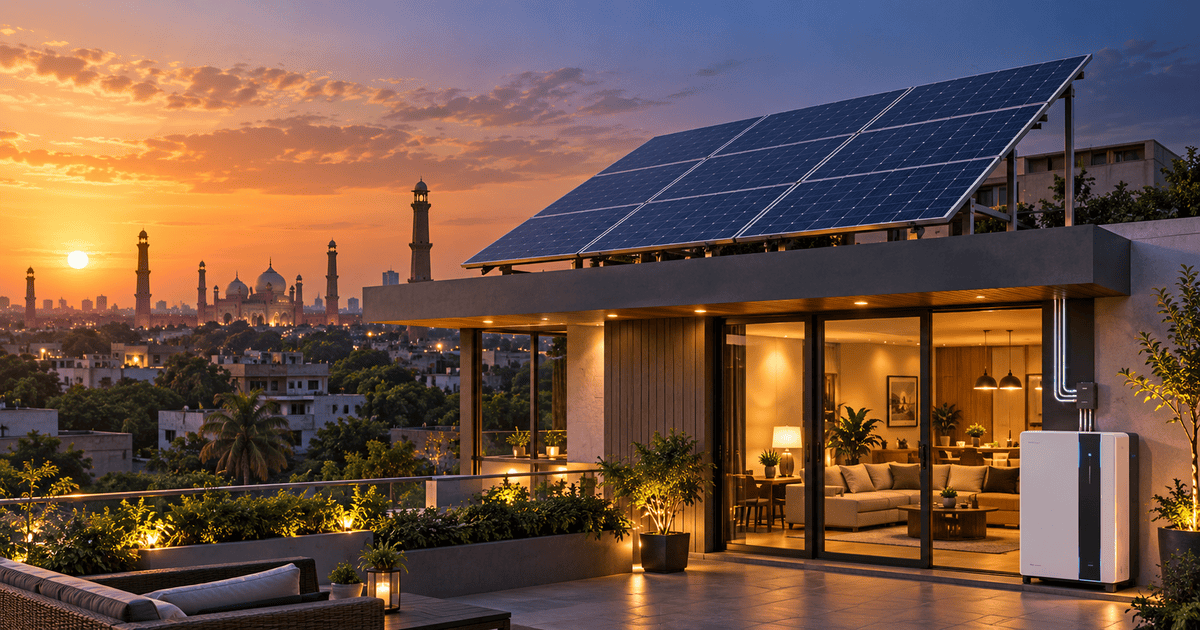
Pakistan’s energy landscape is changing faster than many people expected.
Over the past few years, thousands of homes, offices, shops, factories and commercial buildings have installed solar panels. In cities such as Lahore, rooftop solar systems have become a common sight. People are turning to solar mainly because they want lower electricity bills, greater control over their energy costs and protection from an unreliable electricity supply.
But installing solar panels solves only part of the problem.
Solar panels generate electricity when sunlight is available. Household electricity demand, however, does not disappear after sunset. Lights, fans, air conditioners, refrigerators, computers, televisions and other appliances continue operating well into the evening.
This creates one of the biggest challenges facing Pakistan’s solar transition:
How do we use solar energy when the sun is no longer shining?
The answer is increasingly battery energy storage.
Pakistan’s next stage of renewable-energy development is therefore unlikely to be about solar panels alone. It will increasingly involve combining solar generation with batteries that can store excess electricity during the day and make it available later.
For households and businesses in Lahore, this could change solar from primarily a bill-saving technology into a much broader energy-management system.
Pakistan’s Solar Revolution Has Already Started
Solar power has expanded rapidly across Pakistan.
The main reason is simple: the economics became attractive.
As solar panel prices declined and grid electricity became increasingly expensive, households and businesses began calculating whether producing some of their own electricity made financial sense.
For many consumers, it did.
Pakistan has consequently become one of the most interesting rooftop solar markets internationally. Reuters noted in September 2026 that Pakistan is among the countries demonstrating how strongly consumer demand can drive rooftop solar adoption when households are looking for more affordable and reliable electricity.
The scale of imported solar equipment illustrates how dramatic this change has been. Business Recorder reported that cumulative solar-panel imports had reached approximately 54,711 MW by the first ten months of FY2026, although imported panel capacity should not be confused directly with the amount of capacity actually installed and operating.
Solar has therefore moved far beyond being a niche technology.
It has become part of Pakistan’s mainstream energy market.
However, this success has created the next question.
What happens to all that solar electricity when it is produced at a time when consumers do not need it?
The Biggest Limitation of Solar Power: The Sun Sets
Solar panels have one unavoidable limitation.
They need sunlight.
A typical rooftop system produces most of its electricity between morning and late afternoon. Generation normally becomes strongest around the middle of the day before gradually falling as evening approaches.
Unfortunately, household demand often moves in the opposite direction.
Consider a family living in Lahore.
During a weekday afternoon, several family members may be at school or work. Electricity consumption at home may therefore be relatively low while the rooftop panels are producing significant amounts of power.
Then evening arrives.
Everyone comes home.
Lights switch on. Fans or air conditioners operate. Dinner is prepared. Televisions, laptops, refrigerators and other appliances continue running.
Solar production, meanwhile, has almost disappeared.
Without storage, the home must obtain that evening electricity from another source, normally the national grid or a backup system.
This mismatch between when solar electricity is generated and when electricity is consumed is one of the strongest arguments for battery storage.
What Does a Solar Battery Actually Do?
A solar battery stores electricity for later use.
Imagine a rooftop solar system producing 8 kilowatt-hours of electricity during a particular period of the day while the house consumes only 5 kilowatt-hours.
That leaves 3 kilowatt-hours of surplus electricity.
Without a battery, that electricity may be exported to the grid, depending on the system configuration and applicable regulations.
With a compatible battery system, some of the surplus electricity can instead be stored.
Later in the evening, when solar production falls, the battery can supply electricity back to the house.
The basic cycle is therefore:
Solar panels generate electricity → the house consumes what it needs → surplus electricity charges the battery → stored electricity is used later.
This relatively simple process can significantly change the value of a rooftop solar installation.
Solar Generation Is Only Half of Energy Independence
Many homeowners install solar expecting to become almost completely independent from the electricity grid.
That does not automatically happen.
A standard grid-connected solar system without batteries can remain heavily dependent on the grid outside daylight hours.
There is another important point that homeowners sometimes overlook.
Many conventional grid-tied solar inverters are designed to shut down during a grid outage for electrical safety reasons. This means that simply having panels on your roof does not necessarily guarantee that your home will have electricity during a power failure.
A properly designed hybrid solar and battery system can provide selected backup loads when the grid goes down, depending on the inverter, battery capacity, system configuration and installation.
That makes battery storage important not only for reducing electricity purchases but also for improving energy resilience.
Pakistan Is Already Moving From Solar to Storage
The transition is no longer theoretical.
Battery adoption in Pakistan is already accelerating.
Dawn reported in May 2026 that energy experts increasingly viewed battery storage as the “missing link” in Pakistan’s solar transition, while also noting that imports of solar-related batteries had increased over the previous three years.
Business Recorder reported in July 2026 that an analysis of Pakistan’s market estimated cumulative lithium-ion battery storage imports at around 7.6 GWh by the end of 2025, representing substantial year-on-year growth.
The trend continued into 2026. Business Recorder later reported record monthly lithium battery imports as consumers increasingly combined batteries with solar generation.
These numbers suggest something important.
Pakistan’s solar boom is entering a second stage.
The first stage was about producing electricity.
The second stage will increasingly be about deciding when that electricity is used.
Why Battery Storage Makes Particular Sense in Lahore
Lahore is an ideal example of why solar storage deserves attention.
The city has a large residential market, significant commercial activity and extremely high electricity demand during hot weather.
Summer air-conditioning demand can place substantial pressure on household electricity budgets.
At the same time, Lahore receives enough sunlight throughout much of the year to make rooftop solar attractive for many suitable properties.
Solar generation can help reduce daytime grid consumption.
But evening electricity usage remains significant.
A battery creates a bridge between those two periods.
Electricity generated in the afternoon can be stored and used after sunset instead of being wasted or immediately exported, depending on the homeowner’s setup.
For businesses, storage can also help support important equipment during interruptions and reduce dependence on separate backup arrangements.
Battery Storage Can Increase Solar Self-Consumption
One of the most important concepts in modern solar systems is self-consumption.
Self-consumption simply means using the electricity your solar panels generate yourself rather than sending it somewhere else.
Suppose a home produces 20 units of solar electricity during a day but directly uses only 12 units while the panels are generating.
Without storage, much of the remaining electricity may leave the property.
With batteries, part of those extra units can be stored and consumed later.
The household therefore uses a greater percentage of its own solar production.
This matters because the economics of exporting electricity and importing electricity are not necessarily identical and can change as regulations evolve.
Battery storage gives homeowners another option.
Instead of relying entirely on the financial value of exported electricity, they can increase the amount of solar power consumed inside their own property.
Changing Electricity Policies Increase the Importance of Flexibility
Pakistan’s distributed solar market is evolving.
Policies governing rooftop generation and electricity exported to the grid have changed over time and may continue changing.
Consumers should therefore avoid designing a solar system around only one assumption about future export compensation.
A more flexible approach is to consider several objectives:
- reducing electricity purchased from the grid;
- increasing direct solar consumption;
- storing surplus energy;
- maintaining important loads during outages;
- managing peak electricity demand;
- retaining access to the grid when necessary.
Battery storage can support several of these goals at once.
This does not mean every homeowner should immediately purchase a battery.
It means that battery readiness should increasingly be part of solar planning.
If someone is installing a system today but expects to add storage later, selecting compatible equipment from the beginning can make future expansion easier.
Batteries Can Reduce Evening Dependence on the Grid
Pakistan’s growing rooftop solar capacity is changing the shape of electricity demand.
During sunny daytime hours, thousands of solar-equipped buildings require less electricity from the national grid.
After sunset, solar generation falls rapidly.
Many of those buildings then return to grid electricity at roughly the same time.
Federal Energy Minister Awais Leghari highlighted this challenge at a Battery Energy Storage Systems conference in Lahore in July 2026, saying that distributed solar was reducing daytime demand while creating significant evening requirements that the grid still had to manage.
Battery storage can help smooth this transition.
Instead of every solar household immediately increasing grid consumption after sunset, some evening demand can be supplied from batteries charged earlier in the day.
At scale, storage therefore has potential benefits beyond individual electricity bills.
It can also help create a more flexible electricity system.
Battery Storage Can Improve Backup Power
Electricity reliability remains an important concern for many Pakistani households and businesses.
A battery-backed solar system can be designed to keep selected essential equipment operating during an outage.
Depending on battery size and system design, these loads might include:
- lights;
- fans;
- internet routers;
- computers;
- refrigerators;
- security equipment;
- selected office equipment.
Larger batteries may support greater loads, but this requires careful system design.
Running several air conditioners, electric heaters or other high-power appliances from batteries requires far more capacity than supporting lights, fans and basic electronics.
This is why professional load assessment is essential.
Buying the largest battery available is not automatically the best solution.
The battery should match the homeowner’s actual electricity requirements.
Lithium Batteries Are Changing the Storage Market
For many years, backup power in Pakistan was strongly associated with lead-acid batteries and traditional UPS systems.
That market is now changing.
Lithium-ion battery systems, particularly lithium iron phosphate or LiFePO4 technology, have become increasingly popular for solar applications.
They usually offer several advantages compared with traditional lead-acid systems, including:
- longer cycle life;
- deeper usable capacity;
- faster charging;
- higher efficiency;
- less routine maintenance;
- more compact designs;
- integrated battery management systems.
The initial purchase price may still be higher than some traditional battery options.
However, price alone does not provide a complete comparison.
Consumers should consider how many usable units of electricity a battery can deliver over its expected operating life.
A cheaper battery that needs frequent replacement may not always be cheaper in the long term.
Understanding Battery Capacity
Battery capacity is usually expressed in kilowatt-hours (kWh).
This should not be confused with kilowatts (kW).
Kilowatts describe power.
Kilowatt-hours describe energy.
For example, a 5 kWh battery theoretically contains 5 kWh of energy when fully charged.
However, the amount that should actually be used depends on the battery chemistry, recommended depth of discharge, inverter settings and manufacturer specifications.
If a home’s essential evening loads consume around 1 kW continuously, a 5 kWh battery would not necessarily provide exactly five hours of operation because conversion losses, usable capacity limits and changing appliance loads have to be considered.
A qualified installer should therefore perform an actual load calculation rather than selecting batteries using rough estimates alone.
Solar Battery Sizing Should Start With Your Electricity Usage
A common mistake is purchasing solar equipment based only on roof size or available budget.
Good energy design begins with consumption.
Before choosing a battery, homeowners should examine their electricity usage and identify which appliances they actually want supported.
For example, consider three households.
Household A: Basic Backup
The family mainly wants lights, fans, Wi-Fi and a refrigerator operating during an outage.
Its battery requirement may be relatively modest.
Household B: Evening Solar Use
The family wants to store daytime solar energy and use it across several hours after sunset.
It may require significantly greater battery capacity.
Household C: Heavy Backup
The household expects batteries to support several air conditioners and other high-load appliances.
This requires much more storage capacity, a suitable inverter, heavier electrical infrastructure and a much larger budget.
There is no single battery size that is correct for every home.
Batteries Can Also Help Businesses
The battery opportunity extends beyond homes.
Commercial users can benefit significantly from energy storage.
Businesses such as offices, shops, schools, clinics, warehouses and small manufacturing facilities often depend on uninterrupted electricity.
Even a relatively short power disruption can cause:
- interrupted customer service;
- computer shutdowns;
- payment-system problems;
- lost productivity;
- internet interruptions;
- equipment downtime.
Solar combined with storage can provide businesses with another layer of protection.
The financial calculation for a business should examine not just electricity savings but also the potential cost of downtime.
For some commercial users, preventing interruptions may be almost as valuable as lowering the electricity bill.
Battery Storage Is Important for Pakistan’s National Grid Too
Batteries are not only useful inside houses.
Large Battery Energy Storage Systems, commonly called BESS, can also operate at utility or grid level.
Large-scale batteries can potentially store electricity when supply is abundant and discharge it when demand rises.
They can also assist with:
- balancing electricity supply and demand;
- integrating variable renewable energy;
- responding quickly to changes in grid frequency;
- reducing renewable-energy curtailment;
- supporting peak-demand periods;
- improving overall grid flexibility.
Pakistan is adding more variable renewable generation.
As solar becomes a larger part of electricity production, the ability to shift energy across different hours of the day becomes increasingly valuable.
That is why battery storage should be seen as energy infrastructure rather than simply another household appliance.
Distributed Batteries Could Eventually Work Together
An interesting future development is the Virtual Power Plant, or VPP.
A virtual power plant is not necessarily one enormous physical power station.
Instead, software can coordinate thousands of smaller energy resources, such as household batteries and solar systems.
Imagine thousands of battery-equipped homes across Lahore.
Individually, each battery may seem relatively small.
Together, however, they could represent a substantial amount of stored electricity.
Business Recorder and Dawn have recently discussed the potential for Pakistan’s rapidly growing distributed battery base eventually to support VPP-style energy systems.
Such systems would require suitable regulation, communication infrastructure, smart meters, consumer protections and market rules.
But the concept shows how household batteries could eventually become part of a much larger national energy network.
Solar Plus Storage Can Reduce Dependence on Imported Fuels
Pakistan has historically faced pressure from the cost of imported energy.
Expanding domestic renewable electricity can reduce exposure to international fuel-price volatility.
Solar helps by generating electricity from a domestic renewable resource.
Storage makes solar more useful by allowing some of that energy to be shifted to the hours when it is actually required.
However, batteries also have an import cost, particularly because much of Pakistan’s current lithium battery equipment comes from overseas.
For the long term, Pakistan could benefit from developing stronger local capabilities in:
- battery assembly;
- power electronics;
- inverter production;
- battery management systems;
- recycling;
- technical servicing;
- energy-management software;
- engineering and installation.
The goal should not simply be to import more technology.
It should be to develop a stronger local clean-energy industry around it.
What About Battery Recycling?
Rapid battery adoption creates another responsibility.
Eventually, batteries reach the end of their useful lives.
Pakistan therefore needs safe systems for collection, recycling and disposal.
Lithium batteries should not simply be treated like normal household waste.
A mature battery market requires manufacturers, importers, regulators, installers and recycling companies to consider the entire product life cycle.
Consumers should also purchase batteries from reputable suppliers that offer proper warranties, technical support and clear specifications.
Very cheap products with uncertain origins may create financial and safety risks.
Solar Without Batteries Is Not Necessarily a Bad System
It is important to make one distinction.
Saying that solar alone is “not enough” does not mean every solar installation requires batteries immediately.
A grid-connected system without storage can still significantly reduce electricity costs, particularly for buildings that consume substantial electricity during daylight hours.
For example, offices, schools, shops and factories with high daytime consumption may use much of their solar production directly.
Their economic case for batteries may therefore be different from that of a household where most electricity is consumed after sunset.
The correct system depends on:
- electricity consumption patterns;
- backup requirements;
- available budget;
- solar-system size;
- electricity tariffs;
- applicable export rules;
- expected battery life;
- future expansion plans.
The objective should not be to install as much equipment as possible.
The objective should be to design the system that best matches the consumer’s needs.
What Homeowners in Lahore Should Consider Before Buying a Battery
Before investing in battery storage, ask a solar professional to examine several factors.
1. Your Electricity Consumption
Review at least several months of electricity bills and understand your average daily consumption.
2. Daytime vs Evening Usage
Determine when most electricity is actually used.
A household with heavy evening consumption may receive greater value from storage.
3. Essential Backup Loads
Decide which appliances genuinely need to operate during a power failure.
4. Battery Chemistry
Compare lithium and traditional battery technologies based on usable capacity, cycle life, safety, warranty and total lifetime cost.
5. Inverter Compatibility
Not every solar inverter supports battery storage.
Confirm compatibility before purchasing equipment.
6. Warranty
Check both the product warranty and performance conditions.
A long warranty is useful only when it comes from a supplier likely to provide after-sales support.
7. Installation Quality
Poor installation can reduce efficiency and create serious electrical risks.
Solar and battery installation should be performed by trained professionals following appropriate electrical and manufacturer requirements.
8. Future Expansion
If you may increase solar generation or battery capacity later, select a system that can support expansion.
The Future Is Not Solar Versus the Grid
Pakistan’s energy future does not need to be framed as a competition between rooftop solar and the national electricity grid.
The more useful goal is integration.
Solar can produce low-cost electricity during daylight hours.
Batteries can shift part of that electricity to later periods.
The grid can provide electricity when local renewable generation and storage are insufficient.
Smart energy-management systems can decide where electricity should come from at different times.
This creates a more flexible energy system.
Pakistan’s challenge is therefore moving from simply installing solar panels toward building an intelligent energy ecosystem.
From Solar Homes to Smart Energy Homes
The next generation of solar homes may look very different from the systems installed only a few years ago.
Instead of simply containing panels and an inverter, they may include:
Solar panels + hybrid inverter + battery storage + smart meter + energy-management software.
Such a system could automatically decide whether solar electricity should:
- power appliances;
- charge the battery;
- be exported to the grid;
- or be saved for later use.
Consumers would gain much greater control over their electricity.
This is likely to become increasingly important as electricity systems become more decentralised.
Pakistan’s Solar Revolution Is Entering Its Second Phase
The first stage of Pakistan’s renewable-energy transition was dominated by one question:
How can we generate cheaper electricity?
Solar panels helped answer it.
The next question is more complicated:
How can we use that electricity at the right time?
Battery storage provides an important part of the answer.
Panels generate energy.
Batteries provide flexibility.
Together, they can reduce grid dependence, increase solar self-consumption, provide backup electricity and help consumers manage their energy more effectively.
Pakistan’s rapidly growing battery market suggests that many consumers are already reaching this conclusion.
Frequently Asked Questions
1. Is a battery necessary with solar panels in Pakistan?
No. A solar system can operate without battery storage, particularly if it is connected to the grid. However, batteries allow surplus daytime solar electricity to be stored for evening or backup use, which can increase solar self-consumption and reduce dependence on grid electricity.
2. Can solar panels work during a power outage?
Not every solar system can provide electricity during a grid outage. Many conventional grid-connected inverters shut down during outages for safety reasons. A properly configured hybrid inverter and battery backup system can support selected loads when grid electricity is unavailable.
3. What is the best battery for solar systems in Pakistan?
There is no single battery that is best for every user. Lithium iron phosphate, or LiFePO4, batteries are increasingly popular because of their long cycle life, usable capacity, efficiency and relatively low maintenance. Battery quality, warranty, inverter compatibility and after-sales support should also be considered.
4. How big should my solar battery be?
Battery size depends on your electricity consumption and the appliances you want to operate. A household needing only lights, fans, a refrigerator and Wi-Fi requires far less storage than a household expecting batteries to operate several air conditioners. A professional load calculation should be performed before selecting battery capacity.
5. Are lithium batteries better than lead-acid batteries?
Lithium batteries generally offer longer cycle life, greater usable depth of discharge, faster charging and lower maintenance than traditional lead-acid batteries. However, they can have a higher initial purchase price. Consumers should compare total lifetime cost rather than purchase price alone.
6. Can I add batteries to my existing solar system?
In many cases, yes, but compatibility depends on the inverter and existing system design. Some grid-tied inverters cannot directly support batteries. An installer may recommend adding a compatible battery inverter, upgrading to a hybrid inverter or modifying the system architecture.
7. Can solar batteries reduce my electricity bill in Lahore?
They can help by allowing electricity generated during the day to be used later instead of purchasing as much electricity from the grid. Actual savings depend on consumption patterns, tariffs, solar generation, battery efficiency, battery cost and applicable electricity regulations.
8. How long does a solar battery last?
Battery lifespan varies considerably according to chemistry, quality, temperature, depth of discharge, charging patterns and manufacturer specifications. Consumers should compare expected cycle life and warranty conditions instead of relying only on a stated number of years.
9. Can a battery run an air conditioner?
Yes, a properly sized battery and inverter system can run an air conditioner. However, air conditioners consume significantly more electricity than basic loads such as lights or fans, so supporting them for several hours requires much greater battery capacity.
10. Is solar plus battery storage suitable for businesses?
Yes. Businesses can use storage to increase solar self-consumption, support critical equipment during outages and reduce dependency on grid electricity during certain periods. The financial value depends on the company’s load profile and the cost of interruptions.
11. What is BESS?
BESS stands for Battery Energy Storage System. It refers to a system that stores electrical energy in batteries and releases it when required. BESS installations can range from small residential systems to very large grid-scale installations.
12. What is a Virtual Power Plant?
A Virtual Power Plant, or VPP, uses software and communication technology to coordinate many distributed energy resources, such as household solar systems and batteries. Together, thousands of small systems can potentially behave like a larger power resource.
13. Will battery prices become cheaper in Pakistan?
Battery costs have generally declined as global manufacturing capacity and competition have increased, while Pakistan’s imports have also grown rapidly. Future prices will depend on global battery costs, exchange rates, taxes, shipping costs and local market conditions.
14. Is solar still worthwhile without batteries?
Yes. Solar without batteries can remain highly useful, especially for homes and businesses that consume significant electricity during daylight hours. Battery storage becomes more valuable when consumers want evening solar use, backup power or greater energy independence.
15. What should I check before buying a solar battery in Lahore?
Check battery chemistry, usable capacity, expected cycle life, warranty, inverter compatibility, safety certification, installation requirements and after-sales support. Most importantly, have your electricity consumption and backup requirements properly calculated before purchasing.
16. Is battery storage the future of solar energy in Pakistan?
Battery storage is likely to become an increasingly important part of Pakistan’s solar sector. As rooftop solar penetration grows, storage can help consumers use more of their own generation while giving the wider electricity system greater flexibility. Pakistan’s recent growth in lithium battery imports suggests that this transition is already underway.