
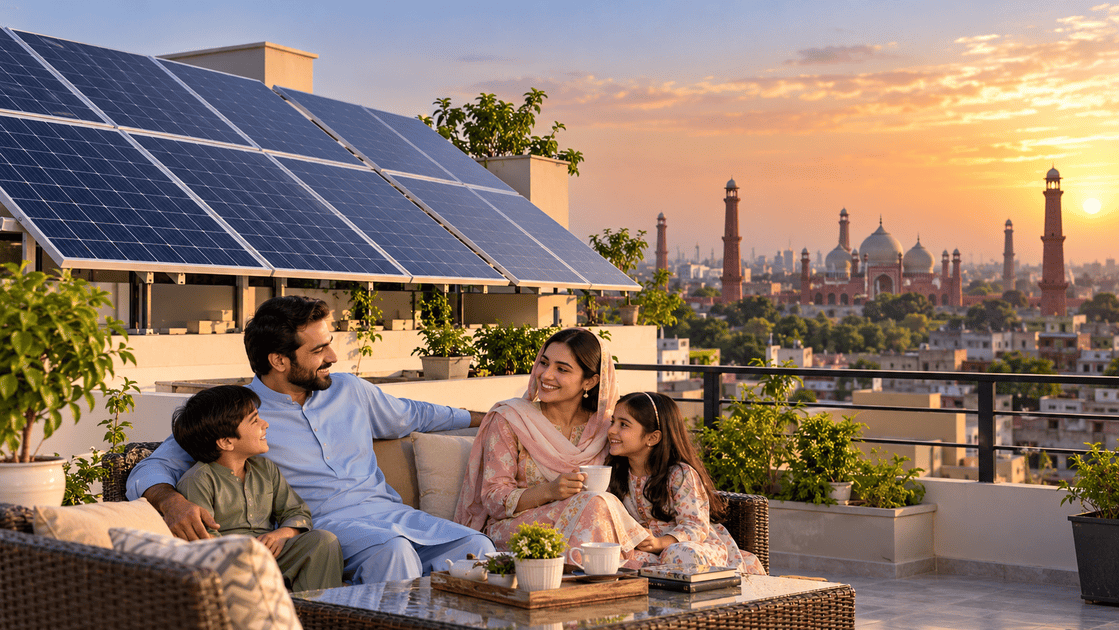
Life in Lahore has always revolved around the home. Rooftops are used for drying clothes, enjoying winter sunshine, flying kites, storing household items, and spending quiet evenings with family. Today, these familiar spaces are taking on another important role: producing electricity.
As electricity costs rise and families look for more reliable ways to manage household energy, solar power is becoming part of everyday life across Lahore. What was once considered a major investment for businesses or wealthy households is now being considered by families in many different neighborhoods.
The change is not limited to electricity bills. Solar energy is influencing how families use appliances, plan their daily routines, think about energy consumption, and even use their rooftop space.
Rooftop Solar in Lahore: How Clean Energy Is Changing Everyday Family Life is therefore more than a story about technology. It is about how a new source of energy is gradually becoming part of normal household life.
Lahore Homes Are Becoming Small Energy Producers
Traditionally, homes have depended almost entirely on electricity supplied through the national grid. Families receive electricity, use it and pay the monthly bill.
Solar power changes this relationship.
When solar panels are installed on a rooftop, the house becomes capable of producing some of its own electricity during daylight hours. Instead of depending completely on outside electricity, families can use energy generated directly above their homes.
This creates a different way of thinking about electricity.
Homeowners begin to understand when their system produces the most power, which appliances consume more electricity and how their daily habits affect overall energy use.
For many households, solar energy therefore becomes more than just equipment installed on the roof. It becomes part of how the family manages the home.
Why Rooftop Solar Is Becoming More Relevant in Lahore
Lahore receives strong sunlight during much of the year, which makes rooftop solar an attractive option for many properties.
The city also has a large number of houses with usable flat rooftops. Depending on the available space, orientation and shading conditions, these rooftops may provide suitable areas for solar panels.
Electricity costs are another major reason families consider solar.
Air conditioners, refrigerators, water pumps, fans, televisions, computers and kitchen appliances can create significant monthly electricity consumption. During Lahore’s hot summer months, cooling alone may account for a large portion of household electricity use.
A properly planned solar system can help reduce dependence on grid electricity during sunny hours.
However, homeowners should understand that every property is different. Solar system size should be based on actual electricity consumption, available rooftop space, budget and future energy requirements.
A professional assessment is usually more useful than choosing a system simply because another household installed the same capacity.
Solar Panels Are Transforming Pakistani Rooftops and Household Traditions
For decades, rooftops in Pakistani homes have had cultural and practical importance.
Children play there. Families sit outside during pleasant evenings. Clothes are dried under the sun. Water tanks, satellite dishes and household storage often share the same space.
Solar installations are adding another purpose to these rooftops.
Instead of being mostly unused during the hottest hours of the day, rooftops can now produce electricity.
This change also affects how people design their homes.
Some homeowners begin considering solar access when constructing additional floors. Others become more careful about placing water tanks, rooftop rooms or large structures that could create shadows over solar panels.
In this way, solar energy is gradually influencing household planning as well as energy consumption.
Family Routines Are Changing Around Daytime Electricity
One interesting effect of solar power is that families often become more aware of when electricity is being produced.
Solar panels generally generate electricity during daylight hours, with production varying according to sunlight, weather, system design and seasonal conditions.
Because of this, households may choose to operate certain appliances during the daytime.
Washing machines, water pumps, irons and other electrical equipment may be used when solar production is stronger rather than later at night.
The change does not need to be dramatic.
Even small adjustments in household routines can help families use more of the electricity generated by their own solar system.
This encourages smarter energy habits rather than simply installing panels and forgetting about electricity consumption.
Solar Energy Is Creating Greater Awareness About Electricity
Before installing solar, many people only think about electricity when the monthly bill arrives.
After installation, homeowners often become much more interested in how electricity actually works.
They may start checking solar production, household consumption and system performance.
Parents may remind children to switch off unnecessary lights. Air conditioners may be used more carefully. High-consumption appliances may be scheduled at better times.
In other words, solar technology can encourage energy awareness throughout the household.
This does not mean families have to constantly worry about electricity. Instead, it helps them understand how small habits influence overall consumption.
Cooling Is a Major Concern for Lahore Families
Anyone living in Lahore understands how demanding summer can be.
Temperatures can become uncomfortable for long periods, making fans and air conditioners important parts of daily household life.
Unfortunately, these appliances also consume significant electricity.
Solar power can be especially useful because the strongest sunlight often occurs during the same period when cooling demand is high.
A well-designed system may help supply part of the daytime electricity required for cooling.
However, families should avoid assuming that installing solar means electricity becomes unlimited.
System capacity still matters.
For example, running several air conditioners along with other heavy appliances may require significantly more power than a smaller solar installation can produce.
This is why solarcompanylahore recommends evaluating actual household consumption before selecting system capacity.
Rooftop Space Is Becoming More Valuable
A rooftop was once viewed mainly as unused space above the house.
Solar energy has changed that perception.
Homeowners are increasingly looking at rooftops as valuable areas capable of producing electricity for many years.
This also makes rooftop planning more important.
Solar panels require suitable placement with limited shading. Nearby buildings, trees, water tanks and rooftop rooms can reduce the sunlight reaching panels at certain times.
Families planning home extensions should therefore consider how future construction could affect their solar installation.
Good planning today can prevent problems later.
Solar Is Becoming a Family Financial Decision
Installing a rooftop solar system usually involves a significant upfront cost.
For this reason, solar is often discussed as a family investment rather than a simple household purchase.
Families may compare their electricity bills, expected energy requirements and available budget before deciding what size system to install.
Some people focus on lowering electricity bills. Others want greater energy independence. Some may also consider battery storage for backup purposes.
There is no single system that is suitable for every home.
A household with two air conditioners and moderate daytime consumption has different requirements from a larger house using multiple cooling units, pumps and appliances.
A careful calculation helps homeowners avoid both undersizing and unnecessarily oversizing the system.
The Importance of Proper Solar System Design
A solar installation is not just a collection of panels.
Several components must work together correctly.
A typical system may include solar panels, an inverter, mounting structures, electrical protection equipment, wiring and monitoring systems. Some installations may also include batteries.
The quality of system design can affect performance, safety and reliability.
Panels should be positioned properly.
Mounting structures must be secure.
Electrical cables should be suitable for their purpose.
Protection devices should be correctly installed.
The inverter should match the system requirements.
These details are especially important because solar systems are expected to operate for many years.
Choosing proper equipment and professional installation can be more important than choosing the cheapest possible quotation.
At solarcompanylahore, the focus should always remain on matching the system with the customer’s actual electricity requirements and rooftop conditions.
Clean Energy Is Becoming Part of Children’s Everyday Experience
Solar power is also changing how younger family members understand electricity.
Children growing up in solar-powered homes may see energy production as something that happens directly at home rather than something that only comes from distant power stations.
Parents can use this opportunity to teach simple lessons about renewable energy, conservation and responsible electricity use.
A child who understands that sunlight is producing electricity on the roof may become more interested in switching off unnecessary appliances or learning how renewable energy works.
These small experiences can shape future attitudes toward energy.
Solar Does Not Mean Completely Forgetting the Grid
One common misunderstanding is that installing solar automatically makes a household completely independent from electricity supplied by the grid.
That is not always the case.
Many rooftop systems continue operating alongside the grid.
How much grid electricity a family uses depends on system size, household consumption, sunlight availability, system configuration and whether battery storage is installed.
Cloudy weather can reduce solar production.
Electricity usage after sunset also has to be supplied through another source, such as the grid or stored battery energy.
Families should therefore view solar as part of an overall energy strategy rather than assuming panels alone will solve every electricity problem.
Solar Panels Require Basic Care
Solar systems are relatively low-maintenance, but they should not be completely ignored.
Dust is an important consideration in Lahore.
Dust, pollution and dirt can accumulate on solar panels and reduce the amount of sunlight reaching the surface.
Panels may require periodic cleaning depending on weather conditions and rooftop surroundings.
Homeowners should also occasionally inspect the system for unusual behaviour.
Monitoring electricity generation can help identify performance changes.
Electrical equipment should be checked by qualified professionals when required rather than handled by inexperienced individuals.
Regular attention can help maintain system performance over the long term.
Battery Storage Is Changing Household Expectations
Some families are also exploring battery storage alongside solar systems.
Batteries can store energy for later use, depending on the system design.
This can be useful when solar panels are no longer generating electricity after sunset or when backup power is required.
However, batteries add additional cost and should be selected carefully.
Battery capacity, expected usage, charging requirements and lifespan all matter.
Not every household needs the same storage solution.
Families considering batteries should first understand which appliances they want to operate during backup periods.
This helps avoid paying for unnecessary capacity.
Solar Is Influencing Home Construction Decisions
Solar energy is gradually becoming part of conversations around new home construction and renovation.
Homeowners may now ask architects or builders to keep rooftop areas open for future solar installations.
Electrical systems may also be designed with possible solar expansion in mind.
Even families that are not ready to install solar immediately may want to avoid creating future obstacles.
For example, placing a large rooftop structure in the sunniest area could reduce the available space for panels later.
Planning for solar during construction can make installation easier in the future.
Choosing Quality Over Short-Term Savings
Price is naturally important when families make a major investment.
However, choosing equipment based only on the lowest price can sometimes create problems.
A solar system involves equipment that must operate outdoors through intense Lahore heat, dust, rain and seasonal weather changes.
Panels, inverters, mounting structures and wiring should therefore be selected carefully.
Installation quality also matters.
Poor electrical connections or weak mounting structures can affect both performance and safety.
A trustworthy solar provider should explain the proposed system clearly rather than simply presenting a price.
Customers should understand system capacity, expected operation, major equipment, warranties and maintenance requirements before proceeding.
solarcompanylahore aims to help homeowners understand these factors so they can make informed decisions rather than simply selecting equipment based on numbers alone.
Solar Power and the Changing Meaning of the Rooftop
The rooftop is becoming one of the most useful spaces in modern Lahore homes.
It still serves traditional household purposes, but it can now perform another function every sunny day: producing electricity.
This represents a quiet but meaningful change.
Families do not necessarily need to change their lifestyle completely after installing solar.
Instead, solar becomes integrated into normal routines.
Laundry may be done during sunny hours.
Cooling habits may become smarter.
Children may learn about renewable energy.
Parents may monitor electricity consumption more carefully.
Future home construction may be planned around sunlight.
These changes show how technology can influence family life without replacing traditional routines.
The Future of Rooftop Solar in Lahore
The growing interest in rooftop solar suggests that household energy decisions are becoming more important for Lahore residents.
Families are becoming more informed about electricity consumption, renewable energy and long-term energy planning.
Future homes may increasingly be designed with solar energy in mind from the beginning.
Solar panels could become as familiar on rooftops as water tanks and satellite dishes.
At the same time, homeowners will need reliable information, suitable equipment and proper installation standards.
The long-term success of household solar depends not only on how many systems are installed but also on how well those systems perform over time.
For homeowners exploring Rooftop Solar in Lahore: How Clean Energy Is Changing Everyday Family Life, the most important step is understanding their own electricity needs before making a decision.
With careful planning, rooftop solar can become a practical part of everyday household life rather than simply another technology trend.
For families considering their options, solarcompanylahore can help assess rooftop conditions, electricity consumption and suitable system requirements before installation.
Frequently Asked Questions
- Is rooftop solar suitable for homes in Lahore?
Many Lahore homes have conditions that can support rooftop solar because the city receives substantial sunlight throughout the year. However, suitability depends on available rooftop area, shading, orientation and household electricity consumption.
A professional site assessment can help determine whether the rooftop is appropriate for installation.
- How many solar panels does a house need?
There is no fixed number.
The required number of panels depends on household electricity consumption, panel capacity, available rooftop area and the size of the solar system.
A smaller household may require considerably fewer panels than a large house operating several air conditioners and other heavy appliances.
- Can solar panels run air conditioners?
Yes, a properly sized solar system can contribute electricity toward operating air conditioners during daylight hours.
However, the number and size of air conditioners that can operate depend on solar generation, inverter capacity and other household electricity usage.
- Do solar panels work during cloudy weather?
Solar panels can still generate electricity when the sky is cloudy, but production may be lower because less sunlight reaches the panels.
System output naturally changes depending on weather conditions and the time of day.
- Do solar panels produce electricity at night?
No. Solar panels require sunlight to generate electricity.
At night, a household must use electricity from another source, such as the grid or energy stored in batteries.
- Are batteries necessary for every solar system?
No.
Some households install solar systems without batteries, while others use battery storage for backup or nighttime energy requirements.
Whether batteries are suitable depends on household goals, budget and electricity needs.
- How much rooftop space is needed for solar panels?
The amount of space required depends on the number and physical size of the panels.
Rooftop structures, water tanks, shadows and surrounding buildings can also affect how much usable space is available.
A site survey is the best way to determine practical panel placement.
- Do solar panels require regular cleaning in Lahore?
They may require periodic cleaning because dust and pollution can collect on the panel surface.
Cleaning frequency depends on local conditions, rainfall, construction activity and the amount of dust surrounding the property.
Homeowners should always follow safe cleaning practices.
- Can I expand my solar system later?
Expansion may be possible, but it depends on the original system design, inverter capacity, rooftop space and electrical configuration.
If future expansion is likely, discussing it during the initial design stage can make upgrades easier.
- How should I choose a solar system for my home?
Start by reviewing your electricity consumption rather than choosing a system based only on what another household has installed.