

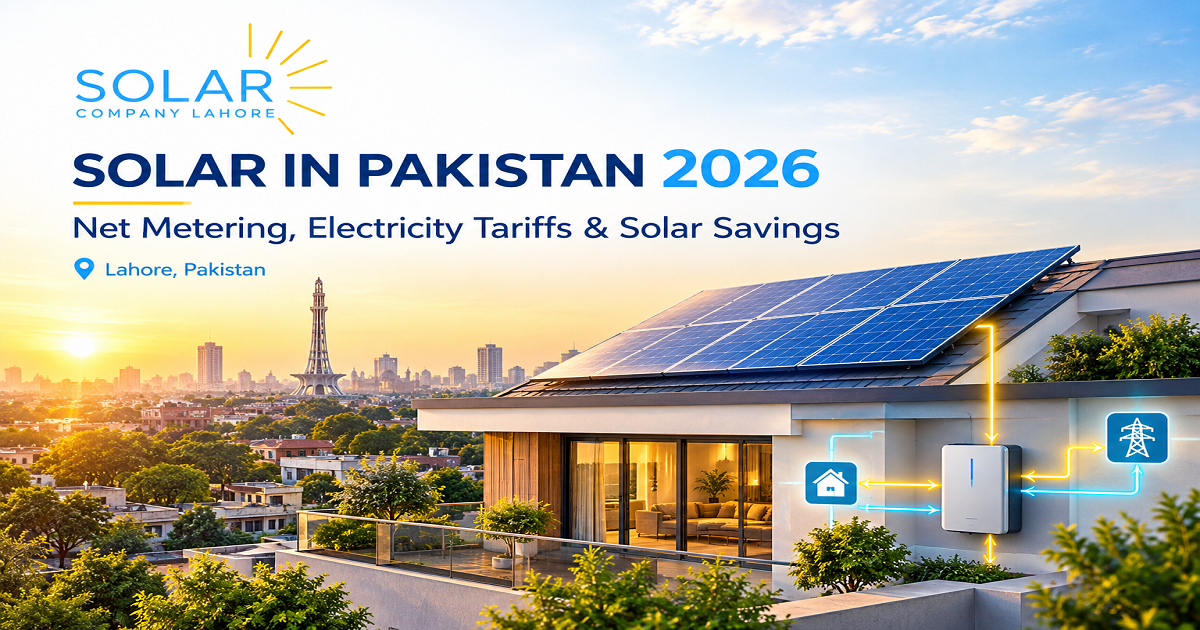
Pakistan’s solar energy market has grown rapidly as households, businesses, factories, and commercial buildings look for ways to manage rising electricity costs. In Lahore, rooftop solar systems have become an increasingly attractive option for people who want greater control over their monthly electricity bills.
However, the financial benefits of solar energy are changing. Electricity tariff adjustments, changes in net metering regulations, and evolving arrangements for purchasing surplus electricity have made it more important than ever to understand how a solar system works financially.
For many people, the main question is no longer simply whether solar panels can generate electricity. They also want to know how much electricity they can use directly, what happens to extra power exported to the grid, and whether their investment will remain worthwhile over the coming years.
Understanding net metering changes and electricity tariffs is essential for making informed decisions about solar installation in Pakistan. Homeowners who understand these developments can select a suitable system, manage their electricity consumption more effectively, and reduce the risk of making an expensive purchasing decision based on outdated assumptions.
This article explains the changing solar landscape in Pakistan, the possible impact on consumers in Lahore, and the practical steps homeowners and businesses can take to get more value from their solar installations.
- Understanding the Growth of Solar Energy in Pakistan
Pakistan receives abundant sunlight throughout much of the year, making solar energy a practical option for residential, commercial, and industrial electricity generation.
In Lahore, long summer days and substantial cooling requirements create significant electricity demand. Air conditioners, refrigerators, water pumps, lighting, and other appliances can contribute to high monthly bills, particularly during hot weather.
Solar panels allow consumers to generate electricity during daylight hours rather than relying entirely on the national grid.
Several factors have encouraged solar adoption in Pakistan:
- Rising electricity costs and household energy expenses.
- Greater availability of solar panels, inverters, and related equipment.
- Improved awareness of renewable energy.
- The need to manage electricity consumption during peak-demand periods.
- The availability of net metering arrangements for eligible consumers.
- Greater interest in hybrid systems and battery storage.
For many households, solar energy offers an opportunity to reduce their dependence on grid electricity. Businesses can also use solar generation to manage operating expenses and improve the predictability of their energy costs.
However, the financial outcome depends on more than the number of panels installed. System design, daytime electricity consumption, equipment quality, installation costs, applicable regulations, and billing arrangements all influence the final savings.
- What Is Net Metering and How Does It Work?
Net metering is an arrangement under which eligible solar consumers can export surplus electricity to the grid and receive bill credits or financial adjustments according to the applicable regulatory framework.
To understand the concept, consider a home in Lahore with a rooftop solar system.
During the day, its solar panels may generate more electricity than the household needs. The surplus electricity can flow into the distribution network, subject to the system’s technical configuration and the consumer’s approved interconnection arrangement.
At other times, such as after sunset or during periods of heavy electricity consumption, the household may need to draw electricity from the grid.
Under a net metering arrangement, exported electricity and imported electricity are accounted for according to the applicable rules. This can help consumers benefit from electricity they generate but do not immediately use.
For example, imagine that a household imports 400 units from the grid during a billing period and exports 300 units of surplus solar electricity.
These figures illustrate the energy flows only. They do not automatically mean that the household will pay for just 100 units. The final bill depends on the applicable import and export rates, billing rules, fixed charges, taxes, and other adjustments.
This distinction is important because electricity units and their monetary value are not always equivalent.
A unit exported to the grid may not receive the same financial value as a unit purchased from the grid. Consequently, the system’s financial performance can change when export compensation or electricity tariffs change.
- Why Are Net Metering Rules Changing in Pakistan?
As rooftop solar adoption increases, the electricity sector faces a different set of challenges. Traditional electricity networks were designed around power flowing mainly from large power stations to consumers. With rooftop solar, some consumers now generate electricity and send surplus power back into the network.
This shift creates both opportunities and financial questions.
One concern raised by policymakers is how the cost of maintaining the electricity network should be distributed among consumers. Grid infrastructure must remain available even when a solar-powered home uses little electricity during the day but imports substantial electricity at night.
Another concern is the financial value assigned to surplus electricity exported by solar consumers. If the rate paid for exported electricity differs from the retail price charged for imported electricity, the economics of a solar installation can change.
Pakistan has therefore been reviewing its regulatory framework. The National Electric Power Regulatory Authority (NEPRA) maintains the official regulatory records, including the Prosumer Regulations, 2026 and subsequent amendments. Consumers should check the latest applicable notification rather than rely on older online explanations.
Legal
+1
For solar users, the important point is that the rules applicable to a new installation may differ from those governing an existing approved connection.
Before purchasing a system, consumers should confirm the current requirements for approval, the applicable import and export billing arrangements, and any conditions affecting their particular connection.
What could these changes mean for solar consumers?
The financial return from a solar system may increasingly depend on how much electricity the household uses directly, rather than how much surplus electricity it exports.
This does not mean that solar energy has lost its value. It means consumers need to pay greater attention to system sizing, daytime consumption, battery requirements, and the terms of their electricity connection.
- How Electricity Tariffs Affect Solar Savings
Electricity tariffs determine how much consumers pay for electricity imported from the grid. These tariffs can vary according to consumer category, consumption level, applicable adjustments, and government-approved charges.
A household in Lahore may notice that the value of solar savings changes even when its panels generate a similar amount of electricity each month.
There are several reasons for this.
Changes in the cost of imported electricity
When the effective cost of grid electricity increases, every unit of electricity generated and consumed directly by a solar system can become more valuable.
For example, if a solar-powered household uses its own electricity to operate an air conditioner during sunny afternoon hours, it may avoid purchasing that electricity from the grid.
The actual saving depends on the applicable tariff and the charges that would otherwise have been payable.
Different values for imported and exported units
The rate charged for imported electricity and the rate credited for exported electricity may differ under the applicable billing arrangement.
Suppose a solar system exports a large amount of electricity at midday but the household uses most of its electricity after sunset. The household may receive less financial value for its exports than it would gain by using the same energy directly.
This is why a system that produces a large surplus is not automatically the most financially efficient option.
Fixed charges, taxes, and adjustments
Solar panels reduce the amount of electricity purchased from the grid, but they do not necessarily eliminate every component of an electricity bill.
Depending on the consumer category and current billing rules, a bill may include fixed charges, taxes, duties, adjustments, or other applicable amounts.
Consumers should therefore avoid assuming that installing solar will always reduce a bill to zero.
Changes in household consumption
A family’s electricity use can change over time. Installing another air conditioner, purchasing an electric vehicle, or adding new appliances can increase demand.
A system designed for the family’s previous consumption may no longer provide the same level of savings.
For these reasons, understanding net metering changes and electricity tariffs is an important part of planning a solar investment.
- Is Solar Still Worth Installing in Lahore?
For many households and businesses, solar energy can still offer meaningful long-term benefits. However, the right system depends on the consumer’s electricity usage, roof space, budget, and preferred level of energy independence.
Lahore’s climate offers good potential for rooftop solar generation, although actual output varies with season, weather, dust, shading, panel orientation, and equipment performance.
The key is to design the system around real electricity demand rather than simply installing the largest possible capacity.
Consider three common situations.
Residential households
Families that run air conditioners, washing machines, water pumps, and other appliances during daylight hours may be able to consume a significant share of their solar generation directly. This can reduce dependence on grid electricity.
Shops and offices
Businesses operating mainly during the day may use solar electricity while it is being generated. Their operating hours can make direct consumption particularly useful.
Factories and workshops
Facilities with daytime machinery loads may benefit from solar generation, provided the system is designed around their actual demand, electrical infrastructure, and operational requirements.
A solar system’s financial performance should be evaluated using realistic assumptions. Consumers should compare the expected cost of installation with the electricity costs that the system is likely to avoid, while accounting for maintenance, equipment replacement, financing costs, and applicable export compensation.
- Why Self-Consumption Is Becoming More Important
Self-consumption means using solar electricity at the property where it is generated instead of exporting it to the grid.
Under a billing arrangement where exported units receive a lower financial value than imported units, increasing self-consumption can improve the financial performance of a solar installation.
There are several practical ways to achieve this.
Run suitable appliances during daylight
Where practical, schedule electricity-intensive activities during periods of strong solar generation.
Examples include:
- Running washing machines during sunny hours.
- Operating water pumps when sufficient solar power is available.
- Using air conditioners during the day instead of relying entirely on evening cooling.
- Scheduling suitable commercial equipment to operate during daylight.
- Charging compatible batteries when surplus solar energy is available.
These adjustments should be made according to household needs, appliance safety, and the electrical system’s capacity.
Match system capacity to actual demand
Installing an oversized system may increase upfront costs without producing a proportional financial benefit if a large amount of its output is exported at a less favourable rate.
On the other hand, an undersized system may fail to meet daytime demand and leave the household purchasing substantial electricity from the grid.
A professional assessment should consider historical bills, seasonal usage, daytime demand, roof conditions, and future electricity requirements.
Monitor generation and consumption
A monitoring application can help users understand how much electricity their panels generate, how much the property consumes, and how much power moves to or from the grid.
This information can reveal opportunities to change appliance schedules or adjust energy usage.
A system that is monitored regularly is easier to evaluate than one whose owner only checks the monthly electricity bill.
- Should Solar Users Invest in Battery Storage?
Battery storage is becoming an important consideration for consumers who want to use more of their own solar electricity after sunset.
During sunny hours, panels may generate more electricity than the property needs. A compatible battery can store some of that energy for later use, subject to the battery’s capacity, charging limits, system design, and conversion losses.
At night, the stored electricity can supply selected appliances or a larger portion of the household’s demand, depending on the installation.
However, a battery is an additional investment. It should not be recommended automatically to every solar customer.
When a battery may make sense
Battery storage may be worth considering when:
- The household consumes a large amount of electricity after sunset.
- Grid outages create operational difficulties.
- The export compensation available under the applicable rules is relatively low.
- The consumer values backup power for essential appliances.
- The household’s budget supports the additional upfront cost.
When a battery may not be necessary
A battery may be less attractive if most electricity is consumed during daylight hours, grid reliability is acceptable, or the additional investment takes too long to recover through savings and other benefits.
Battery prices, usable capacity, warranty terms, replacement expectations, and the value of backup power should all be considered.
For many Lahore households, the decision should be based on a comparison of two options: a properly sized solar system without batteries and a hybrid system with suitable storage.
The best option is the one that meets the household’s needs at a reasonable total cost.
- How Existing Net Metering Customers Should Prepare
Consumers who already have an approved solar connection should not assume that every new regulatory change automatically affects their existing agreement in the same way.
The treatment of existing consumers depends on the applicable regulations, amendments, approvals, and contractual conditions. The latest official documents should be reviewed before making a financial decision.
Legal
+1
Existing solar users in Lahore can take the following steps.
First, review your approval documents. Keep copies of the relevant approvals, interconnection documents, and agreements. Check their applicable terms and dates.
Second, examine your electricity bills. Compare imported units, exported units, credited amounts, and other charges over several billing periods. This helps identify the actual financial benefit of the system.
Third, check your inverter’s performance. Review generation records and look for unexpected reductions in output. Dust accumulation, shading, equipment faults, and other issues can reduce generation.
Fourth, avoid unnecessary upgrades. Do not purchase extra panels or batteries simply because you have heard about regulatory changes. First, calculate whether an upgrade will address a real need.
Finally, obtain clarification when necessary. If the applicable export rate, agreement period, or treatment of an existing connection is unclear, seek written guidance from the relevant distribution company or a qualified professional.
These measures can help consumers make decisions based on their actual circumstances rather than rumours or generalised claims.
- How New Solar Buyers Can Make Better Decisions
For people planning a solar installation in Lahore, the most effective approach is to evaluate the complete system rather than focusing only on panel prices or advertised savings.
A lower installation price does not always represent better value. Equipment quality, inverter compatibility, protection devices, wiring, mounting structures, workmanship, and after-sales support all influence the system’s long-term performance.
Before making a purchase, consider the following factors.
Assess your electricity consumption
Review at least 6–12 months of electricity bills if available. Identify your average consumption, summer peak demand, and the times when electricity is used most heavily.
A household that uses most of its electricity during the day may need a different system design from one whose demand peaks in the evening.
Understand your billing arrangement
Ask which regulations and billing arrangements apply to your proposed installation. Confirm the current requirements for approval, the treatment of exported electricity, and any applicable charges.
Do not base your investment calculations on an export rate quoted for a different regulatory arrangement.
Compare suitable system designs
Request a comparison of appropriately sized on-grid and hybrid systems. Where relevant, include the expected cost of batteries and the value of backup power.
The comparison should explain expected generation, estimated self-consumption, potential grid imports, expected exports, and the assumptions behind the financial projections.
Evaluate the payback period realistically
The payback period is the time required for cumulative financial savings to recover the initial investment.
For example, if a system costs Rs. 1,500,000 and produces an estimated Rs. 300,000 in annual net savings, a simple payback calculation gives five years.
This is an illustrative example, not a forecast for a particular Lahore property. Actual savings can vary because of tariff changes, seasonal generation, export compensation, maintenance costs, and changes in electricity use.
A more reliable assessment should also consider the system’s expected operating life, inverter replacement, battery replacement where applicable, and the possibility that electricity prices or regulations may change.
Choose an installer who explains the details
A professional installer should be able to explain the proposed system in understandable language, provide an equipment specification, discuss safety protections, and explain what is included in the installation price.
At solarcompanylahore, consumers should approach solar purchasing as a long-term energy decision. Understanding the design and financial assumptions before installation can help them choose a system that suits their requirements.
- The Role of Hybrid Solar Systems in Pakistan’s Energy Future
Hybrid solar systems combine solar generation with battery storage and a compatible inverter configuration. Depending on the design, they can supply electricity directly from solar panels, store surplus generation, and draw electricity from the grid when required.
For households that experience outages or use substantial electricity after sunset, this flexibility can be useful.
However, hybrid systems are not automatically the best choice for everyone. Their suitability depends on the household’s consumption pattern, backup requirements, available budget, and the cost of storage.
A properly designed system should identify which appliances need backup power and how long they need to operate. Running an entire home, including several air conditioners, requires considerably more capacity than supporting essential lights, fans, internet equipment, and a refrigerator.
Battery capacity must therefore be calculated from expected loads and backup duration rather than selected solely by price.
Consumers should also understand that a hybrid inverter does not necessarily guarantee uninterrupted power during every grid outage. The equipment must support the required backup functionality, and the system must be installed and configured correctly.
As electricity tariffs and export arrangements evolve, storage may become more attractive for some consumers. Nevertheless, every proposed battery installation should be evaluated using realistic costs and expected benefits.
- What Lies Ahead for Solar Users in Pakistan?
Pakistan’s solar market is likely to remain an important part of the country’s evolving energy system. Solar power can help households and businesses reduce their dependence on grid electricity, diversify their energy supply, and manage operating costs.
At the same time, future returns will depend on more than sunlight and panel efficiency.
Three developments deserve particular attention.
First, regulatory clarity will matter. Consumers need clear information about approval procedures, export compensation, billing arrangements, and the treatment of existing agreements. The latest applicable NEPRA regulations and amendments should guide investment decisions.
Second, system design will become increasingly important. As the financial value of exported electricity changes, installers and consumers will need to pay closer attention to the relationship between solar generation and actual consumption.
Third, energy management will become more valuable. Monitoring applications, appropriately sized hybrid inverters, battery storage, and better appliance scheduling can help consumers use electricity more efficiently.
For new buyers, the priority should be to make decisions based on their own energy requirements and realistic financial calculations. For existing users, reviewing system performance and electricity bills can reveal opportunities to improve savings without unnecessary spending.
At solarcompanylahore, the goal should be to help households and businesses understand their options and select solutions that match their electricity needs, budget, and long-term plans.
Solar energy remains a practical option for many consumers. The strongest investment decisions will be those built on reliable information, appropriate system design, and a clear understanding of the rules governing each connection.
Frequently Asked Questions (FAQs)
- What is net metering in Pakistan?
Net metering is an arrangement that allows eligible solar consumers to export surplus electricity to the grid and receive financial credits or adjustments according to the applicable regulations and billing terms. The exact treatment of imported and exported electricity depends on the rules governing the consumer’s connection.
- Are net metering rules changing in Pakistan in 2026?
Yes, Pakistan’s regulatory framework has undergone changes, including the introduction of the Prosumer Regulations, 2026 and subsequent amendments. Consumers should check the latest official NEPRA notifications and confirm which provisions apply to their specific connection.
Legal
+1
- Will existing net metering customers lose their previous benefits?
Not necessarily. The treatment of existing customers depends on the applicable regulations, amendments, approvals, and contractual conditions. Existing customers should review their documents and obtain clarification from the relevant distribution company before assuming that their billing arrangements have changed.
- Is solar energy still worth installing in Lahore?
Solar energy can still be worthwhile for many Lahore households and businesses. Its financial value depends on installation costs, electricity consumption patterns, system performance, applicable tariffs, export compensation, and maintenance expenses. A property-specific assessment is more reliable than a general savings estimate.
- How can I maximise solar savings if export rates are lower?
Use more of your solar electricity directly during daylight hours. Schedule suitable appliances when solar generation is strong, monitor energy consumption, and choose a system sized to your actual demand. A battery may help shift surplus energy to evening use, but its additional cost should be evaluated carefully.
- Do solar panels eliminate electricity bills completely?
No, not necessarily. Consumers may still receive bills containing charges, taxes, fixed amounts, or electricity imported from the grid. The final bill depends on consumption, solar generation, applicable tariffs, and the relevant billing arrangement.
- Should I install a hybrid solar system with batteries?
A hybrid system may suit households that need backup power or consume significant electricity after sunset. However, batteries increase the initial investment. Compare the expected savings, backup requirements, battery warranty, and replacement costs before deciding.
- How do electricity tariff increases affect solar users?
Higher grid electricity costs can increase the value of solar electricity consumed directly on the property. However, the financial benefit depends on the applicable tariff structure, the proportion of solar power used directly, and the treatment of exported electricity.
- What should I check before installing solar panels in Lahore?
Review your electricity bills, roof condition, daytime electricity demand, expected solar generation, equipment specifications, installation costs, and applicable regulatory requirements. Ask for a transparent financial estimate that distinguishes self-consumed electricity from exported electricity.
- How can solarcompanylahore help me choose a suitable solar system?
solarcompanylahore can be approached for guidance on evaluating solar system options for residential and commercial requirements in Lahore. Before selecting a system, discuss your electricity consumption, budget, backup requirements, equipment specifications, installation scope, and the applicable rules for your connection. Always request a clear proposal with realistic performance and savings assumptions.