

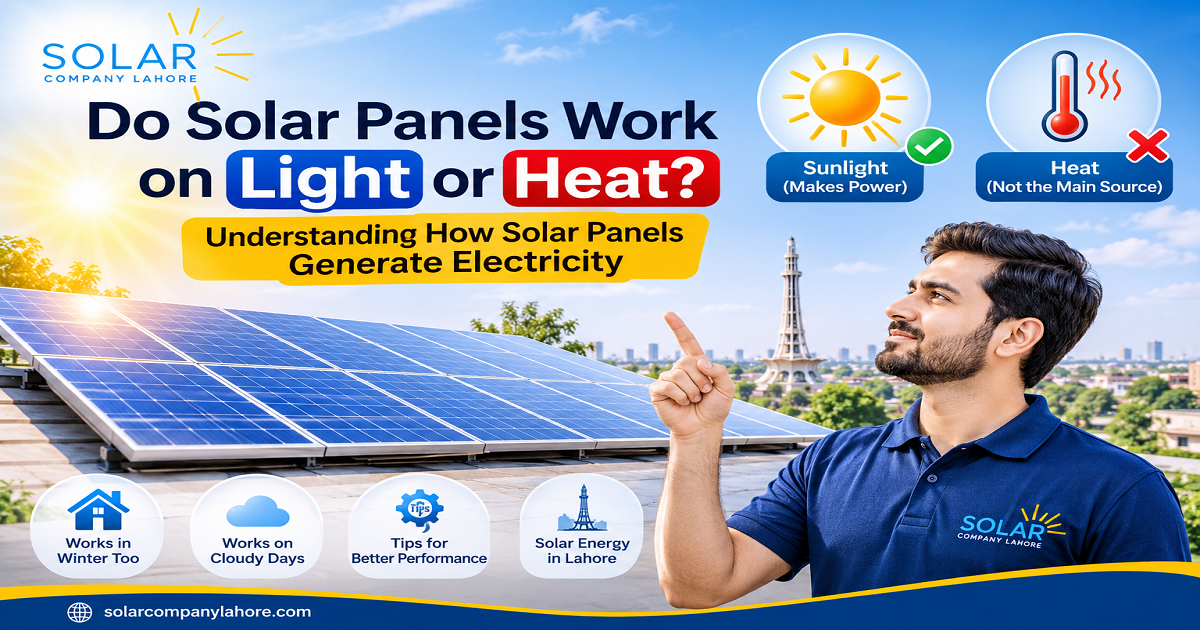
Introduction: The Truth About Solar Panels and Sunlight
Many people in Lahore believe that solar panels need intense heat to generate electricity. This is understandable because Pakistan experiences long, hot summers, and solar panels are often installed on rooftops exposed to direct sunlight. However, there is an important difference between sunlight and heat that every solar energy user should understand.
Solar panels generate electricity primarily from light, not from heat. They use sunlight to produce electrical energy through a process known as the photovoltaic effect. Heat is not the main source of electricity generation. In fact, excessive heat can reduce the efficiency of solar panels, even when the sun is shining brightly.
Understanding this difference helps homeowners make better decisions when planning a solar installation. It also explains why solar panels can produce electricity during cool winter mornings, why their performance changes throughout the year, and why a very hot day does not always result in the highest electricity production.
For homeowners considering solar energy in Lahore, this knowledge is particularly useful. The city receives substantial sunlight throughout the year, making solar energy an attractive option for residential and commercial properties. However, temperature, dust, shading, panel orientation, and system design all influence how much electricity a solar system can generate.
This article explains how solar panels work, why light matters more than heat, how Pakistan’s climate affects performance, and what homeowners can do to get better results from their solar systems.
How Do Solar Panels Generate Electricity?
Solar panels contain photovoltaic cells that convert sunlight into electrical energy. These cells are usually made from semiconductor materials, such as silicon, that respond to incoming light.
When sunlight reaches the surface of a solar panel, the energy carried by the light interacts with the semiconductor material. This interaction releases charge carriers, allowing an electrical current to flow through a properly designed circuit.
The electricity produced by the panels is called direct current (DC). Most household appliances in Pakistan operate on alternating current (AC). Therefore, a solar inverter converts the DC electricity into AC electricity that can be used in homes and businesses.
The basic process involves three main stages:
-
Sunlight reaches the solar cells.
-
The solar cells convert part of the light energy into DC electricity.
-
The inverter converts the DC electricity into AC electricity for household use.
The amount of electricity generated depends on several conditions, including sunlight intensity, panel temperature, shading, system capacity, and the efficiency of the installed equipment.
The Photovoltaic Effect Explained in Simple Words
The photovoltaic effect is the process that allows solar cells to convert light into electricity.
Think of a solar panel as a device that captures energy from sunlight and turns it into a useful electrical form. The panel does not need to become extremely hot to perform this function. It needs sufficient light reaching its photovoltaic cells.
When photons, which are particles of light, strike the semiconductor material, they can transfer energy to electrons. Under suitable conditions within the solar cell, these electrons contribute to an electrical current.
This process occurs even when the surrounding air is cool. That is why a solar panel can generate electricity on a clear winter morning, provided enough sunlight reaches its surface.
For an ordinary homeowner, the most important point is simple: solar electricity comes from light interacting with the solar cells, not from the panel absorbing heat.
How Sunlight Is Converted into Usable Electricity
Solar panels produce DC electricity, but most household electrical systems require AC electricity. A solar inverter manages this conversion.
In a typical grid-connected residential system, electricity generated by the panels first supplies the home’s electrical demand through the inverter. Depending on the system configuration, surplus electricity may be exported to the grid, while a shortfall may be supplied by the grid or a battery.
The amount of electricity available at any moment depends on both solar production and household consumption.
For example, a family running fans, refrigerators, lights, and other appliances during sunny daytime hours may use a significant portion of its solar generation directly. If the system produces more electricity than the home needs, the treatment of the surplus depends on the installed equipment and applicable electricity regulations.
This is why correct system sizing matters as much as selecting good-quality panels.
Why Solar Panels Need Light Rather Than Heat
The question “Do solar panels work on light or heat?” has a straightforward answer: photovoltaic solar panels generate electricity from light.
Light intensity directly affects how much current a solar panel can generally produce. When more usable sunlight reaches the cells, electricity generation usually increases, provided other conditions remain similar.
Heat behaves differently. Solar panels become warmer when exposed to sunlight, but this temperature increase is not what drives their electricity production. Instead, excessive cell temperature usually reduces the panel’s voltage and can lower its overall power output.
Consider two situations:
-
A cool, sunny day: Strong sunlight reaches the panels, while the cells remain relatively cool. This can provide favourable operating conditions.
-
An extremely hot, sunny day: Strong sunlight reaches the panels, but their temperature rises significantly. The heat-related reduction in efficiency can offset some of the benefit of intense sunlight.
The actual outcome depends on sunlight intensity, wind, panel temperature, equipment specifications, and other environmental factors. A hot summer day can still produce more total electricity than a cool winter day because it may have longer daylight hours and stronger sunlight.
The important lesson is that sunlight and heat should not be treated as the same thing when evaluating a solar system.
Do Solar Panels Work in Cold Weather?
Yes, solar panels can work very well in cold weather. They do not require high outdoor temperatures to generate electricity.
As long as sufficient sunlight reaches the photovoltaic cells, the panels can continue producing power during winter. In many cases, lower cell temperatures improve electrical efficiency compared with very hot operating conditions.
This does not mean that winter always produces more electricity than summer. Winter days are generally shorter, the sun follows a different path across the sky, and cloudy weather can reduce the amount of light reaching the panels.
For homeowners in Lahore, solar systems can therefore continue generating useful electricity throughout winter, although the daily and monthly output may differ from summer production.
Why Cool Weather Can Improve Solar Efficiency
Most conventional photovoltaic panels experience a reduction in power output as their cell temperature rises above the reference temperature used for their rated performance.
Manufacturers provide a temperature coefficient in the panel’s technical specifications. For many crystalline silicon panels, this coefficient is negative, meaning that higher cell temperatures reduce power output under otherwise comparable conditions.
Cool weather can help the cells operate closer to their rated performance. If bright sunlight is also available, this combination can be beneficial.
However, cooler weather alone does not guarantee high electricity generation. A cold, heavily overcast day may produce less electricity than a warm, clear day because the available sunlight is much weaker.
Can Solar Panels Work on Cloudy Winter Days?
Solar panels can generate electricity on cloudy days because clouds do not block all sunlight. Some light passes through clouds, and some reaches the panels after being scattered by the atmosphere.
However, the electricity output is usually lower than under strong, unobstructed sunlight. The reduction depends on cloud thickness, weather conditions, panel technology, and the amount of light reaching the cells.
A properly designed solar system can still contribute to household electricity needs during cloudy winter periods. Nevertheless, homeowners should not expect the same output every day.
When planning a system, it is better to evaluate expected generation across different seasons rather than relying on performance during a single sunny afternoon.
How High Temperatures Affect Solar Panel Efficiency
High temperatures are an important consideration for solar installations in Pakistan. During summer, rooftop temperatures can become significantly higher than the surrounding air temperature, particularly when there is limited airflow beneath the panels.
Solar cells convert only part of the incoming sunlight into electricity. Some of the remaining energy contributes to heating the panel. As the cells become hotter, their electrical characteristics change, and their voltage generally decreases.
This can reduce the amount of power produced under otherwise comparable sunlight conditions.
For example, a panel rated at 550 watts is tested under specified standard conditions. It should not be expected to produce 550 watts continuously throughout a hot summer day. Its actual output changes with sunlight intensity, cell temperature, shading, and other operating conditions.
The rated power is a reference for comparing products, not a guarantee of constant real-world output.
Why Rooftop Ventilation Matters
Solar panels installed close to a roof may experience limited airflow, depending on the mounting arrangement. Poor ventilation can contribute to higher operating temperatures.
A suitable mounting structure allows airflow beneath the panels while maintaining the required mechanical strength and safety. The installer should consider the roof type, wind exposure, structural capacity, cable routing, and maintenance access.
Good ventilation cannot eliminate temperature-related losses, but it can help the system operate under more favourable conditions.
Homeowners should avoid modifying mounting structures themselves. Any adjustment should be evaluated by a qualified installer to ensure that the panels remain securely fixed and electrically safe.
Does a Hotter Day Always Produce More Solar Electricity?
No. A hotter day does not automatically produce more electricity.
A hot day with clear skies may offer strong sunlight and long daylight hours, supporting high daily generation. However, the elevated panel temperature can reduce instantaneous efficiency.
A cooler day with strong sunlight may allow the panels to operate more efficiently, although the total daily energy production will still depend on the duration and intensity of the available sunlight.
For this reason, temperature alone is not a reliable measure of solar performance. Homeowners should look at actual energy production in kilowatt-hours (kWh), compare similar weather conditions, and consider the season when evaluating their systems.
Direct Sunlight vs. Diffused Sunlight: What’s the Difference?
Sunlight reaches solar panels in different ways. Understanding these differences helps explain why panels can continue producing electricity when the sky is not completely clear.
Direct sunlight travels from the sun to the panel with relatively little scattering. It generally provides strong illumination and supports higher output when the panels are properly oriented.
Diffused sunlight is scattered by clouds, dust, and molecules in the atmosphere before reaching the panel. It can still generate electricity, although the available energy is often lower than under clear, direct sunlight.
Both forms of light can contribute to solar electricity generation.
How Shading Affects Solar Production
Shading from trees, buildings, water tanks, chimneys, or nearby structures can significantly affect solar output. The impact depends on the location of the shade, its duration, the panel arrangement, and the inverter technology.
Even partial shading can reduce production from a panel or affect a larger section of an array in certain configurations.
Before installation, the installer should assess the roof throughout the day and identify potential shading problems. This is especially important in Lahore’s densely developed residential areas, where neighbouring buildings and rooftop structures may cast shadows.
A carefully planned layout can help reduce avoidable losses.
Does Solar Panel Performance Change Between Summer and Winter in Pakistan?
Yes. Solar generation changes throughout the year because sunlight intensity, daylight hours, weather, and panel temperature change with the seasons.
Pakistan has considerable solar energy potential, but the production of an individual installation depends on its exact location, orientation, equipment, and local conditions.
Solar Panel Performance During Lahore’s Hot Summers
Lahore generally experiences long summer days with strong sunlight. These conditions can support substantial solar electricity generation, particularly when panels are clean and receive unobstructed sunlight.
However, high temperatures can reduce the panels’ instantaneous efficiency. Dust accumulation can also become a concern during dry periods, especially when rain is insufficient to clean the surfaces.
Homeowners should monitor their system’s generation and arrange appropriate cleaning when necessary. Cleaning frequency should depend on actual dust accumulation, local conditions, and the manufacturer’s instructions.
The best way to assess performance is to review daily or monthly generation rather than assuming that every hot day will produce maximum output.
Solar Energy Production During Winter Months
During winter, Lahore experiences shorter days and a lower sun angle than in summer. These factors can reduce the total amount of solar energy available to the panels.
On the other hand, cooler operating temperatures may improve panel efficiency when sunlight is available.
Winter performance therefore reflects a balance between sunlight availability, daylight duration, temperature, and weather. A clear winter day can still provide useful generation, while persistent cloud cover can reduce output.
When estimating the appropriate solar system size, homeowners should consider their annual electricity consumption and seasonal requirements instead of designing the system around only one season.
Which Factors Affect Solar Panel Electricity Production?
Several factors influence how much electricity a solar installation produces. Understanding them helps homeowners identify realistic expectations and avoid unnecessary expenses.
1. Sunlight Intensity and Daylight Hours
The amount of sunlight reaching the panels is one of the main factors affecting generation. Stronger illumination generally increases output, while weak sunlight reduces it.
Longer daylight hours can also increase the total energy produced over a day, provided suitable sunlight is available.
2. Panel Temperature and Ventilation
High cell temperatures can reduce power output. Suitable mounting arrangements and adequate airflow can help limit unnecessary heat buildup.
When selecting panels, homeowners should review the temperature coefficient alongside rated power, warranty conditions, and other technical specifications.
3. Dust, Dirt, and Shading
Dust and dirt can prevent some sunlight from reaching the cells. Bird droppings and other deposits may create localised losses.
Shading can also affect generation, particularly when it occurs over important sections of the array.
Regular inspection and appropriate cleaning help maintain performance. Cleaning should be carried out safely, following manufacturer guidance and avoiding unsuitable chemicals or methods that could damage the panels.
4. Solar Panel Quality and System Design
The performance of a complete solar installation depends on more than the panels alone.
The inverter, mounting structure, DC and AC wiring, protective devices, earthing, and system configuration all matter. Poor design or incorrect installation can create safety risks and reduce generation.
A professional site assessment should consider the household’s electricity consumption, available roof area, shading, expected future loads, and any backup power requirements.
5. Inverter Performance and System Maintenance
The inverter converts the panels’ DC electricity into usable AC electricity. Its capacity, efficiency, operating conditions, and configuration influence the performance of the complete system.
Homeowners should periodically review inverter readings and investigate unusual changes in production. Maintenance should be carried out by a qualified professional, particularly when electrical faults or damaged components are suspected.
How Can Lahore Homeowners Improve Solar Panel Performance?
Homeowners can take several practical steps to improve the performance and reliability of their solar systems.
Choose the correct system size. Review electricity bills and daily consumption patterns before selecting the system capacity. A properly sized system is more useful than simply installing the largest possible array.
Arrange a proper roof assessment. Check available space, structural strength, shading, orientation, and maintenance access before installation.
Select suitable equipment. Compare panel specifications, temperature coefficients, inverter compatibility, warranties, and installation quality. Avoid choosing equipment based on rated wattage alone.
Maintain clean panels. Inspect for dust and deposits, and arrange safe cleaning when necessary. Cleaning should not be performed on hot panels using cold water if the manufacturer warns against thermal shock.
Monitor energy production. Use the inverter’s monitoring system, where available, to review daily and monthly generation. Compare results with reasonable seasonal expectations.
Use electricity wisely. Running suitable appliances during periods of strong solar production can increase direct use of the electricity generated by the panels. High-consumption appliances should always be operated within the limits of the home’s electrical system.
Arrange professional maintenance. Periodic checks can help identify loose connections, damaged cables, inverter warnings, or other problems before they become more serious.
For homeowners planning a new installation or upgrading an existing system, solarcompanylahore.com can be considered as a starting point for exploring solar installation requirements in Lahore. The final system design should always be based on an individual property’s needs and a proper technical assessment.
Common Myths About Sunlight, Heat, and Solar Energy
Misunderstandings about solar technology can lead to poor installation decisions. The following facts help clarify some common misconceptions.
Myth 1: Solar Panels Need Extreme Heat to Work
Fact: Solar panels need light to generate electricity. High temperatures are not required and can reduce efficiency.
Myth 2: Solar Panels Stop Working in Winter
Fact: Solar panels can generate electricity in winter whenever sufficient light reaches them. Their output varies with daylight hours, weather, and temperature.
Myth 3: Solar Panels Produce Maximum Electricity on the Hottest Day
Fact: Strong sunlight can support high generation, but excessive panel temperature can reduce instantaneous power output.
Myth 4: Solar Panels Cannot Work on Cloudy Days
Fact: Solar panels can generate electricity from diffused sunlight. However, output generally falls when clouds substantially reduce the available light.
Myth 5: More Panels Always Mean a Better Solar System
Fact: System capacity must match the property’s roof space, consumption, inverter configuration, and electrical requirements. A poorly designed larger system may not deliver the expected benefits.
Understanding Solar Energy Before Investing in Pakistan
Solar energy can help households manage electricity expenses, but the financial benefits depend on the system’s installation cost, generation, self-consumption, maintenance, electricity tariffs, and applicable grid-export rules.
Before investing, homeowners should ask for a realistic estimate of expected monthly and annual generation. The estimate should account for the property’s location, shading, panel orientation, equipment specifications, and seasonal weather.
It is also important to distinguish between the system’s rated capacity in kilowatts (kW) and the electricity it generates in kilowatt-hours (kWh). Capacity describes the system’s power rating, while kWh measures energy produced or consumed over time.
For example, a 5 kW solar system does not necessarily generate 5 kWh every hour or operate at its full rated capacity throughout the day. Its actual output changes with environmental conditions.
Homeowners should also confirm whether the proposed installation includes batteries, backup capability, monitoring, protective equipment, and any required approvals. Grid-connected systems and battery-based systems serve different purposes, so the design should reflect the household’s priorities.
A properly planned system can provide useful electricity for many years, but its performance should be assessed realistically rather than through exaggerated savings claims.
Conclusion: Sunlight Is the Key to Solar Electricity
Solar panels generate electricity by converting light into electrical energy through the photovoltaic effect. They do not depend on heat as their primary energy source. This explains why they can work in cool weather and why extremely hot conditions may reduce their efficiency.
For Lahore homeowners, solar energy can be a practical option because the region receives substantial sunlight throughout the year. However, the performance of a solar installation depends on more than sunshine alone. Panel temperature, dust, shading, equipment quality, system design, and maintenance all contribute to the final result.
The most effective approach is to select suitable equipment, arrange a professional installation, monitor electricity generation, and maintain the system properly. Understanding how sunlight and temperature interact allows homeowners to make better decisions and develop more realistic expectations about solar performance.
For those exploring residential solar solutions in Lahore, solarcompanylahore.com can be a starting point for learning about installation options and planning a system suited to their electricity requirements.
The key takeaway is simple: solar panels need sunlight to generate electricity, while excessive heat can work against their efficiency. Knowing the difference helps you make more informed decisions about solar energy for your home or business.
Frequently Asked Questions (FAQs)
1. Do solar panels work on light or heat?
Solar panels generate electricity primarily from light. Their photovoltaic cells convert light energy into electrical energy. Heat is not their main energy source, and excessive heat can reduce their efficiency.
2. Do solar panels need direct sunlight to work?
No. Direct sunlight generally provides stronger output, but solar panels can also generate electricity from diffused sunlight on cloudy days. The amount produced depends on how much light reaches the cells.
3. Can solar panels work in winter in Lahore?
Yes. Solar panels can operate throughout winter in Lahore. Cooler temperatures may improve their efficiency, but shorter daylight hours and cloudy conditions can reduce total daily electricity generation.
4. Does hot weather increase solar panel efficiency?
Not necessarily. Strong sunlight can increase electricity generation, but high cell temperatures usually reduce panel efficiency. The overall output depends on both sunlight intensity and operating temperature.
5. Can solar panels generate electricity on cloudy days?
Yes. Solar panels can generate electricity from diffused sunlight, although production is usually lower than on clear, sunny days. Thick clouds can cause a substantial reduction in output.
6. Why do solar panels produce less electricity than their rated capacity?
A panel’s rated capacity is measured under specified test conditions. Real-world output varies with sunlight intensity, cell temperature, shading, dust, equipment performance, and installation conditions.
7. How can I improve the performance of my solar panels in Lahore?
Keep panels appropriately clean, reduce avoidable shading, ensure adequate ventilation, select compatible equipment, monitor generation, and arrange professional maintenance when required.
8. Are solar panels suitable for Pakistan’s hot climate?
Yes. Solar panels are widely suitable for sunny climates, including Pakistan. However, the system should be designed to account for high operating temperatures, dust accumulation, mounting requirements, and local weather conditions.
9. Does rain clean solar panels completely?
Rain may remove some loose dust, but it does not always remove stubborn dirt, bird droppings, or accumulated deposits. Inspect the panels periodically and arrange safe cleaning when necessary.
10. What should I check before installing solar panels at my home?
Review your electricity consumption, available roof space, shading, panel specifications, inverter compatibility, mounting structure, safety equipment, warranties, maintenance requirements, and expected seasonal generation. Obtain a site-specific assessment before making a final decision.