
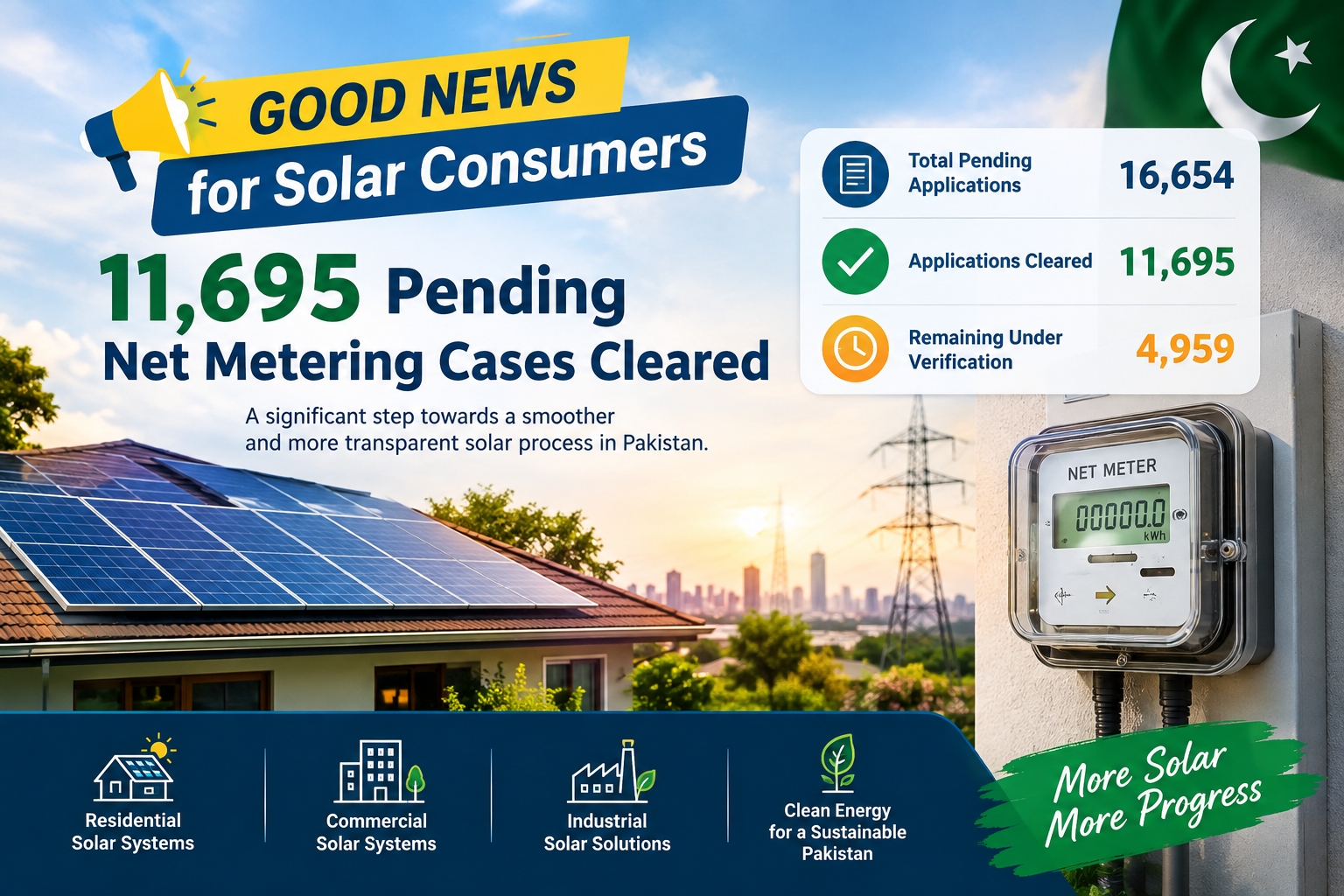
Pakistan’s solar consumers have received encouraging news as the Power Division has announced the clearance of 11,695 pending net metering applications.
For thousands of homeowners, businesses, factories, and commercial solar system owners, delayed net metering approvals had become a major source of frustration. Many consumers had already invested significant amounts in solar systems and completed the required procedures but were waiting for their applications to move forward.
The recent development represents an important step towards resolving this backlog and improving confidence in Pakistan’s solar energy sector.
According to official information, a total of 16,654 net metering applications were pending during the transition from the previous net metering framework towards the net billing system. After a verification and validation process, authorities cleared 11,695 applications that were found compliant with the applicable rules and regulations.
For Pakistan’s rapidly growing solar market, this is undoubtedly positive news.
What Happened to the Pending Net Metering Applications?
The Power Division initiated a process to review thousands of pending applications following directives to address the backlog.
The situation emerged during a period of transition in Pakistan’s solar electricity policies. Thousands of consumers had applications pending at different stages of the net metering process.
According to the latest update:
| Status | Number of Applications |
|---|---|
| Total pending applications | 16,654 |
| Applications cleared | 11,695 |
| Remaining applications under verification | 4,959 |
The cleared applications were verified and found to meet the relevant requirements and regulations. The remaining applications are still going through a verification and validation process.
This means that a significant portion of the backlog has now been addressed, providing hope to consumers who had been waiting for clarity regarding their solar connections.
Why Is This Good News for Solar Consumers?
The clearance of 11,695 pending applications is important for several reasons.
Pakistan has experienced rapid growth in rooftop solar installations over the last few years. Rising electricity prices, frequent increases in energy costs, and improved availability of solar equipment have encouraged households and businesses to install solar systems.
However, installing solar panels alone is not enough for consumers who want to export surplus electricity to the national grid.
For eligible consumers, the approval and connection process is an important part of making full use of their solar investment.
When applications remain pending for long periods, consumers can face several problems:
- Delays in receiving approval for grid-connected solar systems.
- Difficulty planning electricity consumption and savings.
- Uncertainty regarding their investment.
- Delayed benefits from exporting surplus electricity.
- Increased dependence on installers or intermediaries for updates.
By clearing a large number of pending cases, the government has taken a positive step towards reducing these problems.
Direct Communication With Solar Consumers Has Started
One of the most important parts of the new development is the decision to communicate directly with affected consumers.
The Pakistan Inform ation Technology Company (PITC) has reportedly started contacting consumers regarding their application status and the next steps in the process.
Communication is being provided through channels such as:
- SMS
- Other digital communication methods
Consumers can also check their application status through the designated PITC verification portal.
This direct communication system can help reduce confusion and improve transparency.
Important Warning: Consumers Should Not Pay Agents for Faster Processing
The authorities have specifically advised consumers that they do not need to pay any individual or agent to speed up or process their net metering applications.
This is an important message for solar consumers.
In Pakistan, many consumers depend heavily on installers, agents, consultants, or third parties to complete documentation and follow up on applications. While professional solar companies can assist customers with technical documentation and installation requirements, consumers should be careful about anyone demanding additional unofficial payments for approval.
According to the Power Division’s announcement, the purpose of direct communication is to protect consumers from unnecessary intermediaries and possible exploitation.
Consumers should always verify information through official channels.
Understanding Net Metering in Simple Words
Net metering is a system that allows eligible solar consumers to connect their solar power system with the electricity grid.
During the daytime, solar panels generate electricity.
The consumer uses this electricity to operate appliances, equipment, lights, air conditioners, machinery, or other electrical loads.
If the solar system produces more electricity than the property requires at a particular time, depending on the applicable regulations and approved arrangement, surplus electricity can be exported to the grid.
At other times, such as nighttime or periods of low solar production, the consumer may use electricity from the grid.
A bi-directional meter records the electricity flowing in both directions.
This system has played a major role in encouraging rooftop solar adoption in Pakistan.
Why Did So Many Net Metering Applications Become Pending?
The large number of pending applications was connected with the transition in the country’s solar electricity framework and the need for verification of applications.
The Power Division had earlier instructed distribution companies and PITC to address pending cases, particularly where consumers had completed required formalities and fulfilled relevant conditions before the applicable cut-off date.
Each application requires verification against relevant records, regulations, technical requirements, and other documentation.
Some common stages in a solar grid connection process can include:
- Installation of the solar system.
- Submission of the application.
- Technical documentation.
- Demand notice and applicable payments.
- Inspection and verification.
- Licensing or regulatory requirements.
- Meter replacement or reprogramming where applicable.
- Final connection and system activation.
Any delay at one or more stages can result in an application remaining pending.
The recent clearance effort is therefore significant because it addresses a large accumulated backlog.
What About the Remaining 4,959 Applications?
While the clearance of 11,695 applications is positive news, the process is not yet completely finished.
According to the reported figures, 4,959 applications remain under verification.
Authorities are reviewing these applications against:
- Official records.
- Applicable rules.
- NEPRA clarifications.
- Technical requirements.
- Relevant guidelines.
The purpose is to ensure that genuine and eligible consumers receive their rights while applications that do not meet the required conditions are properly reviewed.
For consumers whose applications are still pending, patience and regular monitoring through official communication channels remain important.
A Positive Signal for Pakistan’s Solar Industry
Pakistan’s solar industry has grown rapidly in recent years.
Solar energy is becoming an increasingly important solution for:
- Residential homes.
- Shops.
- Offices.
- Schools.
- Hospitals.
- Factories.
- Agricultural operations.
- Commercial buildings.
The country has strong solar potential due to its geographical location and high levels of sunshine.
However, the long-term success of the solar industry depends not only on solar panels and equipment. It also depends on clear policies, efficient procedures, consumer protection, and reliable communication between consumers and government institutions.
The clearance of thousands of pending applications sends a positive signal to the market.
It shows that the backlog is being addressed and that authorities recognize the importance of resolving legitimate consumer concerns.
Why This Matters for Homeowners
For a homeowner who has invested in a solar system, delays in net metering can create financial uncertainty.
Imagine a family in Lahore that installs a 10 kW solar system.
During the daytime, the system may generate more electricity than the household consumes at certain hours. Without completing the relevant grid connection process, the consumer may not be able to receive the full intended benefit of surplus electricity under the applicable approved framework.
A delayed application can therefore affect:
- Financial planning.
- Expected electricity savings.
- Return on investment calculations.
- Overall confidence in the solar system.
The clearance of pending cases can help such consumers move forward.
Why This Matters for Businesses and Industries
The development is equally important for commercial and industrial consumers.
Businesses often install larger solar systems because their daytime electricity consumption is high.
For example:
- Factories operate machinery.
- Offices use air conditioning.
- Shopping centres have lighting and cooling loads.
- Schools and hospitals consume electricity throughout the day.
Solar power can reduce dependence on expensive grid electricity during daylight hours.
However, businesses require predictable regulatory and approval processes before making large investments.
Reducing delays in solar connection approvals can therefore improve confidence among commercial investors.
The Importance of Transparency in Net Metering Applications
Transparency is one of the biggest challenges in many government and utility-related processes.
Consumers often complain that they do not know:
- Where their application is.
- Which department is handling it.
- What document is missing.
- How long the process will take.
- Whether additional action is required.
Direct communication through SMS, WhatsApp, and digital channels can potentially improve this situation.
A consumer who receives direct updates is less dependent on:
- Agents.
- Middlemen.
- Unofficial contacts.
- Misleading information.
This can make the system more consumer-friendly.
What Should Solar Consumers Do Now?
If you previously applied for net metering and your case was pending, you should take the following steps.
1. Check Your Messages
Review your:
- SMS messages.
- WhatsApp messages.
- Registered mobile number.
Authorities may contact consumers directly regarding the status of their applications.
2. Use the Official Verification Portal
Consumers can check the status of their applications through the PITC verification system mentioned by the authorities.
Be careful to use official platforms and avoid sharing personal information with unverified individuals.
3. Keep Your Documents Available
You may need documents related to your solar system and application.
These could include:
- Electricity bill information.
- Consumer reference number.
- Application documents.
- Demand notice details.
- Proof of payment.
- Solar installation documentation.
Keep copies of important documents safely stored.
4. Do Not Pay Unofficial Agents
Consumers should be cautious if someone claims they can speed up approval in exchange for money.
The Power Division has clearly advised that no payment is required to any individual for expediting or further processing eligible applications.
5. Stay in Contact With Your Solar Installer
A professional solar company can still help consumers understand the technical side of their solar installation.
Your installer can assist with matters such as:
- System documentation.
- Inverter specifications.
- Solar capacity details.
- Electrical diagrams.
- Installation certificates.
- Technical requirements.
However, consumers should always verify regulatory information through official channels.
Net Metering vs Net Billing: Why Consumers Are Concerned
The transition from net metering towards a net billing framework has created concern among many solar consumers in Pakistan.
Consumers naturally want clarity regarding:
- Exported electricity.
- Electricity credits.
- Billing calculations.
- Solar system returns.
- Future investments.
Any policy change in the energy sector can affect consumer decisions.
This is why resolving pending applications became particularly important.
Consumers who had already invested in solar systems wanted their applications processed fairly according to the applicable rules and regulatory requirements.
The recent clearance of 11,695 applications provides some reassurance that legitimate pending cases are being actively addressed.
Pakistan’s Solar Future Remains Strong
Despite policy discussions and regulatory changes, solar energy continues to have significant potential in Pakistan.
Several factors are driving solar adoption:
Rising Electricity Costs
High electricity bills continue to encourage consumers to explore alternative energy solutions.
Abundant Sunshine
Pakistan receives significant sunlight throughout much of the year, making solar energy technically suitable for many locations.
Falling Solar Equipment Costs
Solar technology has become more accessible compared with previous years.
Improved Technology
Modern solar panels, hybrid inverters, lithium batteries, and monitoring systems have improved the efficiency and usability of solar systems.
Energy Independence
Consumers want greater control over their electricity consumption and energy costs.
What Does This Development Mean for New Solar Buyers?
For people planning to install a solar system, this news should be viewed positively but realistically.
The clearance of pending cases demonstrates that authorities are working to resolve the backlog.
However, new solar buyers should still carefully understand the latest applicable regulations before investing.
Before installing a solar system, ask your solar company:
- Which system size is suitable for my electricity consumption?
- Is my roof suitable for solar panels?
- Which inverter should I select?
- Which solar panel technology is appropriate?
- What documentation will be required?
- What are the current grid connection requirements?
- What regulations currently apply to my case?
- How will future policy changes affect my system?
A professional solar company should provide clear answers instead of making unrealistic promises.
Common Mistakes Solar Consumers Should Avoid
Choosing a System Only Based on Price
The cheapest system is not always the best system.
Consumers should consider:
- Solar panel quality.
- Inverter reliability.
- Installation quality.
- Warranty.
- After-sales support.
Ignoring Documentation
Proper documentation is extremely important.
Keep records of all:
- Applications.
- Payments.
- Approvals.
- Technical documents.
- Communication.
Believing Unofficial Information
Solar policy discussions often create confusion on social media.
Always verify important information through:
- NEPRA.
- Power Division.
- Your relevant DISCO.
- Official government announcements.
Paying Unofficial Agents
Consumers should remain cautious about anyone demanding additional money to accelerate the application process.
Oversizing or Undersizing the Solar System
A solar system should be designed according to actual electricity consumption and future requirements.
Installing an incorrectly sized system can affect financial performance.
What This Means for Lahore Solar Consumers
Lahore is one of Pakistan’s largest and fastest-growing solar markets.
Thousands of homeowners and businesses in areas such as:
- DHA Lahore.
- Bahria Town.
- WAPDA Town.
- Johar Town.
- Model Town.
- Gulberg.
- Valencia.
- Cantt.
- Raiwind Road.
are increasingly installing residential and commercial solar systems.
For Lahore consumers, improvements in the approval and application process are important because the city has a large number of grid-connected solar installations.
As solar adoption continues to grow, consumers need professional guidance regarding:
- Solar system design.
- Panel selection.
- Inverter selection.
- Battery storage.
- Electrical protection.
- Grid requirements.
- Documentation.
The Role of Professional Solar Companies
A professional solar company should not simply sell solar panels.
A complete solar solution requires proper planning.
The process should ideally include:
Energy Assessment
Understanding the customer’s electricity consumption.
Site Survey
Checking roof space, shading, structure, and orientation.
System Design
Selecting the appropriate number of solar panels and inverter capacity.
Quality Equipment
Using reliable panels, inverters, cables, breakers, and mounting structures.
Professional Installation
Ensuring electrical and structural safety.
Documentation Support
Helping customers understand the required technical paperwork.
After-Sales Service
Providing maintenance and technical support.
Frequently Asked Questions
1. How many pending net metering cases have been cleared?
The Power Division has announced that 11,695 pending applications have been cleared after verification and validation.
2. How many applications were originally pending?
A total of 16,654 applications were reported as pending during the transition period.
3. How many applications are still under review?
According to the latest reported figures, 4,959 applications remain under verification.
4. How will consumers receive updates?
PITC is contacting consumers through SMS, WhatsApp, and other digital communication channels.
5. Do consumers need to pay an agent for faster processing?
No. Authorities have advised consumers that no payment should be made to individuals for expediting or further processing applications.
6. Can I check my application status online?
Yes. The authorities have provided an online verification mechanism through PITC for checking application status.
7. Is solar energy still a good investment in Pakistan?
The answer depends on electricity consumption, system size, equipment quality, available sunlight, financing, and current regulations. Consumers should conduct a proper assessment before investing.
8. What should I do if my net metering application is still pending?
Keep monitoring official communications, check your application status through official channels, and ensure that your documentation is complete.