
Solar energy has become one of the fastest-growing sources of renewable energy worldwide. Rising electricity prices, environmental concerns, and improvements in solar technology have encouraged homeowners, businesses, industries, and governments to invest in solar power.
Pakistan has also experienced rapid growth in solar installations. From small residential rooftop systems to large commercial and industrial projects, more consumers are turning towards solar energy to reduce their dependence on conventional electricity.
However, despite its many advantages, solar energy is not completely free from challenges.
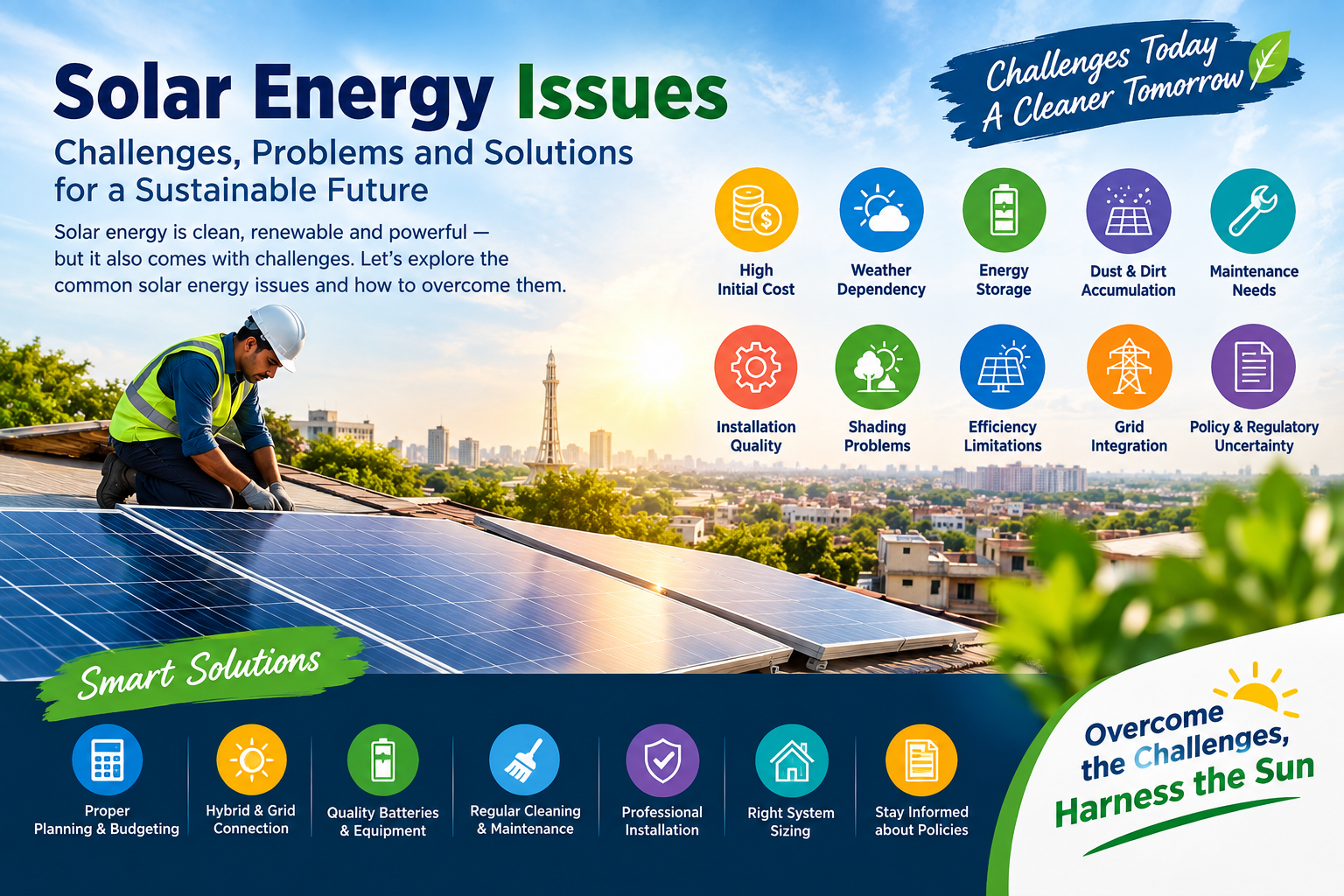
Like every energy source, solar power has technical, financial, environmental, operational, and regulatory issues. Understanding these solar energy issues is important before investing in a solar system.
This article explains the major problems associated with solar energy and discusses practical solutions that can help consumers make better decisions.
What Is Solar Energy?
Solar energy is electricity or heat produced using energy from the sun.
In modern solar power systems, photovoltaic (PV) panels capture sunlight and convert it into direct current (DC) electricity. An inverter then converts this electricity into alternating current (AC), which can be used to operate household appliances, commercial equipment, and industrial machinery.
A typical solar system may include:
- Solar panels
- Solar inverter
- Mounting structure
- DC cables
- AC cables
- Circuit breakers
- Protection devices
- Net meter or bi-directional meter
- Batteries in hybrid or off-grid systems
Although the technology is relatively simple from the user’s perspective, proper system design is essential for reliable performance.
Major Solar Energy Issues
Solar energy offers significant benefits, but consumers should understand its limitations.
The following are some of the most common solar energy issues.
1. High Initial Investment Cost
One of the biggest challenges for many consumers is the initial cost of installing a solar system.
A quality solar installation requires investment in:
- Solar panels
- Inverters
- Batteries, if required
- Mounting structures
- Electrical protection equipment
- Wiring
- Installation labour
For a household or small business, the initial investment can appear expensive compared with simply continuing to pay monthly electricity bills.
Although solar systems can reduce long-term electricity expenses, consumers must arrange the investment before receiving those benefits.
Solution
Consumers should carefully calculate:
- Current electricity consumption
- Monthly electricity bill
- Required solar capacity
- Expected energy generation
- Available budget
Installing an unnecessarily large system can increase the investment without providing proportional benefits.
A properly designed solar system is usually more financially sensible than simply purchasing the largest possible system.
2. Solar Energy Depends on Sunlight
Solar panels generate electricity when sunlight is available.
This means production changes throughout the day.
Solar generation is generally highest around midday when sunlight intensity is strong.
Production decreases during:
- Early morning
- Evening
- Cloudy weather
- Rain
- Heavy dust conditions
Solar panels do not generate electricity at night.
This is one of the fundamental limitations of solar energy.
Solution
This problem can be managed through:
- Battery storage
- Hybrid solar systems
- Grid connection
- Proper load management
For example, a hybrid system can use solar energy during the day and batteries or grid electricity when solar production is low.
3. Energy Storage Challenges
Battery storage remains one of the major issues in solar energy.
Solar panels may produce excess electricity during the daytime, but consumers often need electricity during the evening and nighttime.
Without batteries or a grid connection, unused daytime energy may not be available later.
Traditional battery systems also have limitations, including:
- Limited lifespan
- High replacement cost
- Maintenance requirements
- Capacity limitations
Lithium batteries have improved the situation, but they still increase the total cost of a solar system.
Solution
Consumers should select battery capacity based on actual requirements.
Not every solar system requires batteries.
For example:
| Consumer Type | Recommended System |
|---|---|
| Daytime business | On-grid or hybrid |
| Home with frequent load shedding | Hybrid with battery |
| Remote location | Off-grid system |
| Factory with daytime operations | Commercial solar system |
| Home requiring backup | Hybrid solar with lithium battery |
Proper system design can reduce unnecessary battery costs.
4. Weather Conditions Affect Performance
Weather has a direct impact on solar energy production.
Although solar panels can generate electricity on cloudy days, production is generally lower compared with clear sunny conditions.
Several environmental conditions can affect solar panel performance.
These include:
- Clouds
- Rain
- Dust
- Pollution
- Fog
- Extreme temperatures
- Shading
Pakistan experiences different weather conditions throughout the year.
Cities such as Lahore can experience:
- Heavy summer heat
- Monsoon rain
- Winter fog
- Air pollution and smog
These conditions can temporarily affect solar energy production.
Solution
Consumers should consider local weather conditions during system design.
Regular cleaning and maintenance can also help maintain system performance.
5. Dust and Dirt on Solar Panels
Dust accumulation is a common problem in Pakistan.
Solar panels installed on rooftops are exposed to:
- Dust
- Pollution
- Bird droppings
- Leaves
- Construction debris
A heavily soiled solar panel receives less sunlight.
This can reduce electricity generation.
The problem is particularly important in urban areas with high levels of dust and pollution.
Solution
Solar panels should be inspected regularly.
Cleaning frequency depends on the location and environmental conditions.
Consumers should avoid damaging panels during cleaning.
Important precautions include:
- Do not use harsh chemicals.
- Avoid scratching the glass.
- Follow manufacturer recommendations.
- Use safe cleaning methods.
- Do not walk directly on solar panels.
Professional maintenance services can be useful for large commercial systems.
6. Incorrect Solar System Sizing
One of the most common solar energy problems is incorrect system sizing.
Some consumers purchase systems based only on:
- Their budget
- A neighbour’s system
- Marketing claims
- Monthly electricity bill
However, every property has different energy requirements.
A poorly sized system can create problems.
An Undersized System
An undersized system may not generate enough electricity to meet the consumer’s requirements.
An Oversized System
An oversized system may increase the initial investment unnecessarily.
Solution
A professional solar company should conduct an energy assessment.
The assessment should consider:
- Monthly electricity units
- Peak electricity usage
- Daytime consumption
- Future electricity needs
- Available roof space
- Shading conditions
This helps determine the appropriate system capacity.
7. Poor Quality Installation
Solar equipment quality is important, but installation quality is equally important.
Even expensive solar panels and inverters can experience problems if the installation is poor.
Common installation mistakes include:
- Incorrect wiring
- Loose connections
- Poor cable management
- Incorrect inverter settings
- Weak mounting structures
- Insufficient electrical protection
- Improper earthing
These problems can affect both performance and safety.
Solution
Consumers should work with experienced solar installation companies.
A professional installation should include:
- Proper electrical design
- DC and AC protection
- Earthing
- Quality cables
- Suitable breakers
- Secure mounting structures
- System testing
Solar installation should never be treated as simply placing panels on a roof.
8. Shading Problems
Solar panels require direct sunlight for maximum performance.
Shading can come from:
- Trees
- Nearby buildings
- Water tanks
- Chimneys
- Communication towers
- Other structures
Even partial shading can affect the performance of some solar panel configurations.
Solution
A site survey should be completed before installation.
The installer should identify possible shading throughout the day.
Panel placement should be planned carefully.
In some cases, modern technologies such as optimizers or microinverters may help manage certain shading situations.
However, preventing unnecessary shading is generally better than trying to correct the problem later.
9. Solar Panel Efficiency Limitations
Many consumers misunderstand solar panel efficiency.
A higher-efficiency panel does not mean it produces electricity continuously or works independently of sunlight.
Efficiency refers to how effectively a solar panel converts sunlight into electricity.
Factors affecting performance include:
- Panel technology
- Temperature
- Sunlight intensity
- Installation angle
- Shading
- Dirt
Solution
Consumers should select solar panels based on overall system requirements rather than efficiency numbers alone.
Other important factors include:
- Manufacturer reputation
- Product warranty
- Performance warranty
- Technology type
- Local availability
- Compatibility with the inverter
10. High Temperature Can Reduce Solar Performance
Pakistan experiences extremely high temperatures during summer.
Although solar panels require sunlight, very high temperatures can reduce electrical efficiency.
This creates a common misunderstanding.
A hotter day does not always mean proportionally higher solar electricity production.
Solar panels generally perform best under suitable operating conditions.
Solution
Proper installation can help reduce excessive heat buildup.
Installers should ensure:
- Adequate airflow beneath panels
- Proper mounting structure
- Suitable panel spacing
Good system design can help maintain performance.
11. Grid Integration Issues
Grid-connected solar systems require coordination with the electricity distribution network.
Consumers may experience challenges related to:
- Approval procedures
- Documentation
- Meter installation
- Technical inspections
- Regulatory requirements
Delays in these processes can affect consumers who have already installed solar systems.
In Pakistan, changes in net metering and net billing policies have also created uncertainty among some solar consumers.
Solution
Consumers should understand current regulations before making investment decisions.
They should also:
- Use official information sources.
- Maintain proper documentation.
- Work with professional installers.
- Follow DISCO requirements.
- Avoid relying on rumours or unofficial information.
Solar policies can change, so consumers should always check the latest applicable rules.
12. Regulatory and Policy Uncertainty
Government policies have a major impact on the solar industry.
Changes in:
- Net metering rules
- Electricity tariffs
- Import duties
- Tax policies
- Solar regulations
can influence consumer decisions.
Policy uncertainty may cause consumers to delay investments.
Solution
Pakistan needs long-term and transparent renewable energy policies.
Clear regulations can encourage:
- Residential solar investment
- Commercial solar projects
- Industrial solar systems
- Foreign investment
- Local manufacturing
For consumers, it is important to make decisions based on current official regulations rather than assumptions about future policies.
13. Lack of Consumer Awareness
Many people still have limited understanding of solar technology.
Common misconceptions include:
Myth: Solar panels provide electricity at night.
Solar panels require sunlight to generate electricity.
Myth: Every solar system requires batteries.
Grid-connected systems may operate without batteries.
Myth: Bigger solar systems are always better.
System size should match actual energy requirements.
Myth: Solar panels never require maintenance.
Solar systems require periodic inspection and cleaning.
Solution
Consumers should educate themselves before purchasing a solar system.
A good solar company should explain:
- System type
- Equipment specifications
- Expected production
- Limitations
- Maintenance requirements
Transparency is important.
14. Quality Problems in the Solar Market
The rapid growth of Pakistan’s solar market has created another challenge: equipment quality differences.
The market contains products with varying:
- Quality
- Warranty
- Technology
- Performance
- Reliability
Consumers may find it difficult to differentiate between genuine and poor-quality products.
Solution
Before purchasing solar equipment, consumers should check:
- Manufacturer information
- Product specifications
- Warranty conditions
- Serial numbers
- Supplier reputation
- Local after-sales support
Buying only based on the lowest price can sometimes create long-term problems.
15. Maintenance and After-Sales Service Issues
A solar system may operate for many years, but it still requires periodic monitoring.
Potential issues include:
- Loose electrical connections
- Inverter faults
- Reduced battery capacity
- Communication failures
- Dirty panels
- Damaged cables
Some consumers face problems when their installation company does not provide proper after-sales service.
Solution
Before selecting a solar company, ask about:
- Installation warranty
- Equipment warranty
- Maintenance services
- Technical support
- Response time
A reliable solar company should provide support after installation.
16. Recycling and Environmental Concerns
Solar energy is considered a clean source of electricity during operation.
However, solar equipment eventually reaches the end of its operational life.
Solar panels contain materials such as:
- Glass
- Aluminium
- Silicon
- Metals
Batteries also require responsible handling and recycling.
As solar installations increase worldwide, recycling infrastructure will become increasingly important.
Solution
Governments and manufacturers should invest in:
- Solar panel recycling
- Battery recycling
- Electronic waste management
Consumers should avoid disposing of old solar equipment irresponsibly.
Solar Energy Issues in Pakistan
Pakistan has significant potential for solar energy.
However, the country faces several unique challenges.
High Electricity Costs
Rising electricity prices have increased interest in solar power.
However, consumers often make quick investment decisions without proper technical analysis.
Policy Changes
Changes in solar regulations can create uncertainty.
Consumers need clear and stable policies.
Equipment Quality Differences
Pakistan’s market includes many brands and suppliers.
Consumers need better awareness about equipment selection.
Limited Technical Knowledge
Some installers lack sufficient technical training.
Incorrect installations can create:
- Safety risks
- Reduced production
- Equipment damage
Financial Limitations
Although solar systems can provide long-term benefits, many households cannot easily afford the initial investment.
Solar financing options could help expand access.
Practical Solutions to Solar Energy Problems
Most solar energy challenges can be managed through proper planning.
Here are some important solutions.
Conduct a Professional Site Survey
A site survey should evaluate:
- Roof condition
- Available space
- Shading
- Panel orientation
- Electrical infrastructure
Choose the Right System Type
Consumers should select between:
- On-grid solar
- Hybrid solar
- Off-grid solar
based on their actual requirements.
Use Quality Equipment
A reliable system should include quality:
- Solar panels
- Inverters
- Cables
- Breakers
- Protection devices
- Mounting structures
Install Proper Safety Protection
Solar systems should include appropriate electrical safety measures.
These may include:
- Circuit breakers
- Surge protection
- Earthing
- DC isolators
Requirements depend on system design and applicable standards.
Monitor System Performance
Modern inverters provide mobile applications and monitoring platforms.
Consumers can track:
- Daily generation
- Monthly production
- Energy consumption
- System faults
Monitoring helps identify problems early.
Advantages and Issues of Solar Energy
| Advantages | Issues |
|---|---|
| Reduces dependence on grid electricity | Initial investment required |
| Renewable energy source | Depends on sunlight |
| Low operating cost | Energy storage can be expensive |
| Environmentally friendly during operation | Weather affects production |
| Suitable for residential and commercial use | Requires proper installation |
| Long equipment lifespan | Policy and grid challenges |
| Reduces daytime electricity consumption | Maintenance is still required |
Is Solar Energy Still Worth It?
Despite its challenges, solar energy remains an important solution for electricity consumers.
However, solar should not be considered a magic solution.
The financial and technical benefits depend on several factors:
- Electricity consumption
- Daytime usage
- System size
- Equipment quality
- Installation quality
- Available sunlight
- Local regulations
- Maintenance
A properly designed system can provide significant benefits over its operational life.
However, unrealistic promises should be avoided.
No professional solar company should guarantee a fixed electricity saving without first analysing the customer’s energy consumption and site conditions.
The Future of Solar Energy
Solar technology continues to improve.
Future developments may include:
- Higher efficiency solar panels
- Improved lithium batteries
- Better energy storage
- Smart energy management
- Artificial intelligence-based monitoring
- Advanced grid integration
- Improved recycling technologies
As battery prices and technology continue to develop, solar energy may become even more practical for consumers who require nighttime backup.
Pakistan has significant opportunities to expand its solar sector.
However, sustainable growth will require:
- Clear government policies
- Better consumer awareness
- Technical training
- Quality standards
- Improved grid infrastructure
- Responsible recycling
Frequently Asked Questions About Solar Energy Issues
What is the biggest problem with solar energy?
One of the biggest challenges is that solar electricity production depends on sunlight. Energy storage or grid connectivity is often required to provide electricity when sunlight is unavailable.
Does solar energy work during cloudy weather?
Yes, solar panels can generate electricity during cloudy weather, but production is generally lower than during clear and sunny conditions.
Do solar panels work at night?
No. Solar photovoltaic panels require sunlight to generate electricity. At night, consumers need battery storage or electricity from another source.
What are the main solar energy issues in Pakistan?
Major issues include initial investment costs, policy uncertainty, grid integration, equipment quality differences, technical installation problems, dust, and consumer awareness.
Do solar panels require maintenance?
Yes. Solar systems require periodic cleaning, inspection, and performance monitoring.
Does hot weather improve solar panel production?
Not necessarily. Strong sunlight increases energy generation, but extremely high temperatures can reduce solar panel efficiency.
Are batteries necessary for every solar system?
No. Grid-connected solar systems can operate without batteries. Batteries are mainly useful for backup power and energy storage.
How can I avoid problems with my solar system?
Choose quality equipment, work with experienced installers, properly size the system, install safety protection, and regularly monitor performance.