

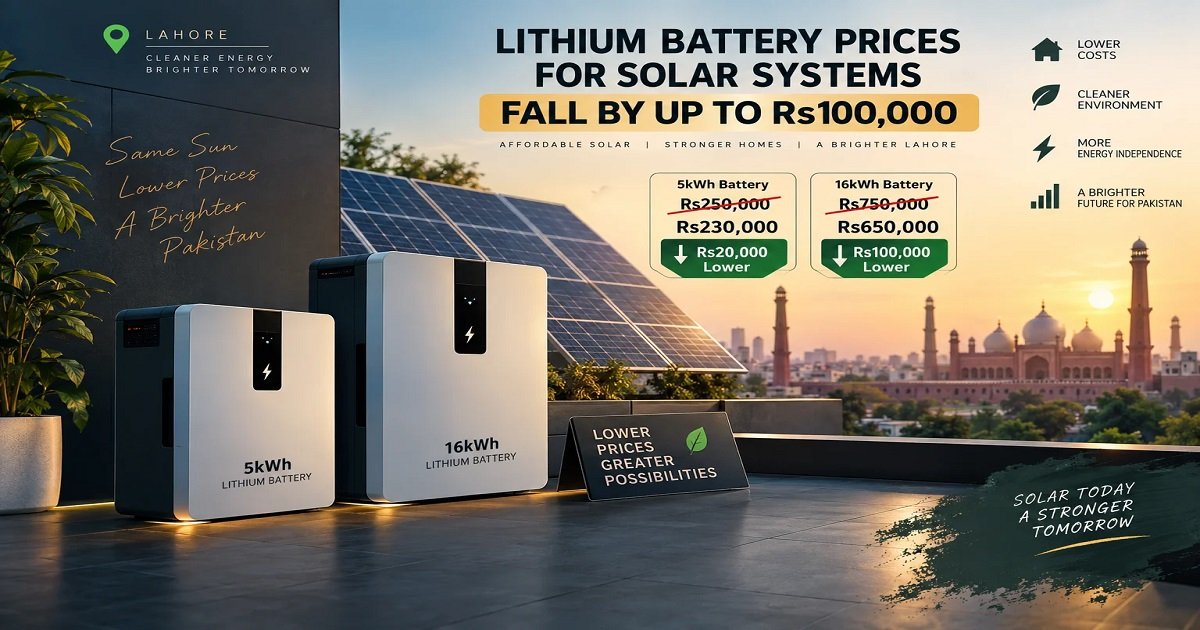
Installing a solar system with battery backup has become more affordable for consumers in Lahore as lithium battery prices have fallen significantly in the local market.
Recent market reports indicate that prices of lithium batteries used with residential and commercial solar systems have fallen by approximately Rs20,000 to Rs100,000, depending on battery capacity and specifications.
One of the most commonly discussed smaller battery sizes has reportedly fallen from around Rs250,000 to Rs230,000, while a larger battery previously available for roughly Rs750,000 has dropped to around Rs650,000.
That means some buyers could potentially save as much as Rs100,000 on the battery alone compared with earlier market prices.
For Lahore households that have been considering a hybrid or off-grid solar system, this is an important development because battery storage is usually one of the more expensive parts of a complete solar setup.
However, lower prices do not automatically mean every battery is a good deal. Capacity, battery chemistry, warranty, Battery Management System, inverter compatibility and after-sales support remain extremely important.
Let’s look at what has changed and what solar buyers in Lahore should know before spending their money.
Latest Lithium Battery Price Changes in Pakistan
According to market reports published in September 2026, lithium battery prices have recorded significant reductions.
| Battery Category Reported | Earlier Price | New Reported Price | Approximate Saving |
|---|---|---|---|
| Smaller 5-class lithium battery | Rs250,000 | Rs230,000 | Rs20,000 |
| Larger 16-class lithium battery | Rs750,000 | Rs650,000 | Rs100,000 |
These prices have been reported by market sources and should be treated as market indicators rather than fixed retail prices. Actual quotations can vary according to brand, capacity, warranty, battery chemistry, dealer and installation requirements.
An important technical point is also worth understanding.
Some local market reports describe batteries as “5kW” or “16kW.” In technical terms, battery storage capacity is normally measured in kilowatt-hours (kWh), while kilowatts (kW) usually describe power.
For example, many residential lithium batteries are sold with capacities around 5.12kWh.
When requesting a quotation, do not simply ask whether a battery is “5kW.” Ask the seller to clearly state:
- Battery capacity in kWh
- Nominal voltage
- Amp-hour rating
- Maximum charge and discharge power
- Usable battery capacity
- Battery chemistry
- Warranty period
This makes it easier to compare two batteries fairly.
Why Are Lithium Battery Prices Falling?
There is rarely one single reason behind a major change in solar equipment prices.
Several factors can influence Pakistan’s lithium battery market at the same time.
1. Greater Competition in the Solar Market
Pakistan’s solar sector has expanded rapidly, bringing more manufacturers, importers, distributors and installers into the market.
When several suppliers compete for the same customers, businesses have a stronger reason to offer competitive prices.
For consumers, this can result in better pricing and a wider variety of battery options.
2. Increased Availability of Lithium Batteries
Solar batteries are no longer a specialised product available from only a small number of suppliers.
Lahore now has a large solar equipment market offering batteries for residential, commercial, hybrid and off-grid installations.
When supply becomes more readily available, buyers have more choices and sellers face greater pressure to remain competitive.
Earlier in 2026, market reports also pointed to adequate inventories and continued imports as factors contributing to reductions in solar equipment prices.
3. Falling Solar Equipment Costs
The decline is not limited to batteries.
Pakistan’s solar market has experienced periods of lower prices for panels, batteries and other equipment during 2026.
In June, for example, reports indicated reductions in lithium battery and inverter prices alongside lower solar panel rates.
Cheaper components can reduce the overall investment required to build a complete solar system.
4. Growing Interest in Energy Storage
More households are considering systems that allow them to use solar electricity after sunset rather than relying completely on electricity exported to the grid.
Pakistan’s regulatory framework for solar prosumers also changed during 2026. NEPRA lists the Prosumer Regulations 2026 and subsequent amendments among its current regulations. Existing agreements received separate protections through later amendments, while the framework for new solar consumers changed.
These changes have made self-consumption and battery storage an increasingly important consideration when designing a solar system.
Why Lower Battery Prices Matter for Lahore
For many Lahore households, purchasing solar panels is only part of the challenge.
Solar panels produce electricity when sunlight is available. A battery allows some of that electricity to be stored and used later.
That becomes useful during:
- Evening hours
- Night-time
- Power outages
- Grid interruptions
- Peak household usage
- Periods when solar production falls
Previously, adding sufficient lithium storage could dramatically increase the cost of a solar installation.
A Rs100,000 reduction on a larger battery can therefore make a meaningful difference to the total project budget.
For example, someone who had allocated Rs750,000 for a larger battery may now see market quotations closer to Rs650,000 for some products in the reported category.
That Rs100,000 could instead be used for better electrical protection, higher-quality installation work, additional panels or simply kept as savings.
Are Lithium Batteries Better Than Traditional Lead-Acid Batteries?
Both technologies can provide backup electricity, but they operate differently.
Lithium batteries, particularly LiFePO4 or lithium iron phosphate batteries, have become increasingly common in modern solar installations.
Lithium Batteries
Lithium batteries generally offer:
Higher usable capacity: A greater portion of the battery’s stored energy can normally be used.
Longer cycle life: Good-quality lithium batteries can be designed for thousands of charge and discharge cycles.
Faster charging: Lithium batteries can usually accept higher charging currents than traditional lead-acid batteries.
Lower maintenance: They do not require routine water topping like some flooded lead-acid batteries.
Smaller physical size: Lithium batteries generally provide more energy storage in a smaller and lighter package.
Integrated management: Modern solar lithium batteries normally use a Battery Management System, commonly called a BMS.
Lead-Acid and Tubular Batteries
Traditional batteries still have one major attraction: their initial purchase price can be lower.
For households requiring occasional backup rather than daily deep cycling, they may still be considered.
However, comparing batteries only by purchase price can be misleading.
Consumers should consider the total usable energy, expected service life, warranty and replacement cost.
A cheaper battery that needs to be replaced more frequently may eventually cost more.
What Is a Battery Management System?
A Battery Management System, or BMS, is one of the most important parts of a lithium battery.
It monitors and controls battery operation.
Depending on the product, the BMS can help protect against problems such as:
- Excessive charging
- Excessive discharge
- High current
- Abnormal temperature
- Cell voltage imbalance
- Short circuits
The BMS may also communicate directly with a compatible hybrid inverter.
This is why consumers should be cautious when comparing a very cheap battery with a more expensive one.
Two batteries may both claim to have a capacity of 5kWh, but their internal cells, BMS, protection systems, communication protocols and warranties may be very different.
How Much Battery Storage Does a Lahore Home Need?
There is no universal answer.
Battery size should depend on your electricity consumption and the appliances you want to operate during backup hours.
A small household wanting backup mainly for lights, fans, internet, television and basic electronics may need significantly less capacity than a home trying to operate multiple air conditioners.
Instead of asking an installer:
“Which battery should I buy?”
ask:
“How many kWh do my required appliances consume during the hours when solar power is unavailable?”
That calculation gives you a much better starting point.
For example, if your essential appliances consume approximately 1kW continuously for four hours, the theoretical energy requirement would be around:
1kW × 4 hours = 4kWh
The real battery requirement may need to be higher because of inverter losses, battery limits, reserve capacity and changes in appliance consumption.
A qualified installer should perform a proper load assessment before recommending storage capacity.
Should You Buy a Lithium Battery Now or Wait for Further Price Cuts?
Trying to predict the lowest possible market price is difficult.
Lithium battery prices in Pakistan can be influenced by:
- International cell prices
- Pakistani rupee exchange rates
- Freight charges
- Import costs
- Inventory levels
- Consumer demand
- Brand availability
- Government duties and taxes
- Dealer competition
Prices could fall further, remain stable or increase again.
Therefore, the better question is whether the current system makes financial and practical sense for your household.
If you genuinely need battery backup and the system meets your requirements at an acceptable price, waiting endlessly for another price reduction may not necessarily be worthwhile.
On the other hand, there is no reason to rush into buying a battery simply because advertisements claim prices have fallen.
Compare several quotations first.
What Lahore Buyers Should Check Before Purchasing a Lithium Battery
The battery market contains products across many price and quality levels.
Before spending several hundred thousand rupees, check the following carefully.
1. Confirm the Actual Capacity in kWh
Ask for the exact nameplate capacity.
For example:
51.2V × 100Ah = approximately 5.12kWh
Do not depend only on marketing labels.
2. Check Usable Capacity
A battery’s advertised capacity and its usable capacity may not always be identical.
Ask how much of the rated capacity can practically be discharged while remaining within warranty conditions.
3. Confirm Battery Chemistry
Ask whether the battery uses:
- LiFePO4
- NMC
- Another lithium chemistry
LiFePO4 batteries are particularly common in stationary solar energy-storage applications.
4. Check Inverter Compatibility
Not every battery communicates correctly with every inverter.
Confirm compatibility before purchasing.
Ideally, obtain written confirmation from the installer or supplier.
5. Understand the Warranty
Do not accept the words “five-year warranty” without reading the conditions.
Ask:
- Is it a replacement warranty?
- Is it repair-only?
- Is there a cycle limitation?
- Is there a capacity-retention condition?
- Who handles warranty claims in Lahore?
- Is the warranty backed by the importer or only the shop?
- What happens if the distributor disappears?
These questions matter.
6. Check the Battery’s Cycle Rating
A battery cycle generally refers to charging and discharging the battery.
However, cycle claims should be read together with their specified Depth of Discharge, temperature and operating conditions.
A claim of 6,000 cycles is much less useful if the seller cannot explain under what testing conditions that number applies.
7. Ask About After-Sales Support
A slightly cheaper battery is not necessarily better value if no technician or spare parts are available later.
For Lahore buyers, reliable local support can be extremely valuable.
8. Request a Proper Invoice
Keep:
- Original invoice
- Serial number
- Warranty card
- Installation report
- Battery specifications
- Dealer contact information
These documents can become important if a warranty claim is required.
Do Not Ignore Installation Quality
Buying an expensive lithium battery and connecting it through poor-quality wiring defeats the purpose of investing in a modern storage system.
The battery installation should include appropriately rated:
- DC cables
- Breakers
- Protection equipment
- Connectors
- Earthing
- Isolation devices
Cable size must also be suitable for the current flowing between the battery and inverter.
High-power battery systems can carry significant electrical current, so installation should be handled by a competent solar technician or electrician.
Saving a small amount on electrical protection can expose equipment worth hundreds of thousands of rupees to unnecessary risk.
Hybrid Solar Systems Could Become More Attractive
Lower battery prices are particularly relevant to hybrid solar systems.
A hybrid inverter can typically work with solar panels, batteries and grid electricity.
During daylight hours, solar energy can power household appliances while also charging the battery when sufficient generation is available.
Stored electricity can then be used later according to the inverter configuration.
For Lahore households looking for both lower electricity dependence and backup during outages, hybrid systems can offer more flexibility than a solar installation without storage.
However, adding batteries does not automatically guarantee financial savings.
Battery storage should be sized according to actual requirements rather than simply purchasing the largest battery available.
Off-Grid Solar Is Also Becoming More Accessible
Battery prices matter even more for off-grid systems because an off-grid property cannot depend on the electricity network whenever solar generation becomes insufficient.
Such systems may require substantial storage capacity.
As battery prices decline, the upfront cost of building larger storage banks can also decline.
This may particularly benefit:
- Farmhouses
- Rural properties
- Small businesses
- Remote offices
- Agricultural installations
- Locations facing unreliable electricity supply
Still, completely disconnecting from the grid is a major decision.
A properly designed off-grid system should consider winter production, cloudy weather, seasonal electricity consumption and backup generation rather than being designed only around ideal summer sunshine.
A Rs100,000 Price Drop Does Not Mean Every Battery Is Rs100,000 Cheaper
This distinction is important.
The reported decline ranges from approximately Rs20,000 to Rs100,000, depending on the battery category.
It does not mean every lithium battery in Lahore has become exactly Rs100,000 cheaper.
Smaller batteries may experience smaller reductions.
Premium brands may maintain higher prices.
Newer models may cost more than older stock.
Some sellers may also provide installation, cables, breakers, mounting equipment or extended warranties within their quoted price.
Always compare like with like.
Compare Cost Per kWh, Not Just the Total Price
One useful way to compare lithium batteries is to calculate the price per kilowatt-hour of storage.
Imagine:
Battery A:
5kWh capacity
Price: Rs230,000
Price per kWh:
Rs230,000 ÷ 5 = Rs46,000 per kWh
Now imagine:
Battery B:
10kWh capacity
Price: Rs420,000
Price per kWh:
Rs420,000 ÷ 10 = Rs42,000 per kWh
Battery B costs more overall, but its storage capacity is cheaper on a per-kWh basis.
This calculation should not be used alone because quality, warranty and cycle life matter, but it makes price comparisons more meaningful.
Watch Out for Deals That Look Too Cheap
Falling prices can benefit consumers, but they can also make it harder to distinguish genuine market reductions from poor-quality products.
Be careful if a battery is dramatically cheaper than comparable products.
Check whether it is:
- New or used
- Refurbished
- Old inventory
- Properly imported
- Covered by a genuine warranty
- Using Grade-A cells
- Compatible with your inverter
Also confirm the manufacturing date and serial number.
The cheapest purchase can become an expensive mistake if the battery fails and there is no reliable warranty support.
What Does This Mean for Pakistan’s Solar Market?
The declining cost of storage could represent an important next stage for Pakistan’s solar industry.
Affordable solar panels made rooftop generation increasingly attractive.
Affordable batteries could now make energy storage accessible to a larger group of households and businesses.
That matters because batteries change the way a solar system is used.
Instead of producing electricity only when sunlight is available, a properly designed system can store part of that energy for later consumption.
For Lahore homeowners, this can make solar installations more flexible and potentially reduce reliance on grid electricity during certain hours.
Businesses can also benefit where uninterrupted electricity is important for computers, security systems, lighting, communications and other essential equipment.
Frequently Asked Questions
1. How much have lithium battery prices fallen in Pakistan?
Recent Lahore market reports indicate reductions ranging from approximately Rs20,000 to Rs100,000, depending on battery capacity and model.
2. What is the latest price of a 5kWh lithium battery in Pakistan?
Market reports in September 2026 have cited a smaller battery category falling from around Rs250,000 to approximately Rs230,000. Actual 5kWh-class battery prices can vary significantly according to brand, chemistry, warranty and specifications, so buyers should obtain current quotations before purchasing.
3. What is the price of a larger lithium battery in Lahore?
A larger battery category described in recent Lahore market reports has fallen from roughly Rs750,000 to Rs650,000, representing a reduction of about Rs100,000.
4. Are lithium battery prices the same across Pakistan?
No. Prices can differ between Lahore, Karachi, Islamabad and other cities. Dealer margins, transportation, brand availability, stock levels and installation packages can all affect the final price.
5. Is a lithium battery better than a tubular battery for solar?
Lithium batteries generally provide higher usable capacity, faster charging, lower maintenance and longer cycle life. Tubular batteries normally have a lower initial purchase price. The better choice depends on budget, daily usage and required backup.
6. What does 5kWh mean on a lithium battery?
A 5kWh battery can theoretically store approximately five kilowatt-hours of energy. Actual usable energy may be slightly lower depending on the battery’s permitted depth of discharge and operating conditions.
7. Why do some sellers call a battery 5kW instead of 5kWh?
The terms are sometimes used loosely in the market. Kilowatts measure power, while kilowatt-hours measure stored energy. Buyers should request the battery’s exact kWh capacity, voltage and amp-hour rating before purchasing.
8. Can a 5kWh lithium battery run an air conditioner?
Potentially, but operating time depends on the air conditioner’s electricity consumption, other connected appliances, inverter efficiency and the battery’s usable capacity. A load calculation should be performed before choosing the battery.
9. How long does a lithium solar battery last?
Battery life depends on battery chemistry, cell quality, temperature, depth of discharge, charging conditions and number of cycles. Buyers should compare the manufacturer’s cycle specification and warranty rather than relying on a general lifespan estimate.
10. What is a BMS in a lithium battery?
BMS stands for Battery Management System. It monitors battery cells and helps manage charging, discharging, voltage, current, temperature and other operating conditions.
11. Can I add a lithium battery to my existing solar system?
Possibly. It depends mainly on the inverter and system design. Grid-tied inverters without battery support may require additional equipment or replacement with a compatible hybrid inverter.
12. Should I buy a lithium battery now or wait for prices to fall further?
Future prices cannot be guaranteed. Exchange rates, international battery prices, imports, taxes, stock availability and demand can change quickly. Buyers who need storage should compare several current quotations and decide according to their requirements rather than trying to predict the absolute lowest market price.
13. What should I check before buying a lithium battery in Lahore?
Check the actual kWh capacity, battery chemistry, BMS, cycle rating, warranty terms, manufacturing date, inverter compatibility, serial number, dealer reputation and local after-sales support.
14. Are cheaper lithium batteries safe to buy?
A lower price does not automatically indicate poor quality, particularly during a market-wide price decline. However, unusually cheap batteries should be checked carefully for cell quality, warranty authenticity, specifications and whether the unit is new or refurbished.
15. Will lower battery prices reduce the total cost of solar installations?
Yes, particularly for hybrid and off-grid systems where battery storage represents a significant portion of the overall investment. The exact saving depends on the number and capacity of batteries required.
16. Are lithium batteries suitable for Lahore’s weather?
Lithium solar batteries can operate effectively when installed according to manufacturer requirements, but excessive heat can affect battery performance and lifespan. Batteries should therefore be installed in an appropriate, ventilated location away from direct sunlight and extreme temperatures.
17. Which lithium battery size is best for a house in Lahore?
There is no single ideal size. A small house with basic backup requirements may need much less storage than a large house operating air conditioners and heavy appliances. Battery sizing should be based on actual energy consumption in kWh.
18. Is battery storage becoming more important for solar users in Pakistan?
Battery storage is receiving greater attention as consumers look to increase self-consumption and reduce dependence on grid electricity. Changes to Pakistan’s prosumer regulations during 2026 have also increased interest in how stored solar energy can be used within the home rather than relying entirely on exported electricity.