

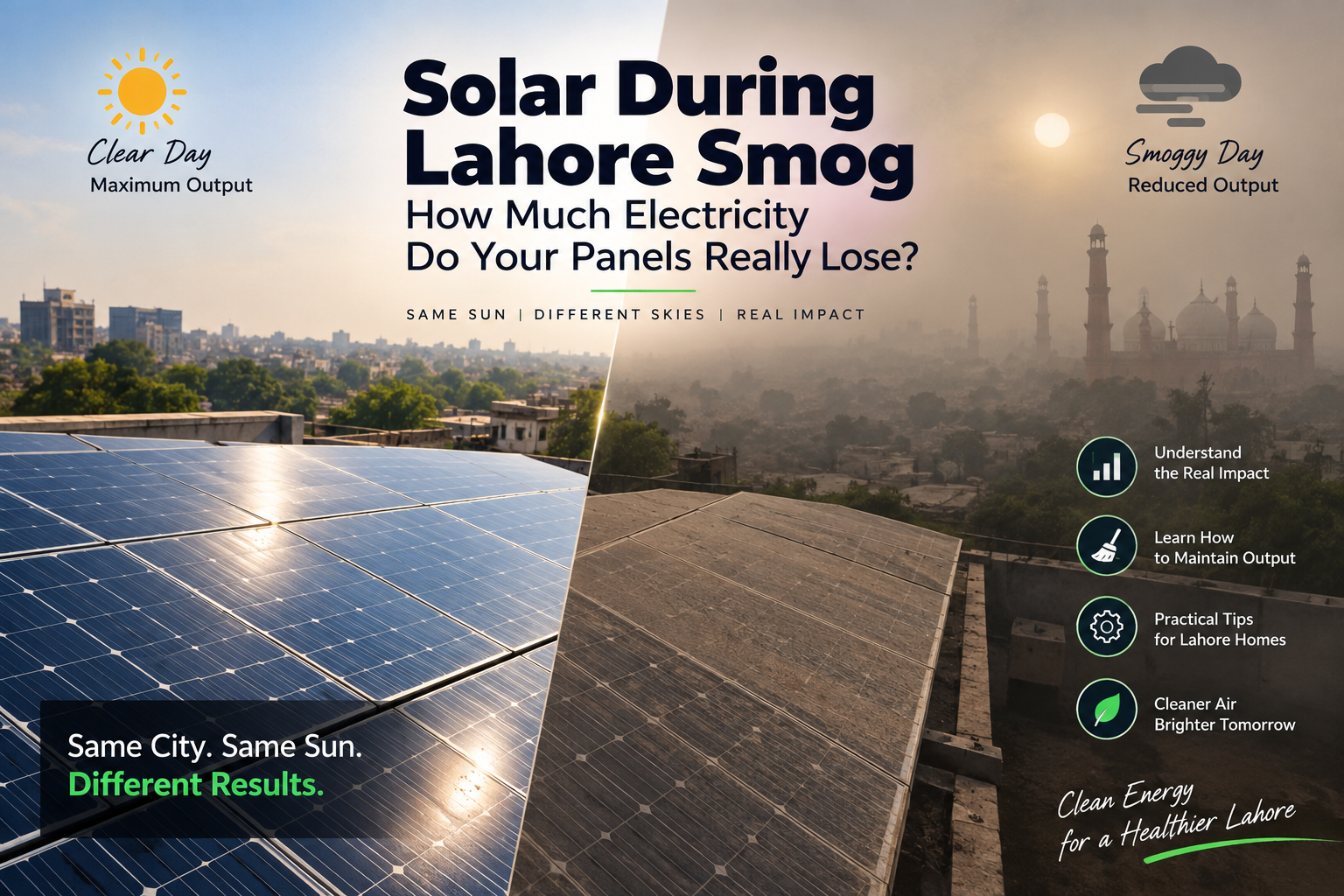
Lahore Has Plenty of Solar Panels, But What Happens When the Sun Disappears Behind Smog?
Solar panels have become a common sight on rooftops across Lahore.
From 5-marla homes to large commercial buildings, more people are producing their own electricity to reduce dependence on grid power and control rising electricity costs.
But Lahore has another reality that appears every year: smog.
During autumn and winter, the city’s blue sky can turn grey. Visibility drops, sunlight feels weaker and a layer of dust can quickly appear on cars, windows, rooftops and solar panels.
That raises an important question for anyone who has invested in solar:
How much electricity are your solar panels actually losing because of Lahore’s smog?
The answer is more complicated than saying smog reduces solar production by a fixed 10%, 20% or 30%.
Smog can affect a solar system in two different ways. Pollution suspended in the atmosphere can reduce the sunlight reaching the panels, while dust, soot and other particles can settle directly on the panel glass and block additional sunlight.
In Lahore, both effects can occur at the same time.
Research conducted specifically in Lahore has found that solar-panel soiling can become significant during the dry October-to-January period. One Lahore study reported a soiling rate of around 0.8% per day for panels installed at a 30-degree tilt during the measured dry periods, although the actual rate varies with weather, location, tilt, rainfall and surrounding pollution.
Understanding the difference between smog, dust and normal winter conditions can help solar owners determine whether their system has a genuine problem or is simply experiencing normal seasonal variation.
Why Lahore Smog Matters for Solar Panels
A solar photovoltaic panel needs sunlight to generate electricity.
The stronger the usable solar radiation reaching the panel, the more electricity the system can potentially generate, subject to factors such as temperature, inverter performance, shading and panel orientation.
Smog places pollution particles between the sun and your solar panels.
These particles can absorb or scatter part of the sunlight before it reaches your rooftop.
Research on solar power and air pollution has shown that particulate matter can affect photovoltaic generation through both atmospheric pollution and physical deposition on solar panels.
Lahore is especially relevant because air pollution can become severe during the cooler months.
For example, official Punjab Environmental Protection Agency monitoring showed Lahore’s citywide AQI at 160 on September 19, 2026, classified as unhealthy for sensitive groups. Individual monitoring stations varied considerably, with Shahdara recording an AQI above 200 at the same reported hour.
And September is not normally considered the peak of Lahore’s winter smog season.
For a solar owner, this matters because pollution can start influencing operating conditions even before the most visibly severe smog arrives.
Smog Reduces Solar Production in Two Ways
Many people think dirty solar panels are the only problem.
They are not.
1. Pollution Blocks Some Sunlight Before It Reaches Your Roof
Fine particles suspended in the atmosphere scatter and absorb solar radiation.
Think about the difference between looking at the sun on a clear spring day and looking at it through thick Lahore haze.
Even when there are no clouds, the sun may appear less intense.
Your solar panels experience the same reduced sunlight.
Scientific research has found that polluted urban environments can receive less usable solar radiation than cleaner environments because aerosols and other particles interact with sunlight.
Cleaning your solar panels cannot fix this part of the problem.
If the pollution is still suspended in the atmosphere, some sunlight will continue to be reduced before reaching the panel.
2. Pollution Settles on the Solar Panel
The second problem happens directly on your rooftop.
Dust, soot and fine particles gradually settle on the glass covering the solar cells.
This process is known as solar panel soiling.
Once particles accumulate, less sunlight passes through the glass to the solar cells beneath it.
It is similar to looking through a clean window compared with a dusty one.
The effect can become more serious when there has been little rain for several weeks.
Lahore Has a Particularly Important Solar-Soiling Problem
One of the most useful studies for Lahore solar owners was conducted using solar modules exposed on a rooftop in Lahore.
Researchers monitored panel performance over approximately 120 days and compared dirty panels with equivalent clean panels.
The study found a relatively high rate of soiling in Lahore during its October-to-January measurement period.
For panels tilted at around 30 degrees, the researchers reported a soiling rate of approximately 0.8% per day during the observed dry periods. The researchers also found significant carbon and quartz content in the deposited material and linked the high carbon content partly to air pollution.
Another Pakistan-focused study examining tilt and soiling estimated that under Lahore conditions, soiling-related power losses could reach approximately 10% for lightly soiled panels and substantially more for heavily soiled panels, with severe accumulation potentially producing much greater losses under the studied conditions.
These numbers should not be interpreted as a guarantee that every Lahore solar system loses exactly the same amount.
A solar installation in DHA may experience different conditions from one near a major industrial or heavily trafficked area.
A panel cleaned several days ago will behave differently from one that has not been cleaned for a month.
Tilt, wind, rain, nearby construction and even the height of the building can influence the amount and type of material reaching the panel.
So How Much Electricity Can You Actually Lose?
For most homeowners, percentages are easier to understand with a simple example.
Imagine a solar system that would normally produce:
30 units, or kWh, of electricity per day under comparable clean-panel conditions.
If environmental and soiling losses were:
| Reduction | Daily Production |
|---|---|
| 0% | 30 units |
| 5% | 28.5 units |
| 10% | 27 units |
| 15% | 25.5 units |
| 20% | 24 units |
| 30% | 21 units |
A 10% difference might not look dramatic on one day.
It represents 3 units every day in this example.
Over 30 similar days, that could represent approximately 90 units of lost generation compared with the clean-system baseline.
This is only an illustration. Actual solar production changes daily depending on available sunlight, system size, panel orientation, temperature, shading, inverter clipping, smog, clouds and other factors.
Can Lahore Smog Really Cause a 20% or 30% Solar Loss?
It can happen under certain conditions, but homeowners should be careful with claims such as:
“Smog always reduces solar production by 30%.”
There is no reliable universal percentage.
Severe soiling can produce very large losses, but the result depends on how much material has accumulated and for how long.
Research conducted in Pakistan’s Sargodha region, for example, compared regularly cleaned and dusty solar systems in an environment with high particulate pollution. The dirty system produced approximately 7.3% to 10.7% less energy in the months studied, depending on the season and conditions.
That study was not conducted in Lahore, so its numbers should not simply be copied and treated as Lahore’s exact result.
The Lahore-specific research is more useful for understanding local soiling behaviour, but even that should be treated as evidence of possible conditions rather than a prediction for every rooftop.
The safest conclusion is this:
A clean solar system may experience some unavoidable production loss during heavy atmospheric smog, while a dirty system can suffer an additional and potentially much larger loss from accumulated pollution and dust.
AQI Does Not Tell You Exactly How Much Solar You Will Produce
This is another important misunderstanding.
If Lahore’s AQI is 300 today, you cannot simply enter “300” into a formula and calculate tomorrow’s solar production.
AQI is primarily an air-quality and health indicator.
Solar generation depends on different measurements, particularly the amount of solar radiation reaching the panel.
Two days with similar AQI readings can produce different solar generation because of differences in:
- cloud cover,
- humidity,
- fog,
- aerosol composition,
- sunlight intensity,
- panel cleanliness,
- temperature,
- wind,
- and the position of the sun.
AQI can be a useful warning that particulate pollution is elevated, but it is not a solar-generation meter.
Why Winter Solar Production Naturally Drops Even Without Smog
Not every winter reduction should be blamed on pollution.
Lahore receives shorter daylight hours during winter than during summer.
The sun also follows a lower path across the sky.
As a result, the total amount of solar energy available during the day changes seasonally.
Clouds and fog can reduce production further.
This means your 10 kW system should not necessarily be expected to produce the same number of units in December that it produced during a clear spring or summer period.
Smog adds another layer to these normal seasonal changes.
That distinction is important when evaluating whether your system is performing correctly.
Lahore’s Dry Winter Makes Soiling More Important
Rain acts as a natural cleaning mechanism.
During the monsoon period, frequent rainfall can wash away some loose dirt from solar-panel surfaces.
Lahore’s dry periods are different.
When several days or weeks pass without meaningful rainfall, pollution can continue accumulating.
Traffic emissions, road dust, construction activity and other airborne particles may gradually form a visible film across the panel glass.
Research into PV soiling has consistently found that precipitation patterns and the length of dry periods are important factors influencing panel cleanliness and energy loss.
This helps explain why maintenance becomes particularly important during Lahore’s dry, polluted months.
Your Location Inside Lahore Can Make a Difference
Two identical solar systems installed only several kilometres apart may not perform exactly the same way.
A property close to:
- a busy main road,
- active construction,
- an industrial area,
- an unpaved plot,
- heavy vehicle movement,
- or another major source of dust
may experience faster panel contamination.
The official Punjab EPA monitoring network itself regularly shows significant differences in particulate pollution between different Lahore monitoring stations.
Therefore, Lahore solar maintenance should ideally be based on the actual condition of your panels and production data, rather than following one universal schedule.
How Can You Tell If Smog or Dirty Panels Are Affecting Your System?
One low-production day does not automatically indicate a problem.
Instead, look for a pattern.
Compare Similar Days
Compare the output with previous days that had similar weather conditions.
If your system normally produces 25 to 30 units on comparable days but suddenly struggles to reach 20 without an obvious weather explanation, further investigation may be worthwhile.
Check Your Inverter or Monitoring Application
Most modern solar inverters provide daily and historical generation data.
Look at your production curve.
A normal clear-day solar curve usually rises during the morning, peaks around the middle of the day and falls later.
Unexpected reductions may indicate shading, pollution, an equipment issue or another problem.
Look at the Panels
A visible grey or brown film is an obvious sign that cleaning may be required.
However, very fine particles can affect transmission even before the panel appears extremely dirty from ground level.
Compare Before and After Professional Cleaning
One of the easiest real-world tests is to compare system generation before and after proper cleaning under reasonably similar weather conditions.
If output rises noticeably, panel soiling was likely contributing to the previous loss.
How Often Should Solar Panels Be Cleaned During Lahore Smog?
There is no single cleaning schedule that works for every Lahore property.
However, the Lahore-specific study mentioned earlier estimated that, under its experimental and economic assumptions, manual cleaning of panels at approximately a 30-degree tilt could be worthwhile around once per week during the studied conditions.
That does not mean every homeowner must clean panels every seven days.
Some properties may need more frequent attention because of nearby construction or heavy dust.
Others may remain relatively clean for longer.
The sensible approach is to combine:
- visual inspection,
- inverter production data,
- weather conditions,
- rainfall,
- surrounding dust sources,
- and professional maintenance advice.
Cleaning unnecessarily every day wastes water and may increase the risk of incorrect handling.
The Wrong Cleaning Method Can Damage Your Investment
Solar panels are designed for outdoor conditions, but their glass surfaces should still be treated carefully.
Harsh chemicals, abrasive brushes and poor cleaning practices can damage coatings or scratch the surface.
Mineral-heavy water can also leave deposits after evaporation.
For rooftop installations, safety is even more important than cleaning frequency. Property owners should use qualified personnel with suitable access and safety equipment rather than taking unnecessary risks on rooftops.
The solar system manufacturer’s cleaning instructions should also be followed.
A small increase in solar production is not worth damaging the panels or creating a safety hazard.
Panel Tilt Can Influence Dust Accumulation
The installation angle of a solar panel does more than determine how sunlight reaches it.
It can also affect how easily dust remains on the glass.
Very flat panels generally allow more material to remain on their surfaces.
Research conducted for Pakistan found significant differences in soiling losses depending on panel tilt. One study reported much greater long-term accumulation-related losses on horizontal modules than on more vertically tilted modules.
This does not mean Lahore homeowners should randomly change the tilt of an existing system.
Tilt affects solar capture as well as soiling, and mounting structures must be designed safely.
Instead, the installation angle should be considered during proper system design.
Does Smog Mean Solar Is Not Worth Installing in Lahore?
No.
Smog reduces solar performance during certain periods, but that does not mean solar panels stop working.
Photovoltaic panels can still generate electricity from available daylight even when conditions are hazy.
The more useful question is not:
“Does solar work during smog?”
It does.
The better question is:
“How can a Lahore solar system be designed and maintained so that seasonal pollution causes the smallest practical loss?”
A properly designed solar installation should account for local weather, seasonal generation, shading, panel orientation, inverter sizing, electricity consumption and maintenance.
Smog is one operating condition to manage, not a reason to assume solar technology is ineffective.
Should You Install Extra Panels to Compensate for Smog?
Simply adding more panels is not always the best answer.
Oversizing a system creates its own financial and technical considerations.
Before adding panels, determine whether poor performance is actually being caused by insufficient installed capacity.
The problem could instead be:
- dirty panels,
- shading,
- an inverter limitation,
- poor panel orientation,
- faulty equipment,
- seasonal weather,
- a damaged string,
- or unrealistic expectations about winter generation.
A properly designed system should be based on realistic annual energy generation rather than assuming peak summer production every day of the year.
Batteries Do Not Fix Smog-Related Generation Loss
Battery storage has become increasingly popular in Pakistan, but a battery cannot generate electricity.
It only stores energy that has already been produced.
If heavy smog and dirty panels reduce daytime solar generation, there may also be less surplus energy available to charge the battery.
This makes solar efficiency even more important for homes using hybrid systems.
A well-sized battery can improve how solar energy is used throughout the day and night, but it does not replace good panel maintenance or adequate solar generation.
A Practical Lahore Smog-Season Solar Checklist
Before Lahore’s main smog period arrives, solar owners should review their system rather than waiting until production suddenly falls.
Check historical production
Know what your solar system normally generates during different seasons.
Monitor production regularly
A gradual decline can be difficult to notice without historical data.
Inspect for dust accumulation
Do not wait until the panels are almost completely covered.
Keep nearby shading under control
New structures, water tanks or growing trees can change a system’s performance.
Arrange safe professional cleaning when required
Cleaning frequency should reflect actual conditions.
Check inverter alerts
Low generation is not always caused by smog.
Compare year-on-year data
If you have had solar for more than a year, compare similar months rather than comparing December with June.
The Biggest Mistake: Looking Only at the Electricity Bill
Your electricity bill alone does not tell you whether your panels are producing correctly.
Household consumption may change from one month to another.
You may run heaters, air conditioners, water pumps or appliances for different periods.
Grid imports and exports can also change.
The better measurement is your solar inverter’s actual daily and monthly energy-generation data.
That information gives you a much clearer picture of whether your system’s output has changed.
What Lahore Solar Owners Should Realistically Expect
The effect of Lahore’s smog should neither be ignored nor exaggerated.
Research clearly shows that particulate pollution and panel soiling can reduce photovoltaic generation. Lahore-specific research also indicates that local soiling can become significant during dry autumn and winter periods.
But there is no scientifically responsible way to say:
“Every solar system in Lahore loses exactly 25% during smog.”
Your actual loss depends on the intensity of atmospheric pollution, the amount of dust already deposited on the panels, rainfall, humidity, cloud cover, panel angle, location and maintenance.
For some systems, the difference may remain relatively modest.
For neglected systems experiencing prolonged heavy soiling, the loss can become substantial.
The best approach is simple:
Measure your own system instead of guessing.
Monitor production.
Keep the panels reasonably clean.
Compare similar weather conditions.
And investigate significant unexplained declines.
Frequently Asked Questions (FAQs)
1. Does Lahore smog reduce solar panel electricity generation?
Yes. Smog can reduce the amount of solar radiation reaching photovoltaic panels. Pollution particles can also settle on the panel glass, creating additional generation losses through soiling.
2. How much solar power can be lost during Lahore smog?
There is no fixed percentage for every system. Loss depends on atmospheric pollution, panel cleanliness, weather, tilt, location and rainfall. Pakistan-based studies have observed meaningful losses from particulate pollution and soiling, while heavily neglected panels can experience much greater reductions than regularly maintained systems.
3. Can solar panels still work when Lahore is covered in smog?
Yes. Solar panels continue generating electricity from available sunlight during hazy and polluted conditions. Their output may simply be lower than under clearer conditions.
4. Does an AQI of 300 mean my solar production will fall by 30%?
No. AQI cannot be directly converted into a solar-generation percentage. Solar output also depends on solar radiation, clouds, humidity, panel cleanliness, temperature, orientation and other conditions.
5. How often should solar panels be cleaned during Lahore’s smog season?
The required frequency depends on the location and amount of dust. Lahore-specific research found frequent cleaning could be beneficial under its studied conditions, but homeowners should determine their schedule using panel condition and generation data rather than following one universal rule.
6. Can dirty panels cause a 20% reduction in solar generation?
Yes, sufficiently heavy soiling can produce large output losses. However, a 20% reduction should not automatically be blamed on dirt. Shading, inverter problems, weather or equipment issues can also reduce generation.
7. Does rain completely clean solar panels?
Rain can remove some loose dust, but it may not always remove sticky pollution, bird droppings or other deposits. Panels should still be inspected after prolonged polluted periods.
8. Is winter solar production lower in Lahore even without smog?
Yes. Winter has shorter days and different sun angles. Fog, clouds and seasonal weather can further reduce production, so winter output should not be directly compared with peak summer or spring production.
9. Does installing a lithium battery solve the smog problem?
No. A battery stores electricity but does not produce it. If solar generation drops, less energy may be available for charging the battery.
10. Should I add more solar panels because Lahore has smog?
Not automatically. First determine whether your current system is properly sized and functioning correctly. Cleaning, orientation, shading, inverter settings and seasonal variation should be checked before increasing system capacity.
11. How do I know whether my solar panels need cleaning?
Monitor your inverter’s generation history, visually inspect the panels where this can be done safely, and compare performance before and after professional cleaning under similar weather conditions.
12. Is solar still a good option for homes in Lahore despite smog?
Smog does not stop solar panels from producing electricity. Proper system sizing, realistic seasonal expectations, monitoring and maintenance can help Lahore homeowners manage pollution-related losses and make better use of their solar investment.