

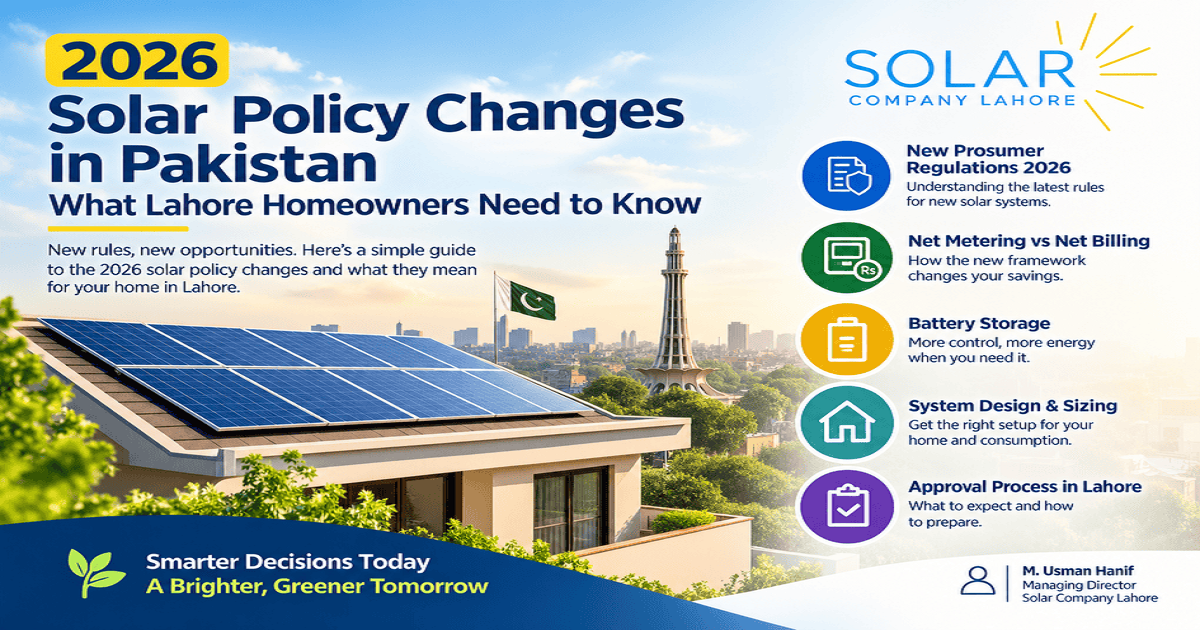
Pakistan’s solar market has entered a new phase in 2026. For homeowners in Lahore, installing solar is still possible, but the rules governing grid-connected systems have changed significantly.
The most important development is the introduction of the NEPRA Prosumer Regulations 2026, which came into force on February 9, 2026. These regulations created a new framework for consumers who generate electricity through renewable energy and interact with the electricity grid. NEPRA has also issued amendments to the framework during 2026, including changes notified in April and August.
For a Lahore homeowner, this means that buying solar panels is no longer simply a question of choosing panel capacity and an inverter. The homeowner also needs to understand how electricity generated during the day will be used, how surplus electricity will be treated, what approvals may be required, and whether a battery should be included in the system.
This article explains the major developments in simple language and focuses specifically on what homeowners in Lahore should consider before making a solar investment.
What Has Changed in Pakistan’s Solar Policy in 2026?
The biggest change is the move from the previous net-metering framework to the new Prosumer Regulations 2026 for new installations.
Under the new framework, new prosumers operate under a net-billing arrangement rather than the previous net-metering mechanism. Existing customers with valid agreements under the earlier framework are treated differently and can continue under their existing arrangements until the agreement expires, subject to the applicable conditions.
This distinction is extremely important.
A homeowner who already has an approved and valid solar agreement should not automatically assume that the rules for a newly installed system apply to them. At the same time, a person planning a new installation in Lahore should not calculate the financial return of the project using old net-metering assumptions.
The financial model needs to reflect the rules applicable to the new system.
Net Metering and Net Billing: What Is the Difference?
The easiest way to understand the policy change is to look at how electricity flows.
Imagine a house in Lahore with solar panels installed on the roof.
During the daytime, the panels produce electricity. The house uses some of that electricity immediately. If production is greater than household consumption, the surplus can flow toward the grid.
Under the old net-metering concept, exported and imported electricity were effectively offset under the applicable arrangement.
Under the new prosumer framework, electricity imported from the grid and electricity exported to the grid are treated differently for billing purposes. This makes self-consumption much more important for a new solar customer.
In practical terms, a homeowner should ask:
- How much electricity does my house use during the day?
- How much electricity does it use after sunset?
- How much solar power will be consumed immediately?
- How much will be exported?
- Would a battery allow me to use more of my own solar electricity later?
- What size solar system actually matches my consumption?
These questions can be more important than simply installing the largest possible solar system.
Existing Solar Users and New Solar Users Are Not the Same
One of the biggest sources of confusion in Lahore is the assumption that every solar customer is now under exactly the same rules.
That is not necessarily the case.
The 2026 framework distinguishes between existing customers operating under earlier approved arrangements and new prosumers. Existing customers with valid agreements can continue under their existing arrangements until expiry, provided they remain within the applicable conditions. A material modification to an existing generation facility can affect the regulatory treatment.
Therefore, an existing solar homeowner should be careful before:
- Increasing system capacity
- Changing major components
- Modifying the generation facility
- Reconfiguring the connection
- Assuming that an old agreement automatically covers a new expansion
Before making a major modification, the homeowner should check the current requirements applicable to the particular connection.
What Does the New Policy Mean for a Lahore Homeowner?
For a homeowner planning solar in Lahore during 2026, the biggest practical change is that solar design should focus more strongly on self-consumption.
In previous years, some customers designed systems primarily around reducing their annual electricity bill through grid interaction.
The new environment encourages a different approach.
A well-designed system should consider the homeowner’s actual electricity consumption pattern.
For example, if a family uses:
- Air conditioners mainly during the afternoon
- Washing machines during daylight hours
- Water pumps during the day
- Refrigeration continuously
- Kitchen appliances during daytime
- Office equipment during working hours
then a large portion of solar generation may be consumed directly.
But if most electricity consumption occurs between sunset and midnight, the value of a battery becomes more significant.
This is why a professional solar survey is increasingly important.
Battery Storage Is Becoming More Important
One of the practical consequences of the new policy environment is greater interest in battery storage.
A battery can store surplus solar energy produced during the day and make that electricity available later.
For a Lahore household, this can be useful for:
- Evening lighting
- Fans
- Refrigerators
- Internet equipment
- Television
- Water pumps
- Selected air-conditioning loads
- Essential appliances during outages
However, batteries should not be added simply because they are popular.
The correct battery size depends on the household’s load profile, backup requirements, inverter capacity, budget and expected operating pattern.
A homeowner who only needs backup for lights, fans and essential appliances may require a very different battery system from a homeowner who wants to operate several air conditioners after sunset.
Solar System Size Should Not Be Selected by Guesswork
Another important lesson from the 2026 policy environment is the importance of correct system sizing.
A common question is:
“Should I install 5 kW, 10 kW or 15 kW?”
The correct answer depends on the individual property.
A solar installer should first examine the electricity bills and consumption pattern.
The assessment should include:
- Monthly electricity consumption
- Maximum connected load
- Daytime consumption
- Night-time consumption
- Air-conditioner usage
- Water-pump usage
- Existing backup system
- Roof space
- Roof orientation
- Shading
- Future electricity requirements
- Battery requirements
Only after examining these factors should the final system capacity be recommended.
What About Solar Approval in 2026?
The 2026 Prosumer Regulations introduced a formal concurrence framework.
NEPRA’s regulations define eligible applicants and establish requirements for connecting renewable distributed-generation facilities to the distribution system. The framework covers solar, wind and biogas generation facilities up to 1 MW.
There have also been changes and amendments during the year.
In April 2026, the Power Division formally requested that NEPRA remove the application fee and licensing requirement for solar consumers with systems of 25 kW or below, arguing that the earlier arrangement was simpler for small consumers.
This demonstrates why homeowners should be careful with old information circulating online.
A website, salesperson or social-media post may describe an earlier version of the regulations. The applicable requirements can change through notifications and amendments.
For this reason, homeowners should verify the current requirements before submitting an application or signing a contract.
Lahore Has a Special Practical Consideration: LESCO
For Lahore homeowners, the distribution-company side of the process is particularly important.
NEPRA’s official records show ongoing prosumer concurrence activity associated with LESCO during 2026, including applications recorded in September.
This means that the regulatory transition has not stopped solar installations altogether.
However, the approval and connection process should be treated as a separate part of the solar project rather than an automatic result of installing panels.
A homeowner should ask the installer:
- Who will prepare the required documents?
- Who will submit the application?
- What approvals are required?
- What happens if the application is delayed?
- What happens if the system needs modification?
- What meter or grid-connection requirements apply?
- Who will handle technical objections?
These questions should be answered in writing before the project begins.
What Happened to Pending Net-Metering Applications?
The transition to the new system created a significant backlog of applications.
In September 2026, the Power Division announced that 11,695 pending net-metering applications had been resolved following a verification process. It stated that 16,654 applications had initially been pending during the transition and that eligible cases were being processed according to the applicable rules.
Earlier in August, the Power Division also directed distribution companies and the Pakistan Information Technology Company to expedite eligible cases where consumers had completed prescribed requirements and had paid demand notices before February 9, 2026.
For Lahore homeowners, the lesson is simple:
Do not assume that every old application and every new application will be processed under the same rules.
The date of application, completion of requirements, payments, approvals and the applicable regulatory framework can matter.
Should Lahore Homeowners Still Install Solar in 2026?
Solar remains an important option for reducing dependence on grid electricity, but the financial calculation has changed.
A homeowner should no longer make the decision based solely on statements such as:
“Your electricity bill will become zero.”
That is not a reliable way to evaluate a modern solar project.
Instead, calculate the project around:
- Electricity consumption
Look at the actual electricity bills rather than guessing the monthly usage.
- Daytime usage
Determine how much electricity is consumed while the sun is available.
- Evening usage
Calculate how much electricity is required after solar generation decreases.
- Battery requirement
Decide whether battery storage is economically and practically suitable.
- Solar capacity
Select a system that matches the property’s requirements rather than automatically selecting the largest system.
- Equipment quality
Panels, inverter, mounting structure, protection equipment, cables and batteries all affect system performance and reliability.
- Future requirements
A family planning to add air conditioners, an electric vehicle, additional appliances or a larger home load should mention those plans during system design.
Why Solar Self-Consumption Matters More Now
Consider a simple example.
A household produces a significant amount of solar electricity at 1:00 PM but has relatively low consumption at that time.
The surplus may be exported.
Later, at 8:00 PM, the solar panels are producing little or no electricity while the family is using lights, fans, appliances and air conditioners.
The homeowner then needs grid electricity or stored energy.
This makes the timing of electricity consumption important.
A properly designed hybrid system can use solar generation during the day, store suitable surplus energy and provide electricity later.
The objective is not simply to produce more electricity.
The objective is to produce electricity when it is useful and manage it intelligently.
Do Lahore Homeowners Need Batteries?
Not every homeowner needs the same battery.
A battery may be particularly useful when:
- Evening electricity consumption is high
- Backup during outages is important
- Daytime electricity consumption is relatively low
- The homeowner wants greater solar self-consumption
- The financial calculation supports the additional investment
On the other hand, a battery may not be necessary for every property.
A household with substantial daytime consumption may be able to use a large portion of its solar production directly.
This is why battery recommendations should be based on the actual load profile rather than a standard package.
Fixed Electricity Charges Also Matter
Another issue homeowners should watch is the wider electricity tariff structure.
The federal government notified tariff changes in February 2026, including changes involving fixed charges for residential consumers.
This is important because installing solar does not necessarily mean that every component of an electricity bill disappears.
Electricity bills can contain different components, and the treatment of charges depends on the applicable tariff and consumer category.
Therefore, a solar feasibility calculation should not simply take the current total bill and assume that the entire amount will disappear after installation.
A realistic calculation should examine the bill component by component.
What Should You Ask a Solar Company Before Installation?
Before signing a solar installation agreement in Lahore, ask for a written proposal containing:
System capacity
How many kW of solar generation are being installed?
Panel configuration
How many panels and what total DC capacity will be installed?
Inverter capacity
What is the AC output capacity?
Battery
If included, what is the usable battery capacity?
Expected generation
What is the estimated monthly generation and what assumptions were used?
Load calculation
How was the recommended system size determined?
Protection
Are DC and AC protection devices included?
Earthing
How will the earthing system be designed and tested?
Structure
What material and thickness will be used for the mounting structure?
Warranty
What warranties apply to the panels, inverter, battery and installation?
Grid connection
Who will handle the applicable approval and connection process?
Future expansion
Can the system be expanded later, and under what conditions?
These questions can prevent many misunderstandings.
Why Professional Solar Design Is More Important in 2026
The solar market has matured considerably.
A homeowner is no longer simply purchasing panels.
The project involves electrical design, load management, grid interaction, protection, batteries, approvals and long-term maintenance.
For this reason, solarcompanylahore recommends that homeowners evaluate the complete energy requirement of the property before deciding on system capacity.
A professional assessment should consider both current consumption and future requirements.
It should also clearly explain which assumptions are based on current regulations and which aspects may change in the future.
Common Mistakes Lahore Homeowners Should Avoid
Installing too much solar
More panels are not automatically better if the system is poorly matched to consumption.
Ignoring daytime consumption
The amount of electricity used during solar-production hours can significantly affect the project’s economics.
Buying a battery without calculating the load
A battery should be selected according to actual backup requirements.
Using outdated net-metering calculations
A calculation based on old rules may produce an unrealistic return-on-investment estimate for a new installation.
Ignoring roof shading
Even partial shading can affect generation depending on system configuration.
Choosing an installer only because of a low quotation
A cheaper initial quotation may omit important components such as protection, proper structure, earthing or installation workmanship.
Not checking documentation
The homeowner should understand the agreement, equipment specifications, warranties and approval responsibilities before installation.
What Does the Future of Solar in Lahore Look Like?
The direction of the market is becoming more focused on solar plus storage and intelligent energy management.
The traditional idea was relatively simple:
Solar panels → home → excess electricity → grid.
The emerging model is more flexible:
Solar panels → home → battery → controlled grid interaction.
This does not mean every home needs a battery.
It means homeowners need to think more carefully about when electricity is generated and when it is consumed.
Lahore has strong solar potential, but the financial success of a system depends on proper design, equipment selection, installation quality and the regulatory framework applicable at the time of installation.
Final Thoughts for Lahore Homeowners
The 2026 changes do not mean that homeowners should stop considering solar.
They mean that the decision needs to be made more carefully.
The most important change is the transition to the new Prosumer Regulations for new systems and the associated move toward net billing. Existing customers with valid earlier agreements have separate treatment under the applicable rules.
For a new Lahore homeowner, the best starting point is not simply asking, “How many panels can I install?”
Instead, ask:
How much electricity does my home actually need, when do I use it, how much solar can I consume directly, how much storage do I need, and what rules apply to my connection today?
That approach can produce a much more realistic solar investment plan.
Because regulations have continued to be amended during 2026, homeowners should also verify the latest applicable requirements before submitting applications or making major financial decisions. NEPRA’s legal records currently list the February 2026 Prosumer Regulations along with subsequent amendments notified in April and August.
For homeowners seeking a professionally designed residential solar solution in Lahore, solarcompanylahore can assess the property’s electricity consumption, roof conditions, backup requirements and system configuration before recommending a suitable solar setup.
Frequently Asked Questions (FAQs)
- Can I still install solar at my home in Lahore in 2026?
Yes. Solar installation remains possible. New grid-connected renewable systems are subject to the 2026 Prosumer Regulations and applicable approval requirements.
- Has net metering ended for everyone?
No. Existing customers with valid agreements under the previous framework can continue under their existing arrangements until expiry, subject to the applicable conditions. New installations are treated under the 2026 Prosumer framework.
- What is net billing?
Under net billing, electricity consumed from the grid and electricity exported to the grid are treated separately for billing purposes. This makes direct solar consumption particularly important for new customers.
- Should I install a battery with my solar system?
It depends on your electricity consumption, backup requirements, daytime usage and financial calculation. A battery can be particularly useful for shifting solar energy from daytime to evening use.
- Can I increase the size of my existing solar system?
You should not assume that an expansion will automatically remain under your previous arrangement. Material modifications can affect the regulatory treatment of an existing system. Check the applicable requirements before making changes.
- Does installing solar eliminate my electricity bill completely?
Not necessarily. Electricity bills can include different charges and components. The applicable tariff, consumption and solar arrangement determine the final bill.
- What happened to pending net-metering applications in 2026?
The Power Division reported in September 2026 that 11,695 pending applications had been resolved following verification. It also reported that 16,654 applications had initially been pending during the transition.
- Is solar still useful if I cannot depend on exporting electricity?
Yes. Solar can still reduce the electricity purchased from the grid by supplying electricity directly to household loads. Battery storage can also allow suitable surplus energy to be used later.
- How should I choose a solar system size?
Start with your electricity bills and load profile. Examine daytime and evening consumption, air-conditioning requirements, backup needs, roof space and future electricity demand before selecting the system capacity.
- What should I check before hiring a solar installer in Lahore?
Ask for a detailed system design, equipment specifications, generation estimate, protection design, earthing details, structure specifications, warranties, installation scope and clear responsibility for applicable grid-connection procedures.