
Lahore’s electricity needs are changing rapidly. Rising electricity costs, increasing demand for air conditioning, frequent load management challenges, and the growing popularity of rooftop solar have made energy management more important than ever.
Installing solar panels is an excellent first step toward reducing electricity expenses. However, simply producing solar power is no longer the whole story. The next generation of solar systems is becoming smarter, more connected, and more capable of making decisions based on real-time energy conditions.
This is where Artificial Intelligence (AI) and the Internet of Things (IoT) can make a meaningful difference.
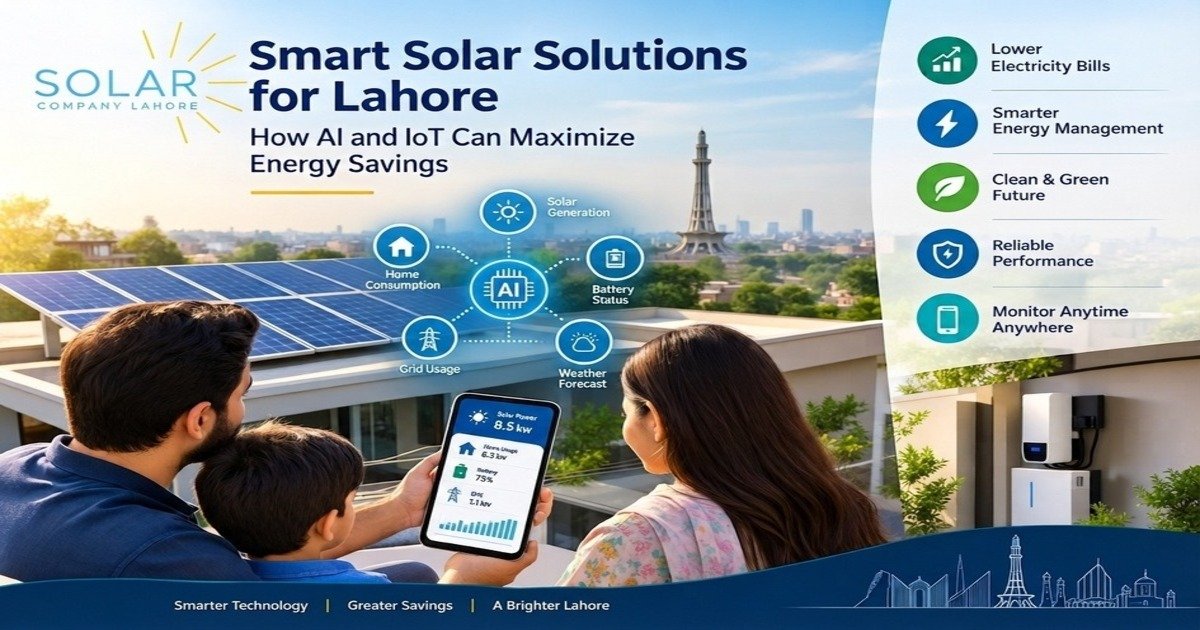
Smart monitoring systems can track solar production, household consumption, battery performance, weather conditions, and electrical loads. AI-based software can then analyze this information and help users make better decisions about when to use, store, or export electricity.
For homeowners and businesses in Lahore, this technology can turn a conventional solar installation into a more intelligent energy-management system.
What Are Smart Solar Solutions?
A traditional solar system mainly focuses on generating electricity from sunlight.
A smart solar system goes a step further.
It can collect information from different components and provide useful insights about how the system is performing. Depending on the equipment installed, it may monitor:
- Solar panel production
- Household electricity consumption
- Battery charging and discharging
- Inverter performance
- Grid electricity usage
- Voltage and frequency
- Individual electrical loads
- System temperature
- Historical energy trends
- Solar generation forecasts
IoT devices allow these components to communicate with monitoring platforms. AI can then analyze the collected information and identify patterns that may not be obvious to the average homeowner.
The result is better visibility and potentially better control over energy consumption.
Why Smart Solar Technology Matters in Lahore
Lahore receives substantial sunlight during much of the year, making rooftop solar an attractive option for homes, shops, offices, factories, and other buildings.
However, solar production is not constant throughout the day.
Generation usually increases after sunrise, reaches higher levels around the middle of the day, and decreases toward sunset. At the same time, electricity consumption can follow a completely different pattern.
For example, a home may generate significant solar power between 10 a.m. and 3 p.m., while the family’s electricity consumption increases during the evening when air conditioners, fans, lighting, televisions, and other appliances are being used.
Without proper energy management, some of the available solar energy may not be used at the most beneficial time.
Smart technology can help address this mismatch.
How AI Can Improve Solar Energy Management
Artificial Intelligence does not mean that your solar panels become intelligent machines by themselves.
Instead, AI can analyze large amounts of information collected from the solar system and use that information to identify patterns and support better decisions.
For example, an AI-enabled energy-management platform could learn that a household normally consumes more electricity between 6 p.m. and 11 p.m.
It can also identify how much solar energy is normally generated during the afternoon.
With enough historical information, the system can help determine when energy should be consumed directly, stored in batteries, or obtained from another available source.
- Better Energy Consumption Forecasting
AI can study historical electricity consumption.
Suppose a house regularly consumes more electricity on weekends than weekdays. The system can identify this pattern.
Similarly, if electricity consumption increases during extremely hot Lahore summers because of air conditioners, the system can recognize the seasonal trend.
This information can help users understand where their electricity is going and where savings may be possible.
- Solar Generation Forecasting
Solar production depends on sunlight and weather conditions.
Cloud cover, rain, dust, temperature, and seasonal changes can affect production.
AI-based systems can combine historical solar production data with available weather information to estimate future generation.
This can be particularly useful when batteries are part of the solar system.
If lower solar production is expected tomorrow, an intelligent energy-management system may help prepare the battery and energy usage accordingly.
- Intelligent Battery Management
Battery storage is becoming increasingly important for people who want greater control over their electricity usage.
However, batteries should not simply charge and discharge randomly.
A smart energy system can monitor battery state of charge, electricity demand, solar generation, and other available information.
This can help determine when battery energy should be stored and when it should be used.
Proper battery management can also help reduce unnecessary cycling and support longer and more efficient operation.
How IoT Connects Your Solar System
The Internet of Things, commonly known as IoT, refers to connected devices that can collect and exchange information.
In a solar installation, IoT can connect different components and sensors to a central monitoring platform.
For example, sensors and connected equipment can provide information about:
- Solar generation
- Inverter operation
- Battery condition
- Energy consumption
- Temperature
- Voltage
- Current
- System faults
- Equipment performance
Instead of waiting for a problem to become obvious, the user can receive information about the system while it is operating.
This is one of the most useful advantages of connected solar technology.
Real-Time Monitoring From Your Phone
One of the simplest benefits of smart solar technology is remote monitoring.
A homeowner can potentially check the performance of a solar system through a mobile application or online dashboard.
Instead of asking whether the solar system is producing enough electricity, the user can see the available data.
For example, a monitoring dashboard may show:
Today’s solar generation: 28 kWh
Today’s household consumption: 22 kWh
Battery status: 75%
Grid consumption: 3 kWh
The exact information depends on the equipment and monitoring platform, but the basic principle remains the same: data creates visibility.
When users understand their energy patterns, they can make better decisions.
Smart Solar and Air Conditioning in Lahore
Air conditioning is one of the biggest electricity-consuming appliances in many Lahore homes and businesses.
During hot weather, electricity demand can increase dramatically.
This makes intelligent energy management particularly useful.
Imagine a house with strong solar production around midday. Instead of allowing excess solar energy to go unused, the household can schedule certain energy-intensive activities during periods of higher solar generation where practical.
For example:
- Running a water pump during strong solar production
- Using certain appliances during daytime
- Charging batteries when solar production is high
- Operating selected commercial equipment during solar hours
This approach is known as load shifting.
The objective is simple: use more available solar energy when it is being produced rather than unnecessarily relying on other electricity sources at another time.
AI Can Help Identify Energy-Wasting Habits
Sometimes the problem is not the solar system.
The problem is how electricity is being consumed.
A smart monitoring platform can reveal unusual or inefficient consumption patterns.
For example, electricity usage may remain unexpectedly high late at night.
The homeowner might discover that an appliance, water heater, pump, or other load is operating longer than necessary.
Without monitoring, this type of consumption can easily go unnoticed.
With historical data, users can compare daily and monthly patterns and investigate unusual increases.
Predictive Maintenance: Finding Problems Earlier
Solar systems require relatively little routine maintenance, but that does not mean problems never occur.
Dust accumulation, loose connections, inverter faults, damaged cables, shading, abnormal temperatures, and other issues can reduce performance.
IoT monitoring can help identify unusual system behavior.
For example, if solar production suddenly falls below the system’s normal performance pattern, the monitoring system may highlight the issue.
This does not automatically mean that a particular component has failed. A qualified technician should investigate the actual cause.
However, early detection can reduce the time between a problem developing and the owner becoming aware of it.
That can be especially valuable for larger commercial and industrial installations.
Solar Panel Performance and Lahore’s Dust
Lahore’s environment can create a particular challenge for rooftop solar.
Dust and pollution can accumulate on solar panels.
A dirty panel does not necessarily stop producing electricity, but excessive surface contamination can reduce the amount of sunlight reaching the photovoltaic cells.
Smart monitoring can help identify unusual production patterns.
For example, if production gradually decreases while weather and other operating conditions remain relatively similar, the system owner can investigate whether cleaning or technical inspection is required.
This makes maintenance more data-driven rather than relying entirely on guesswork.
Smart Solar for Homes
For a residential customer, the objective is usually straightforward:
Reduce electricity costs while maintaining comfort and reliable power.
A smart residential solar solution can combine:
- Solar panels
- A suitable inverter
- Battery storage where required
- Energy monitoring
- Smart meters or sensors
- Mobile monitoring
- Intelligent load management
Not every home needs every feature.
The right solution depends on electricity consumption, available rooftop space, budget, backup requirements, and the family’s daily usage pattern.
A professional assessment should come before selecting equipment.
Smart Solar for Commercial Buildings
Businesses have a different energy profile from homes.
Offices, restaurants, shops, schools, clinics, warehouses, and other commercial buildings may have electricity loads operating for long periods.
Small improvements in energy management can therefore become financially meaningful.
A smart system can help business owners understand:
- Peak electricity consumption
- Solar production
- Daily energy patterns
- Equipment operating periods
- Battery utilization
- Unexpected consumption
- System performance
This information can support better energy planning.
For a business owner, the value of solar is not simply how many panels are installed. The important question is how effectively the generated energy is being used.
Smart Solar for Industrial Users
Industrial facilities generally have more complicated electricity requirements.
They may operate motors, pumps, compressors, machinery, lighting systems, cooling equipment, and other large electrical loads.
IoT-based monitoring can provide a more detailed picture of energy consumption.
Different production areas can potentially be monitored separately, helping management identify where electricity is being consumed.
AI-based analysis can then help identify patterns and unusual changes.
For industrial customers, this can turn energy management from a monthly electricity-bill exercise into an ongoing operational process.
Can AI Actually Reduce Your Electricity Bill?
AI itself does not magically reduce an electricity bill.
This is an important point.
Savings come from better energy decisions, improved system management, reduced wastage, better maintenance, and increased use of available solar energy.
AI can support those decisions by analyzing information.
For example, if data shows that a household is unnecessarily consuming large amounts of electricity during expensive or low-solar periods, the homeowner can change the usage pattern.
If a solar system is underperforming because of a technical problem, early detection can help restore its performance.
The technology is therefore a tool for better energy management, not a replacement for good system design.
The Importance of Correct Solar System Design
Smart technology cannot compensate for a poorly designed solar system.
Before considering AI or IoT features, the fundamentals must be correct.
A proper solar assessment should consider:
- Current electricity consumption
- Monthly electricity bills
- Daytime and nighttime usage
- Available rooftop area
- Roof orientation and shading
- Required backup duration
- Battery requirements
- Inverter capacity
- Solar panel capacity
- Future electricity requirements
Oversizing or undersizing components can affect system performance and investment returns.
A reliable solar provider should explain these considerations clearly instead of simply recommending the largest possible system.
Why Data Transparency Matters
Trust is especially important when investing in a solar system.
Customers should be able to understand what their system is producing and consuming.
A professional installation should provide clear information about equipment capacity, expected performance, maintenance requirements, warranties, and monitoring capabilities.
Customers should also understand that actual solar production varies according to weather, temperature, shading, dust, system design, and other conditions.
No responsible provider should promise a fixed level of electricity generation regardless of these factors.
Cybersecurity Should Not Be Ignored
Connecting electrical equipment to the internet creates another consideration: cybersecurity.
Smart solar systems should be configured carefully.
Users should:
- Use strong passwords
- Avoid sharing login credentials
- Keep supported software updated
- Use secure internet connections
- Restrict unnecessary access
- Work with reputable equipment and installers
The purpose of smart technology is to improve energy management, so security should be considered part of the overall system design.
What Will Smart Solar Look Like in the Future?
The future of solar energy is likely to involve greater integration between generation, storage, consumption, and digital technology.
Solar panels will continue generating electricity, but the surrounding system can become increasingly intelligent.
Future energy-management systems may be able to coordinate:
- Solar generation
- Batteries
- Air conditioning
- Water pumps
- Electric vehicles
- Smart appliances
- Commercial equipment
- Grid electricity
- Weather information
The objective will be to make the entire building more energy-efficient.
For Lahore, this could become increasingly relevant as more households and businesses adopt rooftop solar and battery storage.
How solarcompanylahore Can Approach Smart Solar Solutions
For customers considering a smart solar installation, the first step should not be buying an AI-enabled device.
The first step should be understanding the building’s actual energy requirements.
At solarcompanylahore, the focus should be on matching the solar solution with the customer’s real electricity usage, available space, backup requirements, and future needs.
Smart monitoring can then be incorporated where it provides genuine value.
A good solar solution should be practical, understandable, and maintainable.
Customers should know what their system is doing, why particular equipment has been selected, and how the system should be operated.
Practical Steps for Lahore Homeowners
If you are considering solar for your Lahore home, start with these steps:
Step 1: Review Your Electricity Bills
Look at your recent electricity bills and identify your average monthly consumption.
Step 2: Understand Your Daily Usage
Determine when most electricity is consumed.
Is your major usage during the day, evening, or throughout the entire day?
Step 3: Identify Major Loads
List your air conditioners, refrigerators, water pumps, televisions, washing machines, electric heaters, and other major appliances.
Step 4: Decide Your Backup Requirements
Determine whether you need backup for selected appliances or the entire home.
Step 5: Consider Monitoring
Ask whether the proposed system provides useful monitoring and what information you will actually be able to see.
Step 6: Plan for the Future
Your electricity requirements may increase.
A growing family, additional air conditioner, electric vehicle, larger refrigerator, or other appliance can change your future energy requirements.
Planning ahead can prevent unnecessary modifications later.
Smart Solar Is About More Than Technology
The most important point is that smart solar should not be viewed simply as a collection of modern gadgets.
The real purpose is better energy management.
AI can analyze patterns.
IoT can connect devices.
Monitoring can provide visibility.
Automation can improve control.
But good engineering, correct installation, regular maintenance, and responsible energy usage remain essential.
For Lahore homeowners and businesses, the combination of solar generation and intelligent energy management can provide a more efficient approach to electricity consumption.
Frequently Asked Questions
- What is a smart solar system?
A smart solar system combines solar equipment with monitoring, sensors, communication technology, and sometimes AI-based energy-management features. It provides more information and control over solar generation, electricity consumption, and battery operation.
- Can AI reduce my electricity bill?
AI does not directly reduce a bill. It can analyze energy-consumption patterns and help identify opportunities to reduce wastage, shift loads to solar-generation periods, improve battery usage, and detect unusual system behavior.
- What is IoT in solar energy?
IoT allows solar equipment, sensors, meters, batteries, and other connected devices to exchange information through a network. This makes remote monitoring and data-based energy management possible.
- Can I monitor my solar system from my mobile phone?
Many modern solar systems support mobile or web-based monitoring. Depending on the equipment, you may be able to see solar generation, electricity consumption, battery status, system alerts, and historical performance.
- Is smart solar suitable for Lahore homes?
Yes. Smart monitoring can be useful for Lahore homes because electricity consumption can change significantly with air-conditioning use, weather conditions, and daily routines. However, the technology should be selected according to the home’s actual requirements.
- Can smart technology detect solar panel problems?
Monitoring systems can identify unusual changes in solar production or equipment performance. However, monitoring cannot always identify the exact physical cause. A qualified technician may still need to inspect the system.
- Do I need AI if I install solar panels?
No. A solar system can work effectively without AI. AI and advanced monitoring are additional tools that may provide greater insight and control, particularly for larger homes, businesses, and systems with batteries.
- Does dust affect solar panel performance in Lahore?
Yes. Dust and other surface contamination can reduce the sunlight reaching solar cells. Regular inspection and appropriate cleaning can help maintain performance. Monitoring data can also help identify unusual production changes.
- Is a battery necessary for a smart solar system?
No. A smart solar system can operate without a battery. Batteries become useful when the customer needs backup power, wants to store solar energy for later use, or has specific energy-management requirements.
- What should I consider before installing a smart solar system?
Consider your electricity consumption, daily load pattern, rooftop space, shading, backup requirements, budget, future energy needs, monitoring requirements, and the quality of installation and after-sales support.
- Can smart solar systems be used for businesses?
Yes. Commercial buildings can benefit significantly from energy monitoring because businesses often have larger and more predictable electricity loads. Monitoring can help identify peak consumption, unusual usage, and opportunities for better energy management.
- What is the main benefit of smart solar technology?
The biggest benefit is better visibility and control. Instead of simply generating electricity, users can understand how their energy is produced, stored, and consumed and make more informed decisions about their electricity usage