
Pakistan’s energy landscape is going through an important transformation. Solar power, once considered mainly an alternative source of electricity for homes and businesses, has now reached a significant national milestone.
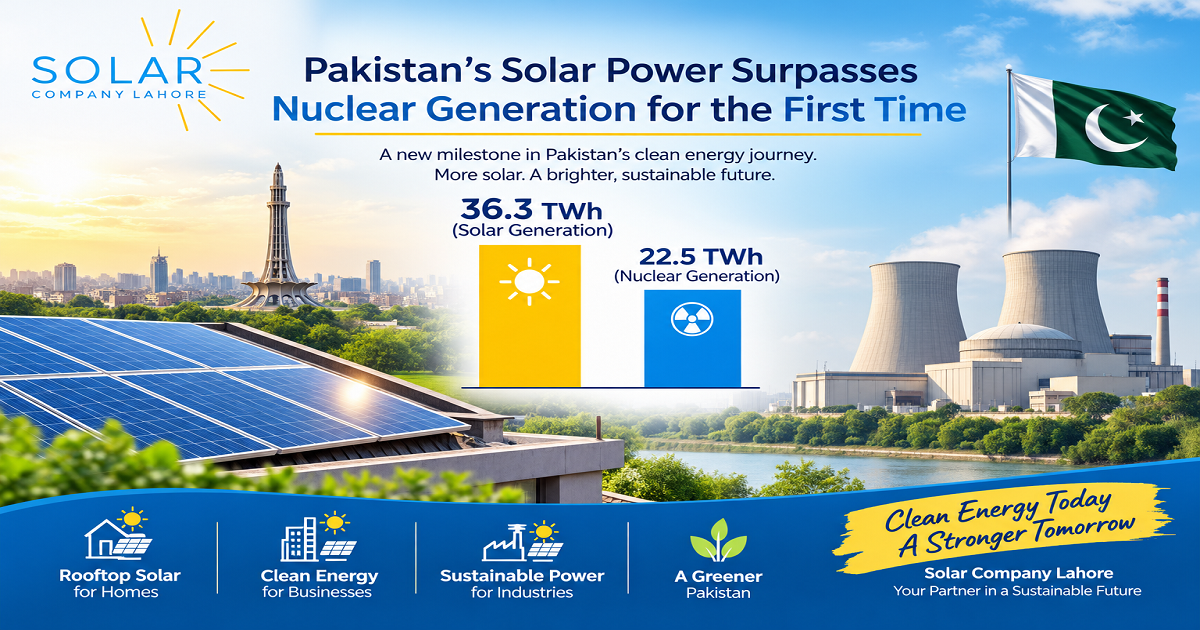
According to the World Nuclear Industry Status Report 2026, Pakistan generated approximately 36.3 terawatt-hours (TWh) of electricity from solar power in 2025, compared with 22.5 TWh from nuclear power. This was the first time that estimated solar electricity generation exceeded nuclear generation in Pakistan.
The development is particularly important because nuclear generation itself reached a record level during the same period. In other words, solar did not move ahead simply because nuclear power declined. Instead, solar generation grew rapidly enough to surpass a growing nuclear contribution.
For Pakistan, this is more than a statistical milestone. It reflects a major change in how households, businesses, agriculture and industries are approaching electricity.
A Major Change in Pakistan’s Energy Landscape
For decades, Pakistan’s electricity system depended heavily on large power plants and centralized generation. Electricity was produced at power stations and then transmitted through the national grid to consumers.
Solar energy is changing this traditional model.
Thousands of homes, shops, offices, factories and agricultural properties are installing solar systems directly where electricity is consumed. This creates a more distributed energy system in which consumers can generate part of their own electricity instead of depending entirely on grid supply.
The rapid growth has been particularly visible in rooftop solar.
Pakistan has experienced a substantial increase in solar-panel imports in recent years. A 2026 analysis by the Pakistan Institute of Development Economics noted that solar photovoltaic module imports had grown dramatically and that net-metered capacity also increased sharply during the previous fiscal year.
This growth shows that the solar transition is not limited to large energy companies or government projects.
It is increasingly being driven by ordinary electricity consumers.
What Does “Solar Surpasses Nuclear” Actually Mean?
The headline “Pakistan’s Solar Power Surpasses Nuclear Generation for the First Time” needs some explanation.
It does not mean that Pakistan has replaced its nuclear power plants with solar panels.
It also does not mean that solar plants have a higher capacity factor or provide electricity continuously throughout the day.
The comparison is about electricity generated over the year.
According to the reported 2025 figures, solar generated around 36.3 TWh, while nuclear generation reached approximately 22.5 TWh.
Nuclear power remains an important source of stable electricity. Pakistan currently operates six nuclear reactors, and nuclear power continues to provide a significant share of the country’s electricity. The IAEA reported six operating reactors with total capacity of roughly 3.26 GW in its 2026 country profile.
Therefore, the development should not be viewed as a competition in which one technology completely replaces another.
Instead, it demonstrates how quickly solar generation has expanded.
Why Is Solar Growing So Quickly in Pakistan?
Several factors are contributing to the rapid adoption of solar energy.
- Rising Electricity Costs
Electricity prices have become a major concern for Pakistani households and businesses.
When monthly electricity bills become difficult to manage, consumers naturally begin looking for alternatives.
Solar provides an opportunity to generate electricity from sunlight after the initial installation cost has been paid.
For a household with substantial daytime electricity consumption, this can make solar an attractive long-term investment.
- Abundant Sunlight
Pakistan receives strong sunlight across much of the country.
Punjab, including Lahore and surrounding areas, has particularly strong potential for rooftop solar because solar systems can produce electricity during a large portion of the year.
This makes solar suitable for residential, commercial, agricultural and industrial applications.
- Rapid Growth of Rooftop Solar
One of the biggest differences between solar and conventional power generation is that solar does not necessarily require a large centralized power station.
A homeowner can install a system on the roof.
A factory can install panels over available roof space.
A farm can use solar to operate pumps.
A commercial building can generate electricity close to where it is consumed.
This distributed nature has helped solar expand much faster than many traditional forms of generation.
- Growing Consumer Awareness
Consumers today understand solar technology better than they did several years ago.
People are increasingly familiar with concepts such as:
- Solar panels
- Hybrid inverters
- Lithium batteries
- Net metering
- Battery backup
- Energy monitoring
- Load management
- On-grid and off-grid systems
This growing awareness is making it easier for consumers to evaluate solar as a serious energy investment.
Why Lahore Is Becoming an Important Solar Market
Lahore has a particularly strong case for rooftop solar.
The city has a large number of residential communities, commercial buildings, factories, educational institutions and agricultural operations around its wider metropolitan area.
At the same time, electricity consumption can become particularly high during hot weather because of air conditioners, refrigerators, water pumps and other appliances.
This creates an important opportunity.
A properly designed solar system can produce significant electricity during the same daytime hours when many properties have substantial electricity demand.
For example, a home may use electricity during the day for:
- Air conditioning
- Refrigeration
- Water pumping
- Fans
- Washing machines
- Computers
- Home offices
- Other household appliances
Commercial properties can have even greater daytime demand.
This is where proper system design becomes more important than simply installing the maximum possible number of panels.
Solar Is Becoming More Than Just Panels
One of the biggest developments in the Pakistani solar market is the move toward complete energy-management systems.
A modern solar installation may include:
Solar panels + inverter + battery storage + monitoring + intelligent load management
This approach can provide greater flexibility.
During the day, solar panels generate electricity.
Some of that electricity can be consumed immediately.
Excess energy can potentially be stored in batteries, depending on the system design and operating arrangement.
The stored electricity can then be used when solar production falls.
This is particularly important because solar generation naturally decreases in the evening.
Pakistan’s Power Division has also highlighted this challenge, noting that solar generation is concentrated in daylight hours and that high penetration of unmanaged rooftop solar can create grid-management challenges, particularly around evening demand.
That means the future of solar is not simply about installing more panels.
It is also about using the electricity intelligently.
The Growing Importance of Battery Storage
Battery storage could become one of the most important developments in Pakistan’s next phase of solar adoption.
Traditional solar systems are strongest during daylight.
But household electricity demand does not stop when the sun goes down.
People return home from work.
Lights are switched on.
Air conditioners may continue operating.
Televisions, refrigerators, pumps and other appliances continue consuming electricity.
Battery storage can help bridge the gap between daytime solar production and evening electricity demand.
For homeowners in Lahore, a properly sized battery system can therefore provide several advantages.
It can store surplus solar electricity and make that energy available later.
However, batteries also increase the initial investment, so they should not be added automatically to every solar system.
The correct decision depends on electricity consumption patterns, backup requirements, tariff structure, available solar generation and the user’s budget.
What This Means for Pakistani Homeowners
The rise of solar generation sends an important message to homeowners.
Solar is no longer simply a technology for people looking for an environmentally friendly alternative.
It has become an important part of household energy planning.
Before installing a system, however, homeowners should avoid making decisions based only on the number of panels.
A good solar assessment should consider:
- Monthly electricity consumption
- Peak electricity demand
- Daytime versus nighttime usage
- Roof size
- Roof orientation
- Shading
- Inverter capacity
- Battery requirements
- Future electricity needs
- Backup expectations
- System maintenance
A larger system is not automatically a better system.
The right system is one that matches the property’s actual electricity requirements.
What Businesses Can Learn From the Solar Boom
Businesses face a different energy challenge.
Electricity is not only a household expense. For shops, offices, restaurants, workshops, warehouses and factories, energy costs can directly affect operating margins.
Many commercial operations also consume substantial electricity during daylight hours.
That makes them particularly suitable for solar.
A commercial solar system can potentially reduce dependence on grid electricity during productive hours while providing greater control over energy costs.
For industrial users, solar can also become part of a broader energy strategy involving energy efficiency, battery storage and intelligent load management.
This is one reason the growth of distributed solar deserves attention beyond the residential sector.
Solar Growth Does Not Mean Nuclear Power Is No Longer Important
It is important to maintain a balanced perspective.
Nuclear power provides stable, continuous electricity and has an important role in Pakistan’s electricity system.
The country’s nuclear generation actually increased in 2025, reaching a record 22.5 TWh according to the World Nuclear Industry Status Report.
Pakistan is also continuing to develop its nuclear programme. The IAEA reported that Pakistan had six nuclear reactors in operation in 2026, while another reactor was under construction.
Therefore, the growth of solar should not necessarily be interpreted as the end of nuclear energy.
Pakistan’s future electricity system is likely to contain multiple sources.
Solar can provide large amounts of daytime electricity.
Nuclear can provide stable generation.
Hydropower can contribute both energy and flexibility.
Wind can add renewable generation.
Battery storage can help manage variable renewable production.
The challenge will be integrating these resources efficiently.
The Hidden Side of Pakistan’s Solar Growth
There is another important point behind the numbers.
Not all solar generation is necessarily visible through traditional grid statistics.
A large number of privately installed solar systems operate behind the meter. Electricity produced and consumed directly at a home, shop or factory does not necessarily pass through the same measurement points used for conventional grid generation.
The World Nuclear Industry Status Report therefore indicated that Pakistan’s solar generation figure could be significantly underestimated because privately installed capacity is not fully captured in conventional statistics.
This means the actual scale of solar adoption may be even larger than official generation figures suggest.
That is an important consideration when discussing Pakistan’s energy transition.
What This Means for the Future of Pakistan’s Electricity System
Pakistan is moving toward a more decentralized energy model.
Instead of depending exclusively on large power stations, the country is gradually developing an electricity ecosystem in which millions of smaller systems can contribute to energy supply.
This could have major implications.
Imagine thousands of homes in Lahore generating electricity from their rooftops.
Add commercial buildings.
Then factories.
Then agricultural tube wells.
Then batteries and smart energy-management systems.
The result is not simply a collection of individual solar installations.
It becomes a distributed energy network.
This transition will require better grid planning, modern electricity infrastructure, appropriate regulations and improved consumer awareness.
Why Professional Solar Design Matters More Than Ever
As solar adoption grows, consumers should also become more careful about system quality.
A solar system is a long-term investment.
The quality of the design, installation, wiring, protection equipment, inverter configuration and mounting structure can influence system performance and safety.
A professional assessment should therefore come before purchasing equipment.
For customers in Lahore, solarcompanylahore believes that solar should be approached as an energy solution rather than simply a panel-selling exercise.
The objective should be to understand the customer’s electricity requirements and then design an appropriate system around those requirements.
This approach can help customers avoid unnecessary equipment and improve the long-term value of their investment.
The Next Stage: From Solar Generation to Smart Energy
The next major stage of Pakistan’s solar development could be smarter energy management.
Solar panels generate electricity.
But smart systems can decide where that electricity should go.
For example:
Solar → Home appliances
or
Solar → Battery
or
Solar → Grid
or a combination of these options depending on the system configuration and applicable regulations.
Smart monitoring can also help users understand how much electricity their system is producing and consuming.
Artificial intelligence and Internet of Things technologies may further improve this process in the coming years by helping predict consumption, identify abnormal system performance and optimize energy usage.
This could be particularly useful in large commercial and industrial installations.
A New Opportunity for Lahore’s Solar Consumers
For Lahore residents, the country’s solar transformation presents both an opportunity and a responsibility.
The opportunity is to reduce dependence on conventional electricity and potentially gain greater control over household or business energy costs.
The responsibility is to make informed decisions.
Consumers should compare system designs rather than focusing only on price.
They should understand warranty terms.
They should ask about installation quality.
They should consider future electricity requirements.
And they should make sure the system is designed according to actual consumption.
At solarcompanylahore, the focus should be on helping customers understand these factors before making an investment.
Frequently Asked Questions (FAQs)
- Did solar power really surpass nuclear power generation in Pakistan?
Yes. According to the World Nuclear Industry Status Report 2026, Pakistan’s estimated solar generation reached 36.3 TWh in 2025, while nuclear generation reached 22.5 TWh. This was the first reported year in which solar generation exceeded nuclear generation.
- Does this mean Pakistan no longer needs nuclear power?
No. Nuclear power remains an important source of stable electricity. Solar and nuclear have different operating characteristics, and Pakistan can use both technologies as part of a diversified electricity system.
- Why is solar growing so quickly in Pakistan?
High electricity costs, abundant sunlight, falling solar-system costs, increased consumer awareness and rapid growth of rooftop installations are among the major factors behind solar adoption.
- Is solar suitable for homes in Lahore?
Yes. Lahore has strong solar potential and many homes have suitable rooftop space. However, the system should be designed according to the home’s electricity consumption, roof conditions and backup requirements.
- Do I need batteries with a solar system?
Not necessarily. Battery requirements depend on whether you need backup power, how much electricity you consume at night, your system configuration and your electricity-supply arrangements.
- Can solar completely eliminate my electricity bill?
Not necessarily. Actual savings depend on system size, electricity consumption, tariffs, system performance, export arrangements and other factors. A properly designed system can substantially reduce electricity purchased from the grid, but customers should avoid guarantees of zero bills without a detailed assessment.
- Is solar better than nuclear power?
It is not a simple “better or worse” comparison. Solar is modular and can be installed close to consumers, while nuclear provides stable, continuous generation. Each technology has a different role in an electricity system.
- Why is battery storage becoming more important?
Solar production is highest during daylight, while electricity demand often continues into the evening. Batteries can store surplus solar energy during the day and make it available later, depending on the system design.
- What should I check before installing solar in Lahore?
Check your electricity bills, daytime and nighttime consumption, roof area, shading, inverter requirements, battery needs, protection equipment, installation quality, warranties and expected future electricity demand.
- What does Pakistan’s solar growth mean for the future?
It suggests that distributed solar will become an increasingly important part of Pakistan’s energy system. The next stage will likely involve better grid integration, battery storage, smart monitoring and more efficient energy management.