
Pakistan is experiencing a major transformation in the way electricity is produced and consumed. Across Lahore and other cities, solar panels are appearing on the rooftops of homes, shops, factories, schools, offices and commercial buildings.
For many years, Pakistan’s electricity system was built around a centralized model. Large power plants generated electricity, transmission networks transported it over long distances, and distribution companies delivered it to consumers.
Rooftop solar is changing that model.
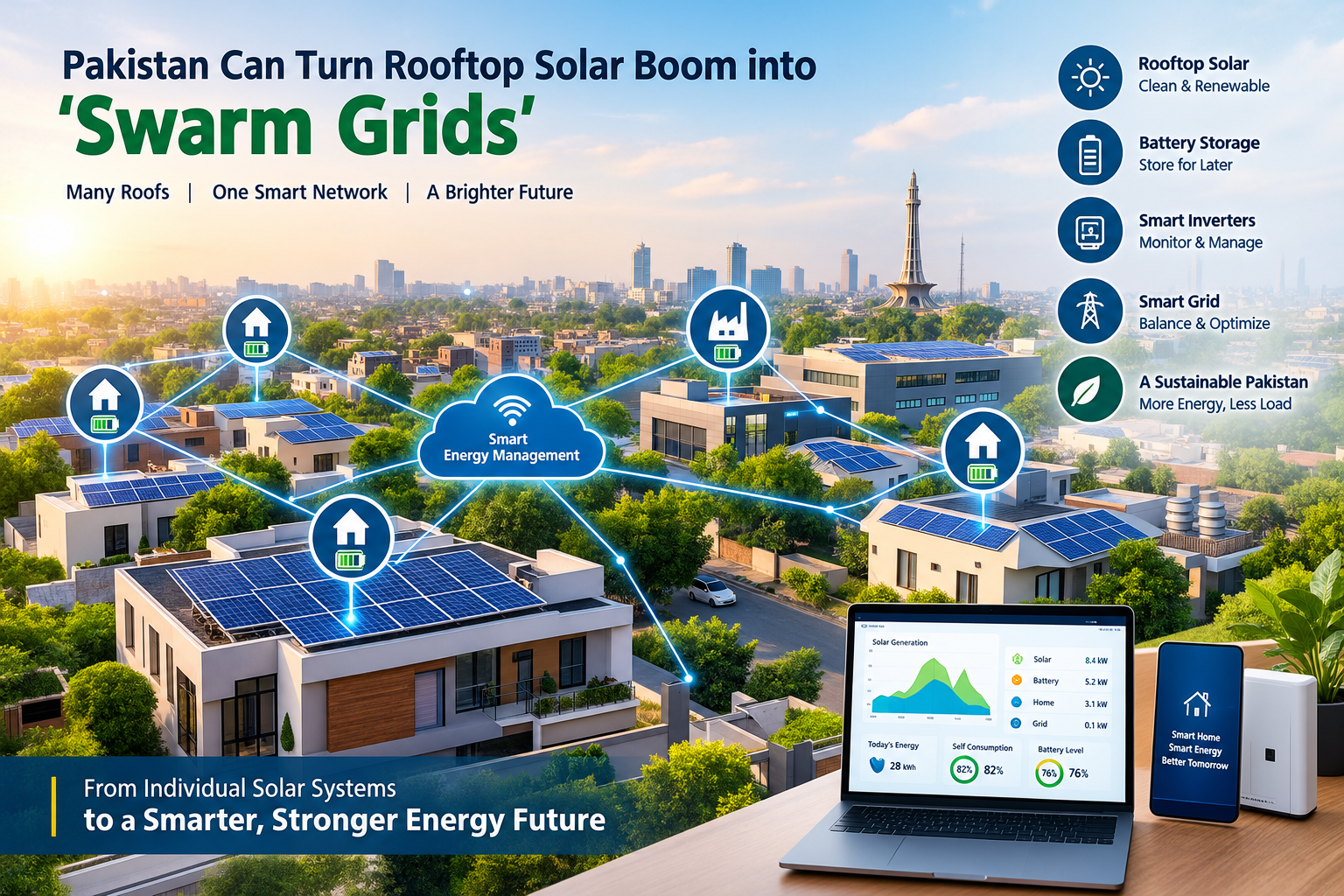
Instead of depending entirely on a few large power stations, thousands or even millions of consumers can generate electricity close to where it is needed. With modern inverters, lithium batteries, smart meters and digital monitoring, these individual solar systems can potentially work together as a coordinated network.
This concept can be described as a “swarm grid.”
The idea is particularly relevant for Pakistan because the country’s rooftop solar market has expanded rapidly. According to figures presented by Pakistan’s Power Division in 2026, solar generation under the previous net-metering framework had reached around 6,978 MW by FY2026, compared with only about 190 MW in FY2020.
The question is no longer simply whether Pakistan will adopt rooftop solar.
The bigger question is:
Can Pakistan turn millions of individual solar systems into a smarter, more flexible electricity network?
What Is a Swarm Grid?
A swarm grid is not necessarily a completely separate electricity grid.
It is better understood as a network of many small energy resources that can operate individually but can also be coordinated to support the larger electricity system.
Imagine a Lahore neighborhood where 500 houses have solar panels.
During sunny afternoon hours, many homes may produce more electricity than they immediately need. Some homes may have batteries. Others may export electricity to the local network.
Instead of treating every rooftop system as an isolated installation, smart technology could coordinate these systems.
One house could store surplus electricity.
Another could use it immediately.
A third could charge an electric vehicle.
A fourth could reduce its electricity demand.
Together, hundreds of these small actions could create a much more flexible local energy network.
This is the basic thinking behind a swarm-style energy system.
Pakistan Already Has the Beginning of This System
Pakistan does not have to start from zero.
The country has already developed a large distributed solar market. The rapid increase in rooftop installations demonstrates that consumers are willing to invest in their own electricity generation.
The government’s Power Division explains that distributed-generation consumers can export excess electricity through a bidirectional metering arrangement under the applicable framework.
However, Pakistan’s regulatory environment changed significantly in 2026.
NEPRA introduced the Prosumer Regulations 2026, replacing the previous net-metering framework with a net-billing approach for new arrangements. This means the economics of exporting surplus electricity are different from the old one-to-one unit-offset model.
This change makes the idea of self-consumption, batteries and intelligent energy management increasingly important.
Instead of designing solar systems primarily around exporting electricity, homeowners and businesses may increasingly benefit from using more of their solar energy themselves.
That creates an opportunity for Pakistan to move from simple rooftop solar toward a smarter distributed-energy system.
Why Lahore Is an Important Example
Lahore is an ideal place to understand the potential of distributed solar.
The city has millions of homes and a large number of commercial buildings, factories, schools, offices and agricultural businesses in its surrounding areas.
Many buildings have usable rooftops.
At the same time, consumers face high electricity costs and want greater control over their energy expenses.
A typical Lahore home with a suitable rooftop could have:
- Solar panels
- A hybrid inverter
- Lithium battery storage
- Smart monitoring
- Grid connection
- Energy-efficient appliances
Now imagine thousands of such systems operating across different neighborhoods.
The electricity would not always have to travel from a distant power station.
A significant portion could be produced and consumed locally.
That is one of the biggest advantages of distributed energy.
From Individual Solar Systems to a Solar Community
The next stage could be community-level coordination.
For example, suppose 1,000 homes in Lahore each have a 10 kW solar system.
Individually, these are simply 1,000 separate installations.
But with appropriate technology and regulation, they could become a coordinated energy resource.
During the afternoon, solar production could be very high.
Smart controllers could encourage battery charging and flexible electricity consumption.
In the evening, when solar production falls and household demand rises, batteries could supply some of the stored energy.
This could reduce the sudden increase in demand from the central grid.
The important point is that the system does not require every household to behave in exactly the same way.
The strength comes from having thousands of small resources working together.
Batteries Could Become the Backbone of the Swarm Grid
Solar panels generate electricity primarily during daylight hours.
But households also consume electricity in the evening and at night.
This is where batteries become extremely important.
A solar system without storage can generate substantial electricity during the day, but a battery-equipped system can move some of that energy from one period to another.
For Pakistan’s emerging solar market, lithium batteries could therefore become much more than backup equipment.
They could become an important part of the country’s future distributed electricity infrastructure.
For example:
Afternoon: Solar panels generate electricity and charge the battery.
Evening: Household demand increases and the battery supplies stored solar energy.
Night: The battery can continue supporting selected loads or recharge according to the system’s operating strategy.
Next morning: Solar production starts again.
When thousands of systems follow intelligent charging and discharging strategies, batteries can potentially help reduce pressure on the wider electricity network.
Global energy markets are already exploring this concept through virtual power plants, where distributed solar and batteries can be coordinated as a larger energy resource.
Smart Inverters Will Be Extremely Important
Solar panels alone cannot create a swarm grid.
The inverter is one of the most important components.
A modern hybrid inverter does much more than convert DC electricity from solar panels into AC electricity.
Advanced systems can monitor:
- Solar generation
- Household consumption
- Battery charging
- Battery discharge
- Grid electricity
- Exported electricity
- Voltage
- System performance
Future systems could also respond automatically to electricity prices, grid conditions and demand signals.
For example, if electricity is expensive during a particular period, the system could reduce grid consumption by using stored solar energy.
If the grid has sufficient capacity, the system could operate differently.
This type of intelligent control is essential if millions of small solar systems are eventually going to work together.
Artificial Intelligence Could Make the System Smarter
The next stage of development could involve artificial intelligence and advanced forecasting.
Solar generation is not constant.
Clouds, temperature, dust and weather conditions affect production.
Household electricity demand also changes throughout the day.
AI-based energy management systems could use historical consumption, weather forecasts, solar production data and battery conditions to predict future requirements.
For example, a smart system could predict:
“Tomorrow afternoon is expected to be highly sunny, so battery charging can be delayed until solar production is strong.”
Or:
“Electricity demand is expected to increase tonight, so preserve additional battery capacity.”
At a larger scale, a coordinated system could combine information from thousands of solar installations.
This could make distributed electricity generation much more predictable.
Swarm Grids Could Help Reduce Pressure on the National Grid
Pakistan’s traditional electricity system has to manage electricity generation, transmission and distribution across long distances.
Distributed solar changes this equation.
When electricity is generated close to the consumer, some demand can be supplied locally.
This can potentially reduce the amount of electricity that needs to travel through parts of the transmission and distribution network.
However, rooftop solar is not automatically beneficial for every part of the grid.
If many systems simultaneously export large amounts of electricity, local networks can experience technical problems such as voltage fluctuations and overloaded equipment.
International experience shows that distribution networks are not always designed for large volumes of two-way electricity flows.
This is why Pakistan needs to move beyond simply installing more panels.
It needs to develop smart distributed energy management.
The Difference Between a Solar Boom and a Swarm Grid
A solar boom means many people install solar systems.
A swarm grid means those systems can intelligently interact with the electricity network.
There is an important difference.
Consider two neighborhoods.
Neighborhood A
Every house has solar panels.
During the afternoon, most systems export electricity at the same time.
At night, nearly everyone buys electricity from the grid.
Neighborhood B
Every house has solar panels, but many also have batteries and smart energy management.
During the afternoon:
- Some solar energy is consumed immediately.
- Some charges batteries.
- Some powers water pumps or appliances.
- Limited surplus is exported.
During the evening:
- Batteries supply homes.
- Flexible loads are managed.
- Grid demand is reduced.
Neighborhood B is much closer to a swarm-grid model.
Why the New Prosumer Environment Makes This More Important
Pakistan’s 2026 regulatory change has altered the financial calculation for new rooftop solar customers.
Under the new framework, electricity imported from the grid and electricity exported by a prosumer are treated differently, making self-consumption increasingly important for system economics. Research examining Pakistan’s 2026 reform similarly highlights the importance of battery storage and demand-side management.
For homeowners in Lahore, this means the question should not simply be:
“How many solar panels should I install?”
A better question is:
“How can I use the maximum amount of my own solar electricity?”
This could encourage a new generation of solar systems designed around actual household consumption rather than maximum export.
What Pakistan Needs to Build Swarm Grids
Pakistan already has millions of potential energy assets distributed across rooftops.
The country now needs the supporting infrastructure.
1. Smart Meters
Accurate measurement of electricity consumption, solar generation, imports and exports is essential.
2. Smart Inverters
Inverters should increasingly support advanced monitoring and grid-management functions.
3. Battery Storage
Affordable and reliable batteries can shift solar electricity from daytime to evening.
4. Digital Energy Platforms
Consumers and utilities need systems capable of monitoring large numbers of distributed energy resources.
5. Better Distribution Networks
Local transformers, feeders and other infrastructure must be upgraded where rooftop solar penetration becomes high.
6. Clear Regulations
Investors and consumers need predictable rules for solar generation, battery storage, electricity exports and grid participation.
7. Cybersecurity
As more solar inverters and batteries become internet-connected, cybersecurity will become increasingly important. Recent research has highlighted security risks associated with exposed distributed-energy devices and poorly protected control interfaces.
Solar Companies Will Have a Bigger Role
The solar industry will also need to evolve.
In the early stages of Pakistan’s solar market, the focus was primarily on:
Panels + inverter + installation.
The future could be more sophisticated:
 Solar + battery + smart inverter + monitoring + energy management + maintenance.
Solar companies in Lahore can play an important role in this transition.
Installers should not simply calculate panel capacity.
They should understand the customer’s electricity consumption pattern.
A household that consumes most of its electricity during daylight may need a different solution from a household that consumes heavily after sunset.
Similarly, a commercial building operating from 9 a.m. to 6 p.m. may have a different solar-storage requirement from a residence.
Good system design should therefore start with energy consumption analysis, not simply panel count.
Benefits for Lahore Households
A well-designed distributed solar system can provide several potential benefits.
Lower Grid Dependence
Consumers can generate a larger share of their own electricity.
Better Energy Control
Battery storage can provide greater control over when electricity is consumed.
Backup During Outages
Hybrid systems with appropriate battery capacity can continue supplying selected loads during grid interruptions.
Better Use of Solar Power
Instead of exporting large amounts of surplus electricity, consumers can use more of their own generation.
Energy Independence
Households and businesses gain greater control over their electricity supply.
Benefits for Pakistan
If properly managed, swarm grids could provide benefits beyond individual households.
They could potentially:
- Reduce pressure on some parts of the distribution network.
- Increase renewable-energy consumption.
- Improve local energy resilience.
- Encourage battery deployment.
- Reduce dependence on centralized generation for some loads.
- Create new energy-management businesses.
- Support electric-vehicle charging.
- Improve utilization of locally generated electricity.
However, these benefits are not automatic.
Poorly planned rooftop solar growth can also create technical and financial problems for distribution companies.
That is why policy, grid investment and technology must develop alongside solar adoption.
The Biggest Challenge: Who Pays for the Grid?
One of the most difficult questions is financial.
If many high-consumption customers generate most of their electricity themselves, utilities may sell fewer units while still needing to maintain transformers, wires, substations and other infrastructure.
The grid does not disappear simply because consumers install solar.
It remains necessary for backup, balancing and electricity delivery.
This creates a difficult question:
How should consumers fairly pay for the grid while still being encouraged to invest in renewable energy?
Pakistan needs a carefully designed tariff structure that recognizes both electricity consumption and the value of network services.
This is one reason the transition from traditional net metering to newer prosumer arrangements is such an important policy issue.
A Possible Future for Pakistan
Imagine Lahore in the next decade.
Thousands of homes have solar panels.
Many have lithium batteries.
Factories generate a significant portion of their daytime electricity.
Shopping centers use rooftop solar.
Schools have solar-plus-storage systems.
Electric vehicles charge during periods when solar electricity is abundant.
Smart inverters communicate with energy-management platforms.
Instead of thinking about every solar system as a separate installation, the electricity sector sees them as thousands of small resources.
That is the real potential of the swarm-grid concept.
Pakistan does not necessarily need to replace the existing grid with a completely new system.
It can gradually transform the existing network by adding intelligence, storage, smart metering and better distributed-energy management.
What Solar Customers in Lahore Should Do Today
For consumers considering solar, the most important advice is simple:
Do not select a system only on the basis of panel capacity or the lowest installation price.
Consider:
- Your actual monthly electricity consumption.
- Your daytime and nighttime usage.
- Your future electricity requirements.
- Battery requirements.
- Inverter quality and warranty.
- Roof structure and available space.
- Solar panel quality.
- Electrical protection and earthing.
- Monitoring facilities.
- Maintenance and after-sales support.
A properly engineered system can provide much better long-term value than a cheap system that is poorly designed.
For Lahore customers especially, dust, heat, rooftop conditions and regular maintenance should also be considered during system planning.
Frequently Asked Questions (FAQs)
1. What is a swarm grid?
A swarm grid is a concept in which many small energy systems—such as rooftop solar panels, batteries, smart inverters and flexible electricity loads—operate individually but can also be coordinated as a larger energy resource.
2. Why is Pakistan suitable for swarm grids?
Pakistan has experienced rapid growth in rooftop solar because of high electricity costs, falling solar equipment prices and strong consumer interest. The country’s distributed solar capacity has grown dramatically in recent years.
3. Can rooftop solar replace Pakistan’s national grid?
No. Rooftop solar cannot simply replace the national grid. The grid remains important for backup, balancing, transmission and supplying electricity when local generation is insufficient.
4. Why are batteries important for swarm grids?
Solar generation is strongest during daylight, while household electricity demand often increases in the evening. Batteries can store excess solar energy and make it available when required.
5. Does every solar system need a battery?
Not necessarily. The appropriate configuration depends on electricity consumption, backup requirements, grid conditions, system economics and the customer’s objectives. However, batteries can become increasingly valuable when maximizing self-consumption is important.
6. What changed in Pakistan’s solar policy in 2026?
Pakistan introduced the NEPRA Prosumer Regulations 2026, replacing the previous net-metering framework with a net-billing approach for new arrangements. This changed the economics of exporting surplus electricity to the grid.
7. What is the role of a smart inverter?
A smart inverter converts solar electricity into usable AC electricity while also providing monitoring and, in advanced systems, energy-management and grid-support functions.
8. Can swarm grids help during electricity outages?
A solar system with an appropriately designed hybrid inverter and battery can provide backup electricity to selected loads during grid outages. A standard grid-tied system without suitable backup capability generally cannot operate normally during a grid outage.
9. Are swarm grids only for large cities like Lahore?
No. The concept can potentially be used in cities, smaller towns, villages, commercial areas and industrial zones. Local conditions and distribution-network capacity would determine the appropriate design.
10. What should Lahore consumers consider before installing solar?
Consumers should assess their electricity consumption, daytime usage, battery requirements, inverter quality, panel quality, roof structure, protection equipment, earthing, warranties, monitoring and after-sales service before making a decision.