
Solar energy has changed the way many people in Lahore think about electricity.
From residential homes in DHA, Johar Town, Bahria Town, Wapda Town and Model Town to commercial buildings across the city, rooftop solar has become an increasingly important way to reduce dependence on grid electricity.
However, the solar market in Pakistan is also going through an important transition.
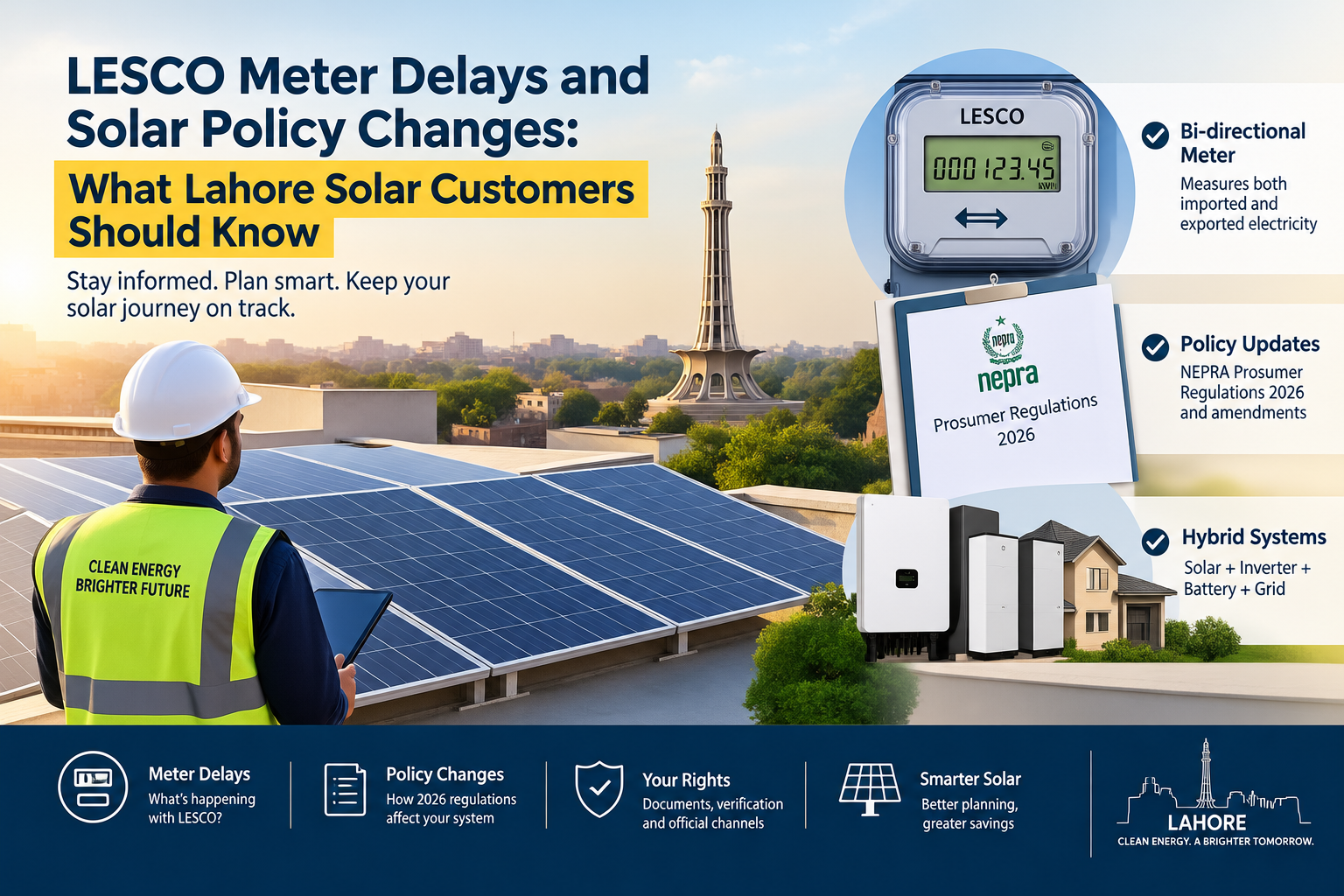
Changes in regulations, the move toward a newer prosumer framework, verification requirements, and delays involving bi-directional meters have created questions for customers who have already installed solar or are planning a new system.
In September 2026, reports indicated that LESCO was facing shortages of bi-directional meters, with some solar consumers who had already paid demand notices waiting for meter installation.
At the same time, the federal government has been working through a large backlog of net-metering cases. On September 5, 2026, the Power Division announced that 11,695 pending applications had been cleared and verified, while another 4,959 were still under review.
So, what does all of this mean for a Lahore resident who wants to install solar?
Let’s look at the situation in simple terms.
What Is Happening With Solar Meters in Lahore?
A grid-connected solar system normally needs a meter capable of recording electricity flowing in both directions.
During sunny hours, your solar panels may produce more electricity than your home is consuming. The surplus can flow toward the electricity grid.
At other times, particularly at night, your property may take electricity from the grid.
A bi-directional meter records these electricity flows separately.
The Ministry of Energy explains that a bi-directional energy meter is used to record both imported and exported electricity for a net-metering connection.
The current problem in Lahore is not necessarily that solar technology has stopped working.
The issue is that meter availability and the processing of grid-connected solar cases have become an important bottleneck for some consumers.
A September 8, 2026 report stated that LESCO had limited stocks of bi-directional meters and that some consumers who had already paid demand notices were waiting for installation.
This is particularly frustrating for customers who have already invested heavily in panels, an inverter and installation.
Why Is the Bi-Directional Meter So Important?
A common question from new solar customers is:
“If I have installed solar panels, why do I need another meter?”
The answer is simple.
Solar panels produce electricity during daylight hours. Your house may not consume all of that electricity at the exact moment it is generated.
For example, imagine a home producing 8 kWh from solar between 10 a.m. and 4 p.m.
If the home uses only 5 kWh during that period, approximately 3 kWh is surplus.
Depending on the applicable regulatory arrangement and the customer’s approved grid connection, that surplus may be exported to the distribution network.
The bi-directional meter measures the electricity moving in both directions.
Without the appropriate grid-connected meter and required approvals, a customer cannot simply assume that exported electricity will receive the same treatment as an approved prosumer connection.
This is why customers should not treat the meter as a minor administrative detail.
The solar panels, inverter, wiring, protection equipment, approvals and meter all form part of the complete grid-connected solar solution.
Pakistan’s Solar Policy Has Also Changed
Another important development is the introduction of the NEPRA Prosumer Regulations, 2026.
NEPRA’s official legal database lists the Prosumer Regulations, 2026, notified on February 9, 2026, along with subsequent amendments issued during 2026, including an amendment dated August 6, 2026.
This is important because the regulatory environment for distributed solar is no longer exactly the same as the system many early solar adopters became familiar with.
For years, the basic attraction of net metering was easy to understand:
Generate electricity → use what you need → send surplus to the grid → receive an adjustment/credit according to the applicable rules.
The newer framework has changed the economics and administrative structure surrounding distributed generation.
Therefore, anyone installing a new solar system in Lahore in 2026 should avoid making an investment decision based entirely on what a neighbour installed several years ago.
Existing Solar Customers and New Customers Are Not Necessarily in the Same Position
This is one of the most important points for Lahore consumers.
A person who already has an approved solar connection, a valid agreement and an operating bi-directional meter may be subject to different arrangements from someone who is applying for a new connection today.
There have also been cases involving consumers whose applications were already substantially processed but remained pending during the regulatory transition.
In August 2026, the Power Division directed distribution companies and PITC to verify cases where consumers had completed specified formalities, including demand-notice payments made before the February 9, 2026 cutoff.
By September 5, the government said that 11,695 applications had been cleared and verified.
This shows why customers should look at their own application status and documentation, rather than relying on general statements circulating in WhatsApp groups or social media.
What Should Lahore Customers Do If Their Meter Is Delayed?
If you have already installed a solar system and are waiting for a bi-directional meter, keep your documentation organized.
Important documents may include:
- Electricity bill
- CNIC-related application information
- Solar application documents
- Demand notice
- Proof of payment
- Approved generation capacity
- Inverter information
- Application or tracking/reference number
- Relevant LESCO correspondence
- Any inspection or connection documentation
If you have completed the required formalities, do not automatically assume that your application has been rejected simply because the meter has not yet been installed.
The current situation includes a significant backlog that authorities have been reviewing.
The Power Division has also stated that consumers whose applications are being verified can be contacted directly through digital channels, and it specifically warned consumers against paying unauthorized intermediaries to expedite applications.
This is an important lesson: keep your paperwork and payment evidence safe.
Do Not Pay an Agent Just Because Someone Says Your File Can Be “Moved Faster”
Solar customers sometimes hear statements such as:
“Your meter can be installed quickly if you pay an additional amount.”
Consumers should be careful with such claims.
The Power Division said in September 2026 that verified applicants were being contacted directly and that no payment was required to individuals for expedited processing of those cases.
Customers should therefore verify information through official channels before giving money to an intermediary.
A professional solar company should also help customers understand the documentation and process instead of making unrealistic promises about government processing times.
What Does the Policy Change Mean for New Solar Buyers in Lahore?
The biggest change in mindset is this:
Don’t Buy Solar Based Only on Panel Capacity
In the past, many customers asked:
“How many panels can I fit on my roof?”
Today, a better question is:
“How much electricity does my property actually use, when does it use it, and how should the solar system be designed around that consumption?”
This is particularly important because solar generation and household consumption do not always occur at the same time.
A family may generate substantial solar power at midday while most of its electricity consumption occurs in the evening.
A business may have the opposite pattern, with substantial daytime electricity consumption.
Therefore, system design should consider:
- Monthly electricity consumption
- Daytime consumption
- Evening consumption
- Air-conditioner usage
- Water pumps
- Refrigerators
- Electric appliances
- Commercial machinery
- Future electricity demand
- Roof area
- Shading
- Inverter capacity
- Battery requirements
- Grid connection requirements
Should Lahore Customers Consider Hybrid Solar?
For many properties, a hybrid solar system deserves serious consideration.
A hybrid system can combine:
Solar panels + hybrid inverter + battery storage + grid connection
The exact configuration depends on the customer’s requirements.
The major advantage of battery storage is that surplus solar electricity can potentially be stored and used later, rather than depending entirely on immediate solar production or grid export arrangements.
For example:
Daytime:
Solar → Home appliances → Battery charging
Evening:
Battery → Home appliances
Night:
Battery/grid → Home
This does not mean every Lahore customer needs a large battery.
A battery can significantly increase the initial cost of a solar system, so it should be sized according to actual electricity requirements and the customer’s budget.
Is On-Grid Solar Still Relevant in Lahore?
Yes, but customers should understand the current rules and economics before making a decision.
An on-grid system can be attractive for customers whose electricity consumption occurs largely during daylight hours and who want to reduce their dependence on grid electricity.
Commercial buildings, offices, schools, workshops and businesses may have substantial daytime loads.
In such cases, direct solar consumption can be particularly useful.
The important point is that solar economics should be calculated using the rules applicable at the time of installation, rather than relying on older net-metering calculations.
What About Businesses in Lahore?
The policy transition is especially relevant to commercial customers.
A business may have a much higher electricity demand than a typical household.
For example, a commercial property may operate:
- Air conditioners
- Computers
- Refrigeration
- Pumps
- Lighting
- Motors
- Production equipment
- Office equipment
A properly designed solar system can reduce the amount of electricity purchased from the grid during solar-production hours.
For commercial customers, the question is therefore not simply:
“How much can I export?”
A more useful question can be:
“How much of my solar electricity can I consume directly?”
This approach can make the solar investment less dependent on assumptions about future export compensation.
Solar System Sizing Is More Important Than Ever
One common mistake is oversizing a solar system simply because more panels are available.
A professional design should consider the sanctioned load, applicable regulatory requirements, inverter capacity and actual electricity consumption.
The government describes net-metering/grid-connected arrangements as involving specific eligibility and technical requirements, including appropriate metering and three-phase connections under the framework described on its net-metering information page.
Customers should therefore ask their installer to explain:
- What system capacity is being proposed?
- Why is that capacity suitable?
- What inverter is being installed?
- Is the inverter approved for the intended grid connection?
- What documentation is required?
- What happens if the meter installation is delayed?
- What battery capacity would be appropriate, if required?
- What assumptions have been used to calculate savings?
A professional quotation should answer these questions clearly.
Choose the Inverter Carefully
The inverter is one of the most important components of a solar system.
It converts electricity generated by solar panels into usable electricity for the property and, depending on the system design, manages interaction with batteries and the electricity grid.
Lahore customers should avoid selecting an inverter simply because it is cheap.
Check:
- Manufacturer
- Model
- Warranty
- Technical specifications
- Grid compatibility
- Local service availability
- Protection features
- Monitoring system
- Battery compatibility
- Certification/approval requirements where applicable
LESCO has previously tightened requirements around inverter information for solar applications, including recording inverter manufacturer and serial-number details.
This makes proper documentation even more important.
What About Solar Batteries in 2026?
Battery technology has become an increasingly important part of the solar discussion in Pakistan.
Lithium batteries can store solar electricity during the day and make it available when solar production falls.
However, batteries are not automatically the best choice for every customer.
The correct decision depends on:
- Electricity consumption pattern
- Required backup duration
- Load-shedding requirements
- Battery capacity
- Battery chemistry
- Inverter compatibility
- Budget
- Expected usage
- Desired level of energy independence
For a Lahore homeowner, a smaller battery may be enough to cover essential evening loads.
For a larger home or business, a larger storage system may be required.
A proper load assessment should come before purchasing the battery.
What Lahore Solar Customers Should Not Do
There are several mistakes customers should avoid during this changing market.
1. Do not rely on old solar calculations
A quotation prepared several years ago may use assumptions that no longer apply.
2. Do not choose an installer only because of the lowest price
Poor-quality installation can create problems with performance, safety and future maintenance.
3. Do not ignore documentation
Keep invoices, equipment details, application documents and payment records.
4. Do not assume a meter will be installed immediately
Current LESCO reports indicate that meter availability has been an issue for some consumers.
5. Do not oversize the system without a reason
Solar capacity should be based on electricity requirements and applicable regulations.
6. Do not believe every social-media claim
Solar policies are changing. Verify important information through NEPRA, the Power Division, LESCO or other official sources.
What Is the Future of Solar in Lahore?
The current challenges do not change one basic fact:
Solar energy remains an important part of Pakistan’s electricity landscape.
The Power Division itself stated in September 2026 that the government continues to support solar and renewable energy while working to establish a transparent and sustainable system.
The market, however, is evolving.
The future of solar in Lahore is likely to involve more attention to:
- Self-consumption
- Hybrid inverters
- Lithium battery storage
- Energy management
- Smart monitoring
- Proper system sizing
- Grid compliance
- Professional installation
- Long-term maintenance
In other words, the industry is moving beyond simply putting panels on a roof.
The quality of the complete energy solution is becoming more important.
Final Thoughts for Lahore Solar Customers
If you are considering solar in Lahore in 2026, there is no need to panic because of meter delays or regulatory changes.
But there is a good reason to become more careful.
The solar market is changing quickly, and customers need to understand the difference between solar generation, self-consumption, battery storage and grid export.
If you already installed solar and are waiting for your bi-directional meter, keep your documents and payment records safe and follow your official application status.
If you are planning a new system, don’t purchase equipment based only on an old net-metering calculation.
Instead, start with your electricity consumption.
Understand your daytime and nighttime loads.
Then choose the appropriate combination of panels, inverter, battery and grid connection according to the regulations applicable to your case.
For homeowners and businesses in Lahore, the goal should not simply be to install the largest possible solar system.
The goal should be to install a safe, properly designed and financially sensible solar energy system that matches the property’s actual electricity needs.
At Solar Company Lahore, this is the approach customers should expect from a professional solar provider: clear information, proper system design, quality equipment, transparent documentation and realistic expectations.
Frequently Asked Questions (FAQs)
1. Why are some Lahore solar customers waiting for bi-directional meters?
Reports in September 2026 indicated that LESCO was facing shortages of bi-directional meters, affecting some consumers who had already paid demand notices and were waiting for installation.
2. Does a solar system work without a bi-directional meter?
Solar panels can generate electricity without a bi-directional meter, but a grid-connected system cannot simply assume that surplus electricity exported to the grid will receive the applicable export credit without the required metering and approvals.
3. Have Pakistan’s solar regulations changed in 2026?
Yes. NEPRA’s official legal database lists the Prosumer Regulations, 2026, notified in February 2026, with subsequent amendments during the year, including an August 2026 amendment.
4. What happened to the pending net-metering applications?
The Power Division announced on September 5, 2026, that 11,695 pending applications had been cleared and verified, while 4,959 remaining applications were still undergoing verification.
5. Should I install solar in Lahore in 2026?
Solar can still be considered, but the system should be designed using the current regulatory and economic conditions rather than older net-metering assumptions.
6. Is a hybrid solar system better for every Lahore home?
Not necessarily. The appropriate system depends on electricity consumption, daytime loads, backup requirements, budget and the customer’s preference for battery storage and grid dependence.
7. Do I need a battery with solar panels?
No. A battery is not automatically necessary. However, battery storage can be useful for customers who want backup power or want to use stored solar electricity during periods when the panels are not generating enough power.
8. What documents should I keep after applying for a solar meter?
Keep copies of your application, demand notice, payment receipt, electricity bill, inverter details, solar system documents, inspection records and any official correspondence.
9. Can an agent guarantee faster LESCO meter processing?
Customers should be cautious about anyone making such promises. The Power Division has specifically advised verified consumers that they do not need to pay individuals to expedite processing.
10. What should I check before buying a solar system in Lahore?
Check the proposed system size, inverter model, panel specifications, battery requirements if applicable, warranty, installation quality, protection equipment, documentation and the assumptions used to calculate your expected savings.