

Introduction
Solar energy has become an important option for Pakistani households looking to manage rising electricity expenses and gain more control over their power supply. With electricity bills putting pressure on family budgets, many homeowners are exploring rooftop solar systems as a long-term investment.
Reports of falling solar panel prices have created renewed interest among people planning to install solar at their homes. However, the price of a panel is only one part of the total installation cost. Buyers also need to consider panel wattage, product quality, inverter capacity, mounting structure, wiring, batteries, installation charges, and available warranties.
So, how much do solar panels cost in Pakistan after the latest price drop in 2026? The answer depends on the panel’s wattage, technology, seller, availability, and the date of purchase.
For homeowners in Lahore, understanding these factors can make it easier to compare quotations and choose a system that suits their electricity consumption and budget. This guide explains the reported panel rates, how to estimate costs, what affects market prices, and how to make a more informed solar investment.
Important price note: The figures discussed in this article are indicative market figures based on the supplied price chart, not independently verified live quotations. Actual prices may change by dealer, city, stock availability, and payment terms.
Latest Solar Panel Prices in Pakistan in 2026
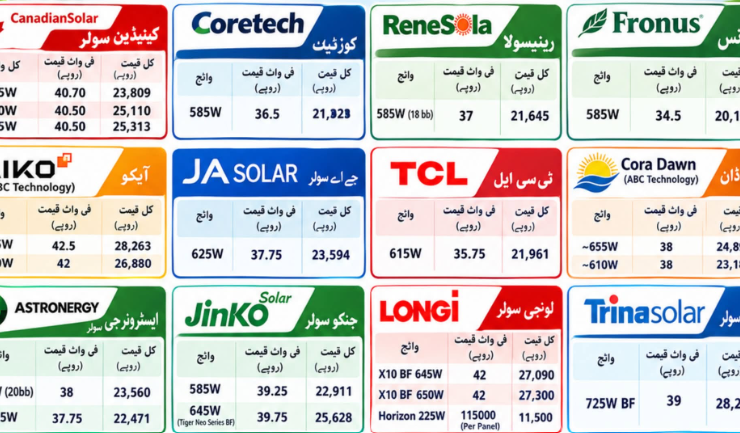 Solar panel prices are usually quoted in two ways: the price per watt and the total price of an individual panel. Both figures matter when comparing products with different power ratings.
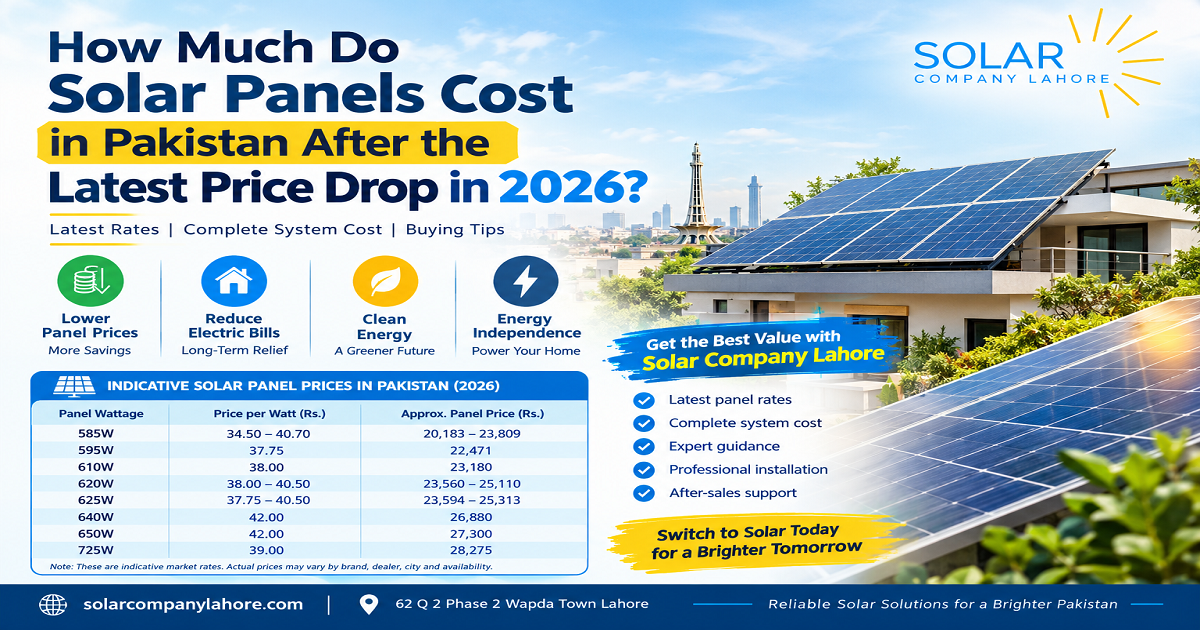
The supplied market chart lists several panel categories, with indicative per-watt prices ranging from approximately Rs. 34.50 to Rs. 42.50 for many of the standard high-wattage models shown. The chart also includes some entries that may represent special models or different product categories, so they should be checked separately before making a purchase.
Here is a practical summary of the rates shown in the supplied chart.
| Panel wattage | Indicative rate per watt | Approximate panel price |
|---|---|---|
| 585W | Rs. 34.50–40.70 | Rs. 20,183–23,809 |
| 595W | Rs. 37.75 | Rs. 22,471 |
| 610W | Rs. 38 | Rs. 23,180 |
| 615W | Rs. 35.75 | Rs. 21,961 |
| 620W | Rs. 38–40.50 | Rs. 23,560–25,110 |
| 625W | Rs. 37.75–40.50 | Rs. 23,594–25,313 |
| 640W | Rs. 42 | Rs. 26,880 |
| 645W | Rs. 39.75–42 | Rs. 25,628–27,090 |
| 650W | Rs. 42 | Rs. 27,300 |
| 655W | Rs. 38–42.50 | Rs. 24,890–28,263 |
| 725W | Rs. 39 | Rs. 28,275 |
These are figures transcribed or calculated from the supplied image, where applicable. Some chart entries may contain rounding or transcription inconsistencies. Confirm the exact model, wattage, and current selling price with a local supplier.
Does a lower price mean every solar panel has become cheaper?
Not necessarily. A reported reduction of Rs. 8,000 may refer to a particular panel category, an earlier quotation, a bulk purchase, or a different product configuration. It should not automatically be interpreted as an Rs. 8,000 reduction on every individual panel.
Likewise, two panels with similar wattage can have different prices because of their efficiency, construction, warranty terms, product availability, and other technical characteristics.
Before accepting a dealer’s claim about a price reduction, ask for the previous price, current price, exact model number, and a written quotation.
What Does an Rs. 8,000 Price Drop Mean for Solar Buyers?
A reduction of Rs. 8,000 can make a meaningful difference to a household’s solar budget, but buyers should first establish what the reduction applies to.
For example, suppose a panel was previously offered for Rs. 30,000 and is now available for Rs. 22,000. The saving would be Rs. 8,000 per panel. If a household purchases ten panels at those prices, the difference would be Rs. 80,000.
This is an illustration of the mathematics, not confirmation that every panel has experienced this price reduction.
| Example purchase | Previous price | Reduced price | Illustrative saving |
|---|---|---|---|
| One panel | Rs. 30,000 | Rs. 22,000 | Rs. 8,000 |
| Six panels | Rs. 180,000 | Rs. 132,000 | Rs. 48,000 |
| Ten panels | Rs. 300,000 | Rs. 220,000 | Rs. 80,000 |
| Twelve panels | Rs. 360,000 | Rs. 264,000 | Rs. 96,000 |
The actual saving depends on the previous and current prices of the same product. It is important not to compare a premium panel with a cheaper model and treat the difference as a genuine market price reduction.
Should you buy panels immediately after a price drop?
A lower price can create an opportunity, but rushing into a purchase is not always the best decision. Check the panel’s condition, documentation, warranty, and compatibility with your planned inverter.
If you intend to install a complete system, request a full quotation rather than buying panels without considering the remaining equipment.
How Much Does a Complete Solar System Cost in Pakistan?
The cost of solar panels is different from the cost of a complete solar installation. A working system requires additional components, and the total depends on its size and configuration.
For planning purposes, the following are broad illustrative budgets for residential systems in Pakistan in 2026. They are not fixed market quotations, and the actual amount should be confirmed with a supplier after assessing the property.
| System size | Illustrative installed cost without batteries |
|---|---|
| 3kW | Rs. 190,000–270,000 |
| 5kW | Rs. 330,000–450,000 |
| 6kW | Rs. 390,000–530,000 |
| 8kW | Rs. 520,000–710,000 |
| 10kW | Rs. 650,000–890,000 |
These planning ranges may exclude some site-specific expenses, upgrades, taxes, or special electrical work. Battery-based systems generally cost more, depending on battery capacity and technology.

What is included in a complete installation?
A professional quotation should clearly identify the following items:
-
Solar panels: Convert sunlight into direct-current electricity.
-
Inverter: Converts electricity into a form suitable for household appliances and manages the system according to its design.
-
Mounting structure: Holds the panels securely on the roof.
-
DC and AC cables: Carry electricity between system components and the building’s electrical installation.
-
Protection equipment: Includes appropriate breakers, isolators, earthing, and surge protection as required by the design.
-
Installation labour: Covers mounting, wiring, configuration, testing, and commissioning.
-
Monitoring equipment: Allows the owner to review system performance where supported.
Batteries, backup circuits, roof reinforcement, and other optional or site-specific requirements may add to the cost.
Before comparing quotations, check whether each installer has included the same equipment and scope of work.
Why Are Solar Panel Prices Changing in Pakistan?
Solar panel rates can change for several reasons. A reduction in one period does not guarantee that prices will continue to fall.
1. International supply and demand
Solar panels are traded internationally. When manufacturers have substantial stock or demand slows, suppliers may offer more competitive prices. Strong demand or limited availability can have the opposite effect.
2. Currency exchange rates
Imported equipment is affected by exchange-rate movements. If the Pakistani rupee weakens against relevant foreign currencies, replacement stock may become more expensive. A stronger rupee can help reduce costs, although the effect depends on other market conditions.
3. Import and distribution costs
Freight, duties, taxes, handling, warehousing, and local transportation contribute to the final selling price. Changes in these costs can affect the price a homeowner pays.
4. Panel technology and efficiency
Newer panel designs may offer improved efficiency or different construction methods. These features can affect the price per watt and the value of the product for a particular roof.
5. Dealer stock and competition
Suppliers may discount available inventory to improve cash flow or make room for newer products. Different sellers may also have different purchasing costs, overheads, and profit margins.
6. Seasonal buying patterns
Demand can change with weather conditions, household electricity consumption, and purchasing trends. However, seasonal discounts are not guaranteed, and waiting for a lower price carries some risk.
The best approach is to compare current quotations for the same specifications instead of relying on a headline claiming that all solar panels have become cheaper.
How to Calculate the Cost of Solar Panels for Your Home
A simple calculation helps you estimate the panel budget before requesting a complete installation quotation.
Panel cost = Number of panels × Price per panel
For example, suppose a home requires ten panels rated at 585 watts each, with an assumed price of Rs. 24,000 per panel.
-
Number of panels: 10
-
Individual panel rating: 585 watts
-
Total panel capacity: 5,850 watts, or 5.85kW
-
Assumed price per panel: Rs. 24,000
-
Total panel cost: Rs. 240,000
This calculation covers the panels only. It does not include the inverter, mounting structure, cables, protection devices, installation, or batteries.
How do you calculate the price per watt?
Divide the panel’s selling price by its rated wattage.
For example, a 585W panel costing Rs. 24,000 has an indicative price of approximately Rs. 41.03 per watt.
This calculation makes it easier to compare panels of different wattages. However, the lowest price per watt should not be the only purchasing criterion. Documentation, product quality, warranty support, and suitability for the intended installation also matter.
Which Solar System Size Is Suitable for a Lahore Home?
The right system size depends on your electricity consumption, daytime usage, roof space, budget, and backup requirements. A larger system is not automatically the best choice.
3kW solar system
A smaller system may suit a household with moderate electricity consumption and limited roof space. It can help run selected household appliances during suitable sunlight conditions, depending on the system design and load.
5kW solar system
A 5kW system may be suitable for a small or medium-sized home with a manageable daytime load. The actual number of appliances it can support depends on their power requirements and whether the system is grid-connected, hybrid, or off-grid.
8kW solar system
An 8kW system may suit a household with higher electricity consumption, multiple air conditioners, or other substantial daytime loads. A load assessment is necessary before selecting the inverter and panel capacity.
10kW solar system
A 10kW system may be appropriate for a larger home or a household with substantial electricity use. Roof space, inverter specifications, electrical connections, and the household’s consumption pattern should all be assessed before installation.
For Lahore homeowners, an installer should review recent electricity bills and determine how much electricity the household uses during the day. This helps avoid spending unnecessarily on excess capacity.
What Should You Check Before Buying Solar Panels?
Buying panels at a competitive price is useful only if the equipment meets your requirements. The following checks can help you avoid common purchasing mistakes.
Check the panel’s grade and documentation
Ask for the exact model number, serial numbers, product datasheet, and available warranty documentation. Confirm whether the panels are new, properly documented products rather than assuming that a low price represents the same product offered elsewhere.
Inspect the physical condition
Check the glass, frame, junction box, connectors, and visible surfaces for damage. Do not accept damaged panels without a clear explanation and an appropriate written agreement.
Review the warranty
Understand the product warranty and the performance warranty. Ask who handles warranty claims in Pakistan and what documents are required if a panel develops a fault.
Confirm the rated wattage
The wattage printed on the panel should match the model and documentation. Do not rely only on a seller’s verbal description.
Check inverter compatibility
The panel’s electrical characteristics must match the inverter’s voltage, current, and operating limits. An appropriately qualified installer should verify the complete system design.
Compare complete quotations
Ask at least two or three suppliers for quotations that specify the equipment, installation scope, warranty terms, payment schedule, and any exclusions.
Consider roof space and shading
Water tanks, parapet walls, nearby buildings, and other obstructions can affect panel placement and energy production. A site assessment can help identify these issues before installation.
How Can Homeowners in Lahore Get Better Value from Solar?
Lahore has a substantial market for residential solar equipment and installation services. Homeowners can improve their purchasing decisions by following a few practical steps.
First, establish a realistic budget. Decide whether you need a grid-connected system, battery backup, or a hybrid arrangement before comparing prices.
Second, request a site survey. Roof dimensions, shading, wiring conditions, and electrical loads can affect the final installation cost.
Third, ask for a written breakdown. A quotation should show the panel cost separately from the inverter, mounting structure, wiring, safety equipment, labour, and any optional battery.
Fourth, compare the estimated energy production with your actual electricity consumption. Solar generation varies with weather, season, shading, orientation, and equipment performance. No installer should promise an exact monthly output without accounting for these factors.
Finally, evaluate the installer as carefully as the equipment. Good workmanship, proper protection devices, documented commissioning, and accessible after-sales support can be more valuable than a small initial saving.
At solarcompanylahore.com, homeowners can use these principles when assessing solar installation requirements and comparing available options. The objective should be to choose a reliable system that suits the property, not simply to purchase the cheapest panels available.
Will Solar Panel Prices Fall Further in 2026?
Future prices are difficult to predict with certainty. International supply, currency movements, import costs, local inventory, and demand can all influence the market.
If prices fall further, buyers may benefit from lower equipment costs. However, waiting for an additional reduction could also mean missing an attractive current quotation or delaying the benefits of producing electricity at home.
A sensible purchasing decision should consider the total installation cost, equipment quality, household consumption, and expected savings. Buyers should also review the applicable electricity export and billing rules rather than assuming that excess solar electricity will be credited at the same rate as electricity purchased from the grid.
For a homeowner who has already assessed the roof, selected a suitable system, and received a competitive written quotation, the decision should be based on the overall value of the installation rather than speculation about future panel prices.
Conclusion
The latest reported reductions in solar panel prices have encouraged Pakistani homeowners to reassess the cost of installing rooftop solar. The figures in the supplied price chart provide a useful starting point for comparison, but they should be treated as indicative rather than guaranteed current selling prices.
The actual cost depends on panel wattage, product specifications, seller availability, and the additional equipment required for a safe and functional installation. A lower panel price can reduce the initial investment, but reliable documentation, appropriate system design, and quality workmanship remain essential.
For homeowners in Lahore, the best strategy is to compare current quotations, verify the equipment, review electricity consumption, and select a system that meets the household’s needs.
solarcompanylahore.com encourages homeowners to make informed decisions by comparing complete installation proposals instead of judging a solar system by its panel price alone.
A well-planned installation can help a household make better use of available sunlight while managing its long-term electricity expenses.
Frequently Asked Questions (FAQs)
1. How much do solar panels cost in Pakistan after the latest price drop in 2026?
The supplied price chart shows indicative prices of approximately Rs. 20,183 to Rs. 23,809 for several 585W panel entries, depending on the listed model and rate. Other current market quotations can be higher. Confirm the exact model and price with a local supplier before purchasing.
2. Has the price of every solar panel fallen by Rs. 8,000?
No. A reported Rs. 8,000 reduction should not be applied to every panel. The reduction may refer to a specific product or earlier quotation. Compare the previous and current prices of the same model to establish the actual saving.
3. What is the price of a 585W solar panel in Pakistan?
The supplied chart lists several 585W entries between approximately Rs. 20,183 and Rs. 23,809. Actual prices vary by model, documentation, condition, seller, and availability.
4. How much does a 5kW solar system cost in Lahore?
For initial budgeting, an illustrative range is Rs. 330,000 to Rs. 450,000 for a complete system without batteries. The final cost depends on equipment specifications, installation requirements, and the items included in the quotation.
5. Is the solar panel price the same as the complete installation price?
No. The panel price covers the panels only. A complete installation also requires an inverter, mounting structure, cables, electrical protection, labour, and potentially batteries or other site-specific equipment.
6. How many solar panels are required for a 5kW system?
Using 585W panels, nine panels provide a combined rated capacity of 5.265kW. The final number depends on the desired system capacity, inverter specifications, available roof space, and installation design.
7. Is the cheapest solar panel always the best option?
No. Buyers should compare the model, rated output, documentation, physical condition, warranty support, and suitability for their system. A slightly more expensive panel may provide better value if it offers stronger documentation and dependable after-sales support.
8. What affects solar panel prices in Lahore?
Prices can be affected by exchange rates, import and distribution costs, product technology, stock availability, supplier margins, and the quantity purchased. Prices can also differ between retail and wholesale transactions.
9. Should I install solar panels now or wait for further price reductions?
There is no guaranteed answer. Compare current quotations and assess your electricity consumption, budget, installation readiness, and expected savings. Waiting makes sense only if the potential benefit outweighs the cost of delaying installation.
10. Do solar panels eliminate electricity bills completely?
Not necessarily. Results depend on system size, household consumption, grid connection, fixed charges, electricity tariffs, and the applicable rules for exporting surplus electricity. A properly sized system can reduce purchased electricity, but complete bill elimination should not be assumed.
11. Do I need batteries with my solar system?
Batteries are not essential for every system. A grid-connected system may operate without them, subject to its design and grid requirements. Batteries can provide backup and increase the use of stored solar electricity, but they also increase the initial cost.
12. Where can Lahore homeowners get advice about solar installation?
Homeowners can contact solarcompanylahore.com to discuss their installation requirements, compare system options, and understand the equipment and costs that should be included in a quotation.